


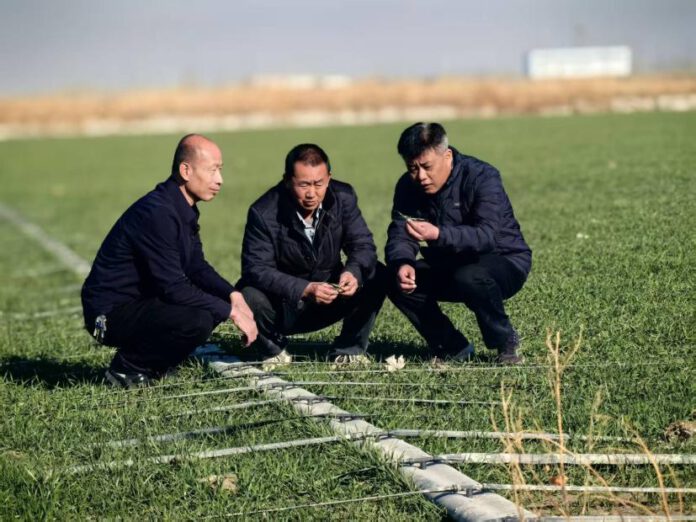
Saline-alkali land has long posed a major challenge to agricultural production. Today, however, it is becoming an important testing ground for agricultural innovation in China. From underground drainage pipes that remove salt from the soil to small solar-powered devices that extract salt through evaporation, China is exploring more water-efficient, effective, and precise approaches to land reclamation. Although these technologies work in different ways, they share a common goal: to remove excess salt from the soil while minimizing water consumption and the loss of soil nutrients.
Saline-alkali land is difficult to cultivate not simply because its surface is covered with a white crust, but because excessive salts interfere with plants’ ability to absorb water and may cause ion toxicity. This problem is particularly serious in the arid and semi-arid regions of northern China, where rainfall is limited and evaporation is intense.
Salts dissolved in groundwater can move toward the soil surface with rising moisture. When the water evaporates, the salts remain behind, creating a recurring process known as salt accumulation or secondary salinization. Even if irrigation temporarily reduces the salt concentration in the upper soil layer, salinity may return if the groundwater level is not controlled and dissolved salts have no effective way to leave the soil. Successful reclamation therefore requires more than flushing salt out with irrigation water. It also requires a reliable drainage system to remove the salt-laden water.
This principle has been put into practice at the 27th Regiment of the Second Division of the Xinjiang Production and Construction Corps in northwestern China. The area once contained extensive tracts of moderately to severely saline-alkali land, where crop yields were low and agricultural production was severely constrained. In 2014, the regiment introduced subsurface drainage technology. Perforated drainage pipes were installed underground to collect and discharge salt-laden water after irrigation and soil leaching. The system also helps control the groundwater table, reducing the risk of salts returning to the root zone. The process resembles dialysis for the land: irrigation water dissolves the salts, while underground pipes collect and carry the saline water away. The two processes work together to achieve sustained desalination.
Although subsurface drainage may appear to involve little more than burying pipes in the soil, the depth and spacing of those pipes can significantly affect the results. If the pipes are too far apart, saline water must travel a greater distance before reaching the drainage system, and some areas may not be adequately desalinated. Reducing the spacing shortens the distance that salts must travel and generally improves drainage efficiency. However, installing pipes more closely together is not always the best solution. More pipes mean higher construction costs, and the drainage process can also carry valuable nutrients out of the soil. The design must therefore balance desalination performance, infrastructure investment, and soil fertility.
A field study conducted in the Hetao Irrigation District of Inner Mongolia provides concrete evidence of this trade-off. Researchers compared three subsurface drainage treatments, with pipe spacings of 10, 20, and 30 meters, under the same general conditions of pipe burial depth and irrigation management. The results showed that the 10-meter spacing achieved better salt removal overall than the 20- and 30-meter treatments after three irrigation and leaching cycles. In the 0–10 cm soil layer, the initial salt contents of the three treatments were 17.22, 17.74, and 17.17 grams per kilogram, respectively. By the time of autumn irrigation, these values had fallen to 10.78, 11.56, and 11.95 grams per kilogram. Calculated from the initial and final concentrations, the corresponding desalination rates were approximately 37.4%, 34.8%, and 30.4%. These findings suggest that, under the conditions of this particular experiment, closer pipe spacing can accelerate salt removal from the surface soil. They do not, however, mean that a single reclamation cycle can completely eliminate salinity.
The study also revealed a less obvious aspect of soil reclamation: reducing salinity does not necessarily improve every soil property at the same time. During the early stages of irrigation and leaching, soil pH and certain alkalinity indicators may temporarily increase before declining later. This reflects the complex movement of water and salts through the soil and changes in exchangeable sodium. Salinity, alkalinity, and groundwater conditions are closely interconnected, and their responses to treatment may differ.
Meanwhile, drainage can cause nutrient losses. In the experiment, the 10-meter spacing treatment achieved better desalination but also generally experienced greater losses of nutrients, including nitrogen, phosphorus, and potassium. Subsurface drainage must therefore be accompanied by soil fertility monitoring, appropriate fertilization, and measures to replenish nutrients. More closely spaced pipes may be suitable for severely saline soils, while wider spacing may be considered for less saline land, depending on soil texture, groundwater depth, and economic conditions. A single design should not be applied indiscriminately to every location.
Practical results from the 27th Regiment in Xinjiang demonstrate the potential value of this engineering approach. According to reports on the project, the demonstration area achieved an average desalination rate of 49% after one salt-leaching treatment and reduced irrigation water consumption by 17.2%. Following implementation, the average soil salt content fell to approximately 3 grams per kilogram. Wheat yields increased from 387 to 580 kilograms per mu, while pepper and tomato production also rose substantially. One mu is approximately 667 square meters.
The local authorities are now integrating subsurface drainage with drip irrigation, water and fertilizer management, soil salinity monitoring, and automated control systems to improve the precision of water management. The aim is to move away from relying primarily on experience to determine when to irrigate and drain, and toward decisions informed by real-time measurements of soil moisture, salinity, and groundwater levels. These figures reflect the results of a specific demonstration project and should not be interpreted as guaranteed outcomes for all saline-alkali land treated with the same technology.
If subsurface drainage creates an underground pathway for removing salts, a solar-powered soil desalination technology being explored by researchers including Deng Hongbing and Chen Chaoji at Wuhan University approaches the problem from another direction: can salt be collected near the soil surface while reducing dependence on freshwater?
The technology uses a straw-like tubular carrier, fibrous filter paper, and covering materials to form a desalination device. Through capillary action, the filter paper draws saline water from the soil toward an evaporation zone. Solar energy supplies the heat needed to evaporate the water, leaving the salt behind to crystallize on the device. Dark covering materials help absorb solar radiation, while the structure of the fibrous material affects water transport and salt migration. Unlike conventional leaching methods that require substantial quantities of water, the system is designed to use solar energy to drive localized evaporation and recover salt in solid form, potentially reducing freshwater consumption and the production of concentrated saline wastewater.
According to reports on the research, one experiment using saline water reduced soil salt content from 11.04 milligrams per gram to 0.95 milligrams per gram, a reduction of approximately 91.4%. The reported figure of around 93% may reflect a different experimental dataset or calculation method, so it should not be treated as a fixed result that can be achieved under all conditions.
The research team has also highlighted the device’s low material cost, simple manufacturing process, and potential for repeated use. However, successful results under experimental conditions do not automatically translate into equivalent performance across large agricultural fields. Further evaluation is needed to determine its treatment capacity per unit area, service life, salt recovery efficiency, long-term effects on soil quality, and suitability for different soils and climates. Its significance lies in offering a promising avenue for further research, particularly in regions where freshwater is scarce.
Although these two technologies operate differently, both reflect the expanding range of approaches to saline-alkali land reclamation. Subsurface drainage focuses on water and salt movement through the soil and on controlling groundwater levels. Solar-assisted evaporation seeks to concentrate and recover salts using natural energy while reducing dependence on large volumes of freshwater. The technologies are not necessarily alternatives to one another. Rather, they address different needs and resource conditions. Subsurface drainage requires careful consideration of pipe layout, drainage outlets, construction costs, and nutrient losses, while solar-powered desalination must demonstrate its efficiency, reliability, and economic viability at a larger scale.
Innovation in China’s saline-alkali land management is also moving beyond individual technologies toward integrated systems. Underground drainage pipes can be combined with drip irrigation, soil moisture and salinity sensors can help determine the timing of leaching, and automated gates and remote-control platforms can improve the precision of irrigation and drainage.
Meanwhile, low-cost desalination devices may offer additional possibilities in areas with severe freshwater constraints. These approaches do not eliminate the need for salt-tolerant crops, soil amendments, or the restoration of organic matter. The objective is not simply to reduce soil salinity in the short term, but to establish a sustainable water and salt balance that allows land to remain productive without developing new salinity problems.
There is no universal solution for saline-alkali land. In severely saline areas with high groundwater levels and suitable drainage conditions, properly designed subsurface drainage combined with irrigation and leaching may be an effective option.
In regions where freshwater is extremely limited, solar-powered desalination and related technologies deserve further investigation. Once land has been reclaimed, continued monitoring, appropriate irrigation and drainage, and soil fertility management are essential to maintaining the results.
Source: soils issas ac cn, xinhua, tencent