


In September 2026, a young girl in a Southeast Asian household was chatting with her new AI teddy bear. The toy understood her instructions and responded almost instantly, turning an ordinary playtime into an interactive experience. Thousands of kilometres away in Shantou, Guangdong Province, computing infrastructure was working continuously behind the scenes. Large AI models processed the girl’s requests and generated responses, which were then transmitted back to the overseas device through international telecommunications networks.
The teddy bear and the computing power behind it had travelled abroad in very different ways. The physical toy had left the production lines of Chenghai, Shantou’s renowned toy manufacturing hub, and crossed borders through conventional logistics. The digital intelligence that brought it to life, however, continued to be delivered from data centres in Shantou with every question, response and interaction.
The two exports, manufactured goods and digital services, are increasingly becoming part of the same industrial value chain. For Shantou, a city with decades of manufacturing and international trade experience, the convergence of artificial intelligence and computing services is opening a new chapter in its economic transformation.
Chenghai is one of the world’s major toy manufacturing centres, producing approximately one-third of the world’s plastic toys. Over the years, the district has developed a comprehensive industrial ecosystem spanning product design, mould-making, injection moulding, assembly and supply-chain management. Yet, like many traditional manufacturing clusters, its toy industry has long faced pressure from product homogenisation, limited brand premiums and narrowing profit margins. Competing primarily on production scale and cost has become increasingly difficult as manufacturers seek sustainable growth.
Artificial intelligence offers a potential way forward, but integrating AI into traditional toys requires more than adding a microphone or speaker. Manufacturers must also address model integration, communications, computing resources, software development and data compliance. For small and medium-sized enterprises, building an entire AI technology stack independently can involve substantial investment, lengthy development cycles and ongoing maintenance costs.
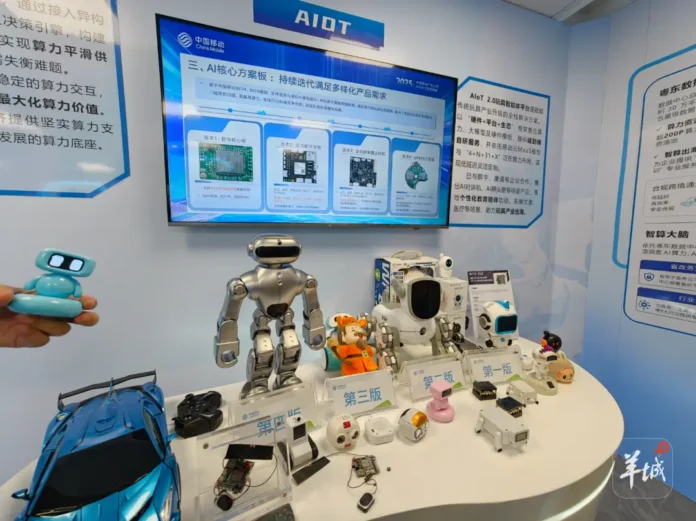
To lower these barriers, China Mobile’s Shantou branch has developed an integrated service system that combines connectivity, computing power and AI capabilities. In 2025, the company introduced an AI toy solution board and launched an AIoT toy agent platform, providing standardised modules, solution boards, communication chips and platform services that can be integrated into existing manufacturing processes. Instead of developing every component from scratch, manufacturers can select the capabilities they need and incorporate them into their products.
According to relevant estimates, some manufacturers can bring AI toys into mass production in as little as three weeks. The platform-based approach can shorten AI transformation cycles by approximately 60% and save around RMB 200,000 in upgrade costs. China Mobile previously reported that nearly 200,000 AI toy modules had been signed up for deployment, with services reaching more than 100 local toy companies. These developments are helping AI move beyond a small number of technology-intensive businesses and into the broader manufacturing ecosystem.
A further milestone came on March 23, 2026, when the Shantou AI Toy Industry Ecosystem Conference was held at the Shantou Cross-Border Digital Economy Industrial Park. China Mobile’s Shantou branch unveiled its first OpenClaw intelligent toy, alongside a series of products and services, including the AIoT 2.0 integrated platform, the Suanli Tongyi Token platform, AI-SIM cards and AIoT solution boards.
The launch marked a shift from technical solutions and component supply towards tangible products and commercial-scale manufacturing. Cooperation across the semiconductor, hardware, large-model, computing, cross-border e-commerce and overseas telecommunications sectors is also helping establish a more complete support system for companies seeking to develop and export AI toys.
The significance of this ecosystem extends beyond giving toys new features. By combining standardised hardware, intelligent-agent platforms and computing services, it allows smaller manufacturers to develop products with lower upfront investment and greater flexibility. Companies can adapt language capabilities, interactive functions and content to different overseas markets without having to build their own AI infrastructure. Traditional toy manufacturers are gaining access to the AI value chain, while technology providers are finding scalable applications for their services.
As AI toys reach international markets, another opportunity is emerging: the export of computing services themselves.
For an AI-enabled toy, the initial hardware sale is only the beginning of its commercial life. Everyday conversations, content updates, remote software upgrades and personalised services all require ongoing access to AI models. Revenue opportunities can therefore extend beyond a one-off product transaction to include long-term operations and recurring digital services.
However, manufacturers have faced two major obstacles: the cost of accessing overseas AI models and the complexity of cross-border data compliance. Some companies previously relied on overseas models such as ChatGPT, where service costs could be significantly higher than those of comparable domestic solutions. At the same time, different jurisdictions impose different requirements on personal information, voice data and cross-border data transfers. Individual toy manufacturers often lack the resources to manage these technical and regulatory challenges independently.
Shantou’s emerging Token export model is designed to address these constraints. In April 2026, the city completed what was reported as China’s first full-chain verification of Token exports, establishing a closed-loop process for delivering AI inference services to overseas users.
Under this model, an overseas user submits a request to an AI application. The request enters a designated service zone through a compliant connection, where a data centre in Shantou performs model inference and processes the associated tokens. The result is then transmitted back to the overseas device through international telecommunications networks. The computing and token consumption take place in China, while the resulting AI service is delivered to users abroad.
A token is a basic unit used by large language models to process and generate information. Every prompt and response may consume a certain number of tokens. For AI toys, tokens underpin the ability to understand instructions, formulate language and generate interactive responses. For computing service providers, token consumption also offers a way to measure usage, calculate service costs and explore revenue-sharing arrangements across the AI ecosystem.
Shantou’s ability to develop this model rests on several complementary advantages. Its international submarine cable landing infrastructure and telecommunications networks provide connectivity to overseas markets. Deploying computing resources locally can reduce reliance on overseas service intermediaries, while optimising model access can help control latency and costs. The city’s participation in the “data processing and service export” pilot in the Shantou Overseas Chinese Economic and Cultural Cooperation Pilot Zone also provides a framework for exploring compliant data processing and cross-border service delivery, subject to applicable regulations.
According to reported cases, an individual AI toy interaction can cost approximately RMB 0.03, with a response time of around 900 milliseconds. Related deployments have reduced the latency between the two locations to 32.7 milliseconds, while certain computing services cost more than 30% less than overseas alternatives. As adoption has expanded, the volume of exported tokens has risen sharply, from an average of approximately 100 million per day at the end of April 2026 to a daily level in the tens of billions.
By September 2026, Shantou was supplying more than 15 billion tokens a day to overseas markets, according to local industry reporting. The services supported a growing range of applications, including AI toys, cross-border e-commerce, digital-human customer service, AI-generated short dramas and overseas marketing content.
For toy manufacturers, these developments are changing the economics of their products. Traditionally, the value of a toy has been concentrated in materials, design, manufacturing and distribution. Once AI capabilities are introduced, product competitiveness also depends on the quality of interaction, model performance, content updates and long-term service delivery.
A conventional plastic toy can potentially command a price of several hundred yuan after being upgraded into an interactive AI product, compared with a price of only a few dozen yuan for a basic version. At the same time, access to domestic models and locally deployed computing resources can reduce ongoing operating costs. Lower service costs and higher product value create new opportunities for manufacturers competing in overseas markets.
The transformation is also reshaping Shantou’s cross-border e-commerce sector. A growing number of young entrepreneurs are applying AI to overseas product selection, customer enquiries, marketing content generation and order management. For these businesses, AI is not merely a feature embedded in a toy; it is also a tool for connecting suppliers, sales channels and international consumers.
Entrepreneurs such as Luo Rui, who works in global product sourcing and cross-border commerce in Shantou, see AI as an opportunity to expand the services offered to traditional manufacturers. With intelligent agents handling routine tasks, relatively small teams can manage workloads that previously required considerably more personnel. The combination of manufacturing expertise, established foreign-trade networks and AI-powered operations is creating new forms of cooperation across the local economy.
A more comprehensive industrial ecosystem is helping support this transition. At the March 2026 industry conference, China Mobile’s Shantou branch signed a strategic cooperation framework agreement on AI toy ecosystem development with the Shantou Overseas Chinese Economic and Cultural Cooperation Pilot Zone, the Chenghai District People’s Government, the Shantou Chenghai Toy Association and the Shenzhen Artificial Intelligence Association. The company also established deeper industrial partnerships with local intelligent-hardware businesses covering solution development, module production and mass manufacturing.
The Shantou AI Toy Innovation Centre was unveiled at the same event. Designed to support research and development, manufacturing, business incubation and overseas expansion, the centre is intended to bring together resources that have traditionally been spread across different parts of the industrial chain.
The Suanli Tongyi Token platform is another important component of this ecosystem. By integrating multiple AI models and computing resources, it provides businesses with centralised access, intelligent computing-resource allocation and billing services. It also offers a framework for coordinating service providers and exploring how value can be distributed among ecosystem participants.
For manufacturers, this integrated approach can reduce the need to negotiate separately with multiple technology suppliers. For computing providers and software developers, it creates opportunities to reach a wider range of applications and improve resource utilisation. In this sense, the platform is intended to function not simply as a technical tool but as a link between computing infrastructure, AI developers and manufacturing businesses.
As demand grows, expanding computing capacity and strengthening service capabilities will become increasingly important. Local plans include increasing the capacity of the eastern Guangdong data-centre cluster, improving multilingual model support and developing cross-border compliance systems. Shantou is also exploring the extension of its Token export capabilities into cross-border e-commerce, gaming, digital content and AI-generated animation, linking computing services with additional sectors that already possess international market experience.
Nevertheless, the Token export model remains at an early stage, and its expansion faces significant challenges. Current applications are concentrated largely in AI toys, with Southeast Asia serving as a major target market. Different countries and regions have distinct requirements concerning data localisation, personal information protection and AI services. Some markets impose strict restrictions on cross-border data transfers and related technology services, potentially limiting the range of business models available.
Other challenges include multilingual adaptation, local customer support, service reliability and the continuing cost of regulatory compliance. Expanding infrastructure alone will not guarantee sustainable growth. Shantou will also need to strengthen technical standards, improve operational services and deepen cooperation with overseas partners if it is to turn its early progress into a lasting competitive advantage.
The city’s current transformation builds on an industrial history stretching back to the early years of China’s reform and opening-up. Supported by its overseas Chinese networks and foreign-trade connections, Shantou developed a strong manufacturing base in toys, textiles and garments. The “front shop, back factory” model helped establish production capacity, international business relationships and extensive export experience.
Artificial intelligence is now introducing new technological elements into that established industrial system. Toys continue to leave factories in Chenghai, but their value is no longer limited to plastic components, moulds and assembly. A digital link connecting local computing resources with global users gives manufacturers an opportunity to participate in model services, content operations and digital trade.
From bringing AI toys into mass production in as little as three weeks to supplying more than 15 billion tokens a day to overseas markets, Shantou is exploring a development path in which manufacturing and digital services reinforce one another. The underlying transformation is not simply about adding AI features to conventional products. It is about connecting hardware production, model capabilities, computing services and cross-border operations into a more integrated value chain.
As an AI toy enters an overseas household, every subsequent interaction may generate demand for another digital service. For Shantou, the longer-term opportunity lies not only in exporting more intelligent toys, but also in moving beyond one-time product sales towards a model in which manufactured goods and recurring digital services are delivered together to global markets.
Source: stcn, 21jingji, xinhua, stdaily, chinanews, sohu