


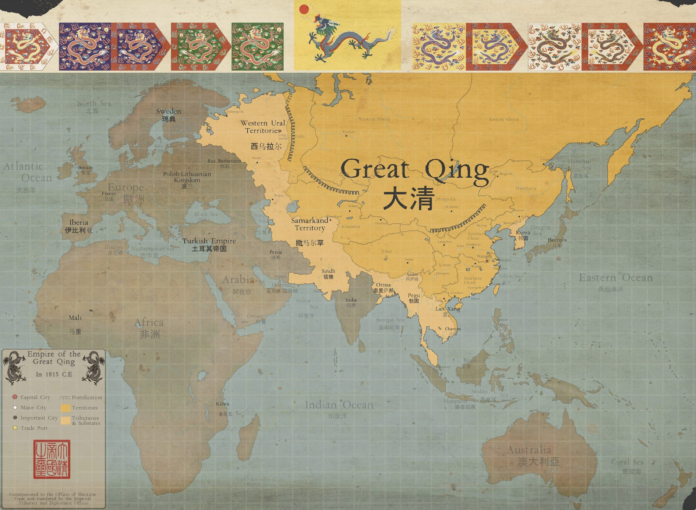
The formation of the modern Chinese state was not simply a process of dynastic replacement or the collapse of an empire followed by the creation of a nation-state. Rather, it was a centuries-long process of state transformation involving territorial expansion, ethnic integration, fiscal and military restructuring, and the reconstruction of political identity.
From the establishment of the Qing dynasty in the mid-seventeenth century to the founding of the People’s Republic of China in the mid-twentieth century, China experienced a profound transition: from a traditional ethnic-cultural state centered on the Han Chinese heartland, to a multiethnic territorial state, then to a modern sovereign state, and finally to a highly centralized modern political order.
Understanding this transformation requires moving beyond the conventional “empire versus nation-state” framework and examining the interaction among three fundamental variables: geopolitics, fiscal-military structures, and political identity.
The development and transformation of states are fundamentally shaped by how they respond to external pressures, how they acquire and organize resources, and how they create shared political identities.
Geopolitical conditions determine a state’s strategic priorities and security needs; fiscal-military institutions determine whether a state can convert social resources into political and military capacity; and political identity determines whether a state can effectively integrate different groups and sustain legitimacy. The evolution of modern China was the result of the continuous interaction among these three forces.
The Qing dynasty represented the crucial stage in which China transformed from a traditional ethnic-cultural state into a multiethnic territorial state. Before the Qing, successive Chinese dynasties were primarily based on a Han-centered political and cultural identity.
Their political core was located south of the Great Wall, especially in the agricultural regions of the Central Plain, while the northern grasslands and frontier regions were often viewed as external spaces beyond the civilizational boundary.
The rise of the Qing fundamentally changed this historical pattern. When the Manchus entered China proper and replaced the Ming dynasty, they not only established a new ruling dynasty but also redefined the meaning and geographical scope of “China.”
The Qing expansion occurred in two distinct stages. The first stage involved the rise of the Manchu state in the northeast, the conquest of the Ming dynasty, and the consolidation of control over the Chinese interior. In this period, Qing expansion resembled many other imperial formations: the primary objectives were the acquisition of territory, population, and economic resources. The second stage, however, was fundamentally different. From the late seventeenth century to the mid-eighteenth century, Qing campaigns against Mongolia, Xinjiang, and Tibet were not driven primarily by the pursuit of wealth or unlimited territorial expansion, but by strategic concerns related to security and geopolitical stability.
A central element of Qing geopolitical strategy was its alliance with Mongol groups beyond the Great Wall. This alliance had been essential to the Manchu conquest of the Ming and remained critical for protecting the capital and the northern frontier. When the Dzungar Mongols expanded eastward and threatened Qing interests, the Qing court launched a series of military campaigns. The incorporation of Outer Mongolia, Xinjiang, and Tibet into the Qing realm was therefore largely a consequence of defensive and preventive strategies rather than a deliberate attempt at imperial expansion.
This feature distinguished the Qing from many traditional empires. Unlike imperial powers that continuously expanded outward in search of resources, the Qing established relatively fixed borders after the mid-eighteenth century. It did not seek to exploit frontier regions as colonial possessions or major sources of taxation. Instead, the interior provinces served as the economic foundation of the state, while frontier regions functioned primarily as strategic buffers protecting the core territories. Through alliances, political recognition, religious patronage, and administrative control, the Qing maintained stability across a vast and diverse territory.
The Qing state also developed a distinctive fiscal-military structure. Unlike early modern European states, which were trapped in continuous military competition and therefore constantly expanded taxation and administrative capacity, the Qing faced relatively limited external military pressure for much of its history. As a result, it developed a low-tax, low-cost governing system. The state relied primarily on land taxation, while local social order was maintained to a considerable degree through gentry networks, clan organizations, and village institutions.
This system had significant advantages during periods of stability. The Qing government could maintain a large population and vast territory without creating an enormous bureaucratic apparatus or imposing heavy taxation. However, its weakness was its lack of flexibility. Because the fiscal system was designed for a relatively stable environment, it was poorly prepared for sudden geopolitical and domestic crises.
By the nineteenth century, this equilibrium began to collapse. Rapid population growth intensified pressure on land resources, contributing to large-scale internal conflicts. At the same time, European imperial powers entered East Asia and fundamentally altered China’s geopolitical environment. The Opium War and subsequent conflicts forced China into a global system of sovereign states dominated by Western powers, exposing the weaknesses of the traditional Qing order.
Yet the Qing state did not simply collapse. Instead, it underwent a significant transformation during the second half of the nineteenth century. One of the most important changes occurred in the fiscal and military sphere. The traditional land-tax-based fiscal system gradually evolved into a more flexible structure relying on customs revenue, commercial taxation, foreign loans, and other modern financial mechanisms. Although this transformation weakened central control over resources and strengthened regional officials, it also provided the financial foundation necessary for suppressing domestic rebellions, recovering Xinjiang, and launching modernization efforts.
The late Qing state developed a unique form of decentralized but still integrated governance. Regional governors gained greater control over taxation, military organization, and administration, but they remained connected to the central government through personnel appointments and political legitimacy. This system can be understood as a form of “localized centralism”: power and resources moved downward, but the overall national framework remained intact.
During this period, Chinese political identity also underwent a fundamental transformation. Centuries of Qing rule gradually created a shared sense of belonging among different ethnic communities, including Manchus, Han Chinese, Mongols, Tibetans, and Muslims. By the late nineteenth and early twentieth centuries, many Chinese intellectuals and officials began to move beyond loyalty to the dynasty itself and developed a broader identification with “China” as a territorial and political community. This transformation was crucial because it allowed the successor state after the fall of the Qing to inherit the Qing territorial framework rather than fragment along ethnic lines.
The twentieth century introduced a new stage in China’s state transformation. After the collapse of the Qing dynasty, central authority weakened and regional military leaders emerged, creating a period commonly described as warlord fragmentation. However, this era was not merely one of disorder. Within regional competition, new forms of state capacity emerged. Some regional regimes developed modern fiscal systems, administrative institutions, transportation networks, educational systems, and economic policies. In this sense, China’s reunification process resembled the experiences of later-forming European nation-states, where powerful regional forces first consolidated themselves before creating a unified national state.
The Nationalist Party (Kuomintang) eventually achieved formal unification through the Northern Expedition. Its success depended on three major factors. First, it received Soviet assistance, which strengthened its military organization. Second, it gained access to greater financial resources by consolidating Guangdong, expanding into the Yangtze River region, and later controlling national taxation systems. Third, it promoted nationalism and anti-imperialism, which helped it gain broader political support.
Before the outbreak of full-scale war with Japan, the Nationalist government had made significant progress in building a nationwide political and military structure. It gradually reduced regional fragmentation and began creating unified fiscal and administrative institutions. During the Second World War, this state structure enabled China to survive Japanese invasion and eventually emerge as one of the victorious Allied powers. China abolished unequal treaties imposed by foreign powers, recovered territories lost to Japan, and gained a permanent seat on the United Nations Security Council.
However, the same factors that explain the Nationalist Party’s achievements also explain its ultimate failure. Japanese aggression interrupted its state-building process. Financial pressures limited its governing capacity. Most importantly, the Nationalist government never achieved complete political and organizational centralization. Internal factions, regional military interests, and tensions between central and local authorities weakened its ability to coordinate national power effectively.
The Communist Party ultimately succeeded because it achieved a more comprehensive form of centralization in the areas of geopolitics, fiscal resources, and political identity. After the Second World War, Soviet involvement in Northeast China dramatically altered the balance of power. Northeast China possessed some of the country’s most developed industrial resources, transportation networks, and military infrastructure. By gaining access to this region, the Communist movement transformed itself from a relatively limited regional force into a powerful national military organization.
At the same time, the Communist Party developed a highly effective fiscal and mobilization system. It combined centralized control over economic resources with grassroots organization in rural society. Through land reform, party networks, and mass mobilization campaigns, it was able to obtain enormous human and material support. This combination of modern centralized institutions and deep social penetration created a sustainable source of military and political strength.
Most importantly, the Communist Party succeeded in creating a highly unified political organization. Through ideological discipline, party organization, and recognition of centralized leadership, it overcame regional divisions and internal conflicts. Compared with the Nationalists, the Communists achieved a much higher level of organizational cohesion. This enabled them to defeat their rivals and establish a new centralized state in 1949.
From a broader historical perspective, China’s modern state formation can be understood as a three-stage process. First, the Qing dynasty transformed China into a multiethnic territorial state. Second, the late Qing and Republican periods transformed this territorial state into a modern sovereign state recognized within the international system. Third, the revolutionary process of the twentieth century rebuilt political authority through centralization and party organization.
This historical trajectory differs fundamentally from the classic Western narrative of a transition from empire to nation-state. Modern China was not created by the collapse of an empire and the fragmentation of its territories into separate national units. Instead, it emerged through the accumulation of multiple historical layers. Traditional Chinese civilization provided the cultural foundation; Qing territorial expansion created the geographical framework of modern China; and twentieth-century political transformation created the centralized state structure that exists today.
Modern China therefore contains several historical dimensions simultaneously. It inherits the cultural traditions of the ancient Chinese civilization, the multiethnic territorial structure established by the Qing, the sovereignty recognized by the modern international system, and the centralized political organization developed during the twentieth century. Its formation was not the product of a single revolution or a single dynasty, but the result of centuries of historical transformation.
The “Chinese path” of state formation lies precisely in this unique combination of historical inheritances. The ancient Chinese state provided demographic and cultural foundations; the Qing created the territorial framework of a modern China; and the political transformations of the nineteenth and twentieth centuries shaped its institutional structure. Together, these forces produced a modern state that is vast in scale, territorially integrated, and politically centralized.
Nevertheless, state formation does not represent the end of state development. In the twenty-first century, China continues to face challenges involving regional integration, relations between the state and society, the construction of shared national identity, and its role within the global order. A mature modern state requires not only organizational strength but also broader social consensus and international responsibility. Understanding China’s historical transformation is therefore essential not only for explaining its past, but also for understanding its future.
Source: open times, sociologyol, sina, xinhua, reddit