


Xinjiang is China’s largest cotton-producing region and an important part of the global cotton industry. Over more than seven decades, its cotton sector has evolved from a relatively small-scale, labor-intensive industry into an integrated system encompassing seed breeding, mechanized farming, digital management and textile manufacturing.
In 2025, Xinjiang produced 6.165 million tonnes of cotton, accounting for 92.8% of China’s total output. Its cotton production and yield per unit area have ranked first in China for 32 consecutive years. This transformation reflects not only the expansion of production but also significant advances in agricultural science, machinery, digital technology and business organization.
In the early years of the People’s Republic of China, Xinjiang accounted for approximately 1.1% of national cotton production. Farming relied heavily on manual labor, while seed varieties and cultivation techniques remained relatively underdeveloped. In 1950, the 22nd Corps of the Chinese People’s Liberation Army planted cotton on three mu of land in the Xiaogu reclamation area along the Manas River, achieving a promising harvest. The following year, local cultivation practices began to spread across northern Xinjiang.
By 1953, cotton cultivation in the Manas River region had expanded to 20,000 mu, marking the beginning of large-scale production. As agricultural techniques improved and the textile industry developed, Xinjiang’s cotton output continued to grow. Between 1980 and 1985, production increased nearly 2.5-fold. By 1994, the region’s cotton-growing area had exceeded 10 million mu. In 2014, China introduced a target-price subsidy policy for cotton in Xinjiang, providing additional support for the industry. By 2024, Xinjiang accounted for approximately 86% of China’s cotton-growing area and 92.2% of national cotton output.
Improved seed varieties have been fundamental to this development. In 1953, Chen Shunli and his team began experimenting with imported Soviet long-staple cotton seeds. In 1955, they developed Shengli No. 1, a variety better suited to local growing conditions. Further crossbreeding and selection eventually produced Junhai No. 1 and subsequent varieties in the Xinhai series, improving maturity, yield and fiber quality. Breeding objectives later expanded to include disease resistance, drought and heat tolerance, suitability for mechanical harvesting, and different textile applications. Today, more than 90% of cotton varieties grown in Xinjiang are domestically bred, all its long-staple cotton varieties are locally developed, and improved varieties cover more than 98% of its cotton-growing area.
Cotton breeding has entered a new phase driven by genetics, big data and artificial intelligence. By analyzing cotton genomes, researchers can investigate genetic markers associated with early maturity, disease resistance, environmental adaptability and fiber quality, making breeding more targeted and efficient. In 2025, the Cotton Research Institute of the Xinjiang Academy of Agricultural Sciences introduced more than 3,400 domestic and international germplasm resources, developed over 40 new germplasm materials with potentially valuable traits such as drought tolerance, salt tolerance and heat resistance, and bred and registered seven new cotton varieties. The integration of advanced breeding technologies and locally adapted varieties provides a foundation for continued improvements in yield, quality and resilience.
Xinjiang’s arid climate, limited rainfall and high evaporation rates make water management and soil salinization major agricultural challenges. Researchers have developed cultivation techniques suited to local conditions, including the “short, dense, early and mulched” planting system for mechanically harvested cotton, the “dry sowing followed by wetting” method, integrated water-and-fertilizer drip irrigation, and chemical growth regulation. These approaches optimize plant height, planting density, crop development and nutrient supply, improving resource efficiency while facilitating mechanical harvesting. Drip irrigation delivers water and fertilizer directly to the root zone, helping reduce unnecessary water use and fertilizer losses.
Salt-affected land management has also expanded agricultural production potential. In the Moguhu area of Shihezi, soil salinity in some locations once reached approximately 17‰, severely restricting agricultural use. A combination of subsurface drainage, salinity control, drip irrigation and soil improvement has helped remove accumulated salts. According to data from a local demonstration base, soil salinity in treated areas fell from approximately 17‰ to below 3‰. Weather stations, soil-moisture sensors, pest-monitoring equipment and automated irrigation controls now support more precise field management. These practices demonstrate how engineering, agronomy and digital monitoring can work together to improve agricultural productivity in arid regions.
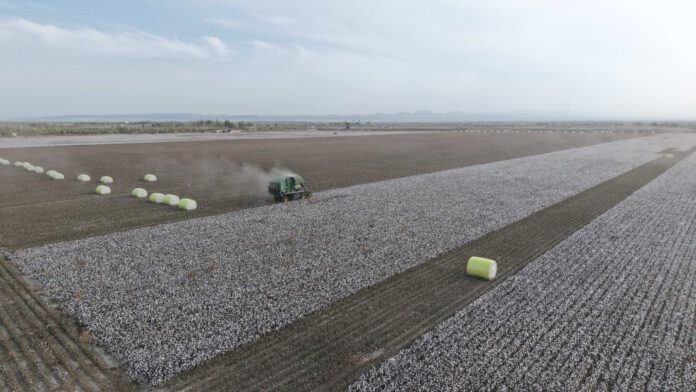
As cotton-growing areas expanded, the high cost of manual harvesting and seasonal labor shortages became increasingly important concerns. China introduced agricultural machinery purchase subsidies in 2004, accelerating mechanization in Xinjiang. From around 2012, farms increasingly adopted mechanical cotton harvesting. Improvements in machinery, cultivation methods and field infrastructure gradually extended mechanization across land preparation, sowing, crop management and harvesting.
By 2019, Xinjiang’s mechanical harvesting rate had exceeded 40%. After 2020, cotton pickers capable of compressing harvested cotton into compact modules became more widespread, simplifying transportation and subsequent processing. In 2025, the mechanization rate for plowing, sowing and harvesting reached 97%, while the mechanical harvesting rate remained above 90%. The overall mechanization rate has exceeded 95% for five consecutive years.
Beidou satellite navigation, precision sowing and automated crop protection have further improved efficiency. Some navigation-guided sowing equipment can follow preset routes with errors controlled to within a few centimeters. Large tractors handle land preparation, specialized equipment and agricultural drones carry out crop protection, and cotton pickers substantially reduce harvesting time and labor requirements. In Luntai County, the mechanical harvesting rate has exceeded 96.7%. Local production figures indicate that mechanical harvesting costs approximately 0.5 yuan per kilogram, compared with around 2 yuan for manual picking, illustrating the potential cost advantages of mechanization.
Digital agriculture is extending these gains by replacing decisions based primarily on experience with data-driven management. Satellite remote sensing, soil sensors, weather monitoring, agricultural information platforms and intelligent algorithms collect field data to support irrigation, fertilization and pest-control decisions. In Yuli County, the “Super Cotton Field” project began in 2021, using sensors, intelligent machinery and digital management platforms to operate 3,000 mu of cotton fields. Under traditional management, such an area might require approximately 20 workers for routine field operations. Following digital transformation, two managers can coordinate equipment and farming activities. Project data indicate that yields exceeded 500 kilograms per mu, while comprehensive production costs fell by approximately 254 yuan per mu, a reduction of about 22%. By the end of 2025, the project’s cultivation and management model had been promoted across more than two million mu in Xinjiang.
Agricultural drones have also evolved to incorporate automated chemical mixing, refilling, charging, route planning and spraying. These functions reduce the need for continuous manual control. At the Super Cotton Field, water, fertilizer and pesticide management have been digitized, and 75% of management operations have achieved unmanned operation. In Manas County, digital agriculture platforms integrate satellite remote sensing, drip irrigation, agricultural monitoring and the Huifengshou application to support the entire cotton production cycle. Large-scale digital agriculture demonstrations began there in 2022. Together, these technologies are shifting agricultural work away from repetitive manual tasks toward data analysis, equipment coordination and operational management.
Mechanization and digitalization have also changed the organization of agricultural businesses. Agricultural cooperatives and machinery-service providers allow farmers to access advanced equipment without having to purchase an entire fleet independently. Shaya County has 54,700 units or sets of agricultural machinery and 112 agricultural machinery cooperatives serving cotton fields throughout the county. Young people returning to rural areas increasingly work in machinery operation, equipment maintenance, data management and cooperative management. Although mechanization reduces demand for some seasonal harvesting jobs, it also creates opportunities in agricultural services, repairs, logistics and processing.
The development of Xinjiang’s cotton industry extends beyond the fields. Harvested seed cotton is processed into lint through ginning and can then be spun into yarn, woven into fabric and manufactured into garments, home textiles and industrial textile products. The development of local ginning facilities and textile factories has shortened transportation distances and strengthened connections between cotton farmers and processors. Xinjiang has established a textile and apparel industry covering cotton, chemical fibers, spinning, weaving, dyeing, clothing, home textiles and industrial textiles. Expanding local processing creates additional value, diversifies employment and helps the region move beyond the sale of raw agricultural materials.
Xinjiang’s agricultural experience also has implications for international cooperation. Many arid and semi-arid regions face similar challenges involving limited water resources, soil salinity and climate variability. Xinjiang’s experience in cotton breeding, drip irrigation, mechanized farming and saline-soil management can provide useful technical references. Demonstration projects, training programs and agricultural partnerships have helped extend relevant technologies to other countries. The Xinjiang Tianye Group, for example, has established demonstration bases in 17 countries participating in the Belt and Road Initiative, with a reported demonstration area of 200,000 mu. Such cooperation focuses not only on improving crop yields but also on water efficiency, land productivity and agricultural resilience.
Quality control and institutional safeguards have developed alongside technological progress. On July 1, 2026, the Xinjiang Uyghur Autonomous Region Regulations on Promoting Cotton Quality came into force. The regulations promote a digital traceability system covering the cotton supply chain, allowing the origins and destinations of cotton bales, as well as relevant responsibilities, to be recorded and verified. This strengthens quality management and supports more standardized industry operations.
As agricultural technology continues to advance, Xinjiang’s cotton industry is moving toward higher productivity, improved quality, greater efficiency and more sustainable resource use. Its transformation illustrates how integrating agricultural science, engineering, digital technology and industrial development can strengthen modern agriculture in arid regions.
Source: xinjiang gov cn, sina, china daily, paper people, guancha