


Once regarded simply as waste, kitchen scraps are increasingly being transformed into a valuable resource in China. From Hami in Xinjiang to Shunyi in Beijing, cities and residential communities are exploring ways to turn food waste, fallen leaves and other organic materials into compost, soil conditioners, soil remediation materials and microbial fertilizers. Through waste sorting and scientific composting, materials that would otherwise enter the waste stream are being returned to the soil, creating a practical link between urban waste management, ecological restoration and sustainable development.
Kitchen waste contains a significant amount of organic matter and therefore has considerable potential for resource recovery. Conventional disposal methods, such as landfill and incineration, can reduce the volume of waste but do not fully utilize its organic value. As China continues to promote household waste sorting, the treatment of sorted waste has become a critical part of establishing an effective waste management system. Composting provides one possible solution by using microorganisms to break down organic materials and convert them into stable substances that can be used to improve soil.
Hami, one of the cities participating in China’s pilot program for household waste sorting, has been exploring this approach in its urban landscaping system. Local horticultural authorities have experimented with mixing kitchen waste and garden waste for composting, while using biological enzymes to accelerate fermentation. Fruit peels, vegetable leaves, roots and other food scraps are combined with plant residues and processed under controlled conditions. After decomposition and maturation, the resulting organic material can be used as a soil conditioner and remediation agent.
Scientific composting is considerably more than simply piling organic waste together. The proportions of different materials, moisture levels, temperature, ventilation and microbial activity all affect the quality and efficiency of the process. Fallen leaves and kitchen waste, when properly combined, can provide suitable conditions for microorganisms to break down organic matter. As decomposition continues, unstable organic compounds are gradually converted into more stable humus-like substances. The result is a material that can improve soil structure and increase organic matter, rather than waste requiring further disposal.
Some Chinese cities and communities are also experimenting with enzymes and microbial preparations to improve the composting process. Such methods can shorten the time required for organic waste to mature and help control odors and undesirable substances. The resulting products can then be used in landscaping, gardening and agricultural applications, creating a cycle in which organic waste from cities is returned to the land as a resource.
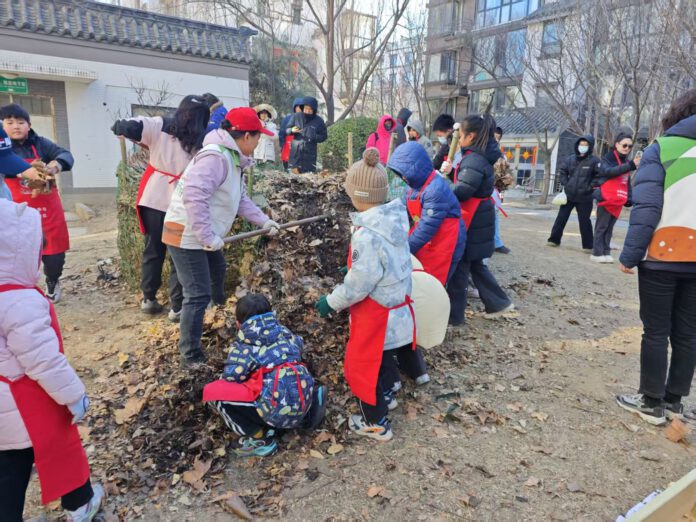
A community composting project in Jiangshanfu Community in Beijing’s Shunyi District provides another example of how this approach can work at the neighborhood level. Kitchen waste is mixed with fallen leaves and other garden residues and placed in specially designed composting boxes. Through appropriate layering, moisture and temperature control, and regular turning, the organic materials gradually decompose over several months. The finished compost, often described as “black gold soil,” is dark, loose and rich in organic matter, and can be used for planting and community landscaping.
The significance of such projects extends beyond waste reduction. When residents can see food scraps being transformed into usable soil, waste sorting becomes a tangible process rather than an abstract environmental concept. Some communities have introduced programs allowing residents to exchange sorted kitchen waste for compost. Such initiatives provide a direct and visible incentive for participation and help transform waste sorting from a policy requirement into an everyday habit.
Community composting can also create new opportunities for public participation. Composting sites can become places where residents learn about gardening, soil, microorganisms and ecological cycles. Children can take part in environmental education and planting activities, while older residents can contribute their experience in horticulture. Through these activities, an environmental project can gradually develop into a platform for communication and community engagement.
The experiences of Hami and Beijing demonstrate two complementary approaches to the resource utilization of kitchen waste. At the city level, organic waste can be incorporated into broader systems for composting and the production of soil conditioners and microbial fertilizers. At the community level, smaller-scale composting can enable organic waste to be processed locally and reused within the neighborhood. Although the scale and technology may differ, both approaches follow the same principle: waste should be separated according to its characteristics and treated according to its resource value.
This transformation, however, requires more than simply collecting and composting kitchen waste. Effective source separation, collection and transportation systems, appropriate treatment facilities, technical standards and quality controls are all essential. Compost products must also meet relevant safety and quality requirements before they can be used in agriculture, landscaping or soil restoration. Only when these elements are connected can waste resource utilization develop from isolated pilot projects into a stable and scalable system.
The broader significance lies in a changing understanding of what constitutes waste. A fruit peel, a vegetable leaf or a pile of fallen leaves may appear to have little value once discarded, yet these materials contain organic matter that can re-enter the natural cycle. Turning them into compost and soil improvement materials reduces the amount of waste requiring final disposal while returning nutrients and organic matter to the soil.
As China continues to advance household waste sorting and pursue greener patterns of urban development, the resource utilization of kitchen waste is likely to become an increasingly important part of the urban environmental system. From large-scale municipal treatment facilities to modest composting boxes in residential communities, these practices demonstrate that waste management can go beyond disposal. With appropriate technology, participation and institutional support, what was once considered the end of the consumption cycle can become the beginning of a new ecological one.
Source: bjnews, sohu, sina, xinjiang gov cn