


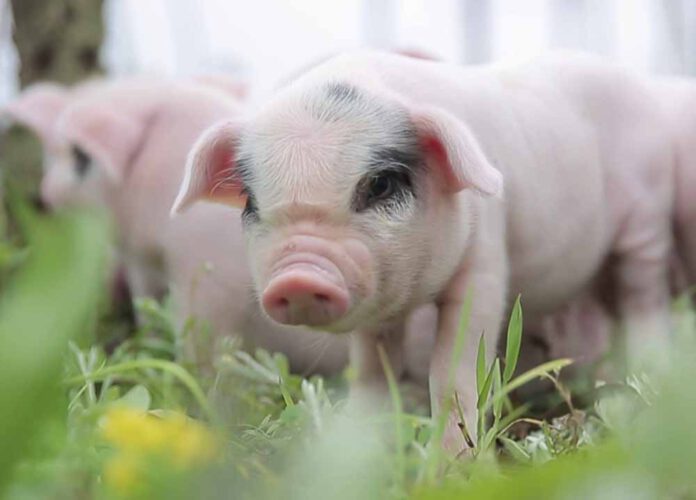
What can a pig offer beyond meat? In Rongchang, Chongqing, China, the answer is reaching far beyond the boundaries of traditional animal husbandry. With a breeding history spanning more than 400 years, the Rongchang pig is evolving from a prized local breed into a standardized laboratory animal and a source of high-end biomedical materials, driven by advances in science and technology.
The Rongchang pig is recognized as one of the world’s eight renowned pig breeds and is an important representative of China’s indigenous livestock resources. Its distinctive appearance, white coat and dark markings around the eyes, has earned it the nickname “Panda Pig.” Its traditional farming system has been included in China’s Important Agricultural Cultural Heritage list. Beyond its excellent meat quality, with intramuscular fat content generally exceeding 3.12% and reaching over 7% in some populations, the breed is known for its strong reproductive performance, ability to thrive on coarse feed, stress resistance and adaptability to the hot, humid climate of southwestern China. These traits give it considerable genetic and breeding value.
Traditionally, the value of the Rongchang pig has been concentrated in livestock farming and meat processing. However, as biomedical research and the medical-device industry have advanced, scientists have begun to explore the breed’s genetic advantages from a new perspective. Its relatively high genetic homozygosity, limited variation between individuals and stable expression of traits make it valuable not only for breeding, but also for standardized laboratory animal production and biomedical materials that require consistent and traceable source materials.
Following the outbreak of African swine fever in 2019, demand grew for high-standard laboratory pigs to support vaccine research, development and evaluation. Drawing on its expertise in sterile Caesarean delivery and aseptic artificial rearing, the Chongqing Academy of Animal Sciences supplied more than 40 SPF Rongchang pigs to the Harbin Veterinary Research Institute of the Chinese Academy of Agricultural Sciences, providing important support for scientific research. This collaboration also highlighted the breed’s potential for development in laboratory animal science and biomedicine.
SPF stands for “Specific Pathogen Free.” SPF pigs are bred and raised under strict biosecurity and environmental controls to eliminate designated pathogens that could interfere with scientific research or product development. Producing them requires end-to-end management of breeding stock, housing conditions, drinking water, feed and personnel access. After years of research, scientists have established a technical system covering sterile Caesarean delivery, artificial rearing and closed-colony breeding. Through bio-purification, 21 major potential pathogens have been eliminated, resulting in a unique domestic SPF Rongchang pig core population.
In 2024, researchers successfully developed the Chongmu Experimental Rongchang Pig, China’s first new laboratory pig resource of medium body size. It received a New Laboratory Animal Resource Identification and Evaluation Certificate from the Chinese Association for Laboratory Animal Sciences. The pigs test negative for both antigens and antibodies associated with six major swine diseases, making them suitable for vaccine evaluation, drug development and biomedical research. The SPF Rongchang pig population has now reached 600. The platform can supply approximately 300 germ-free pigs annually, with an average survival rate of around 80% for germ-free piglets. A production line with a capacity of 1,000 pigs is also under development.
The development of laboratory-grade pigs has also led to further technological breakthroughs. Using cells from the Rongchang pig, researchers have developed six products, including reversibly immortalized bone marrow mesenchymal stem cells and immortalized porcine alveolar macrophages. These provide new tools for diagnosing major animal diseases, including African swine fever and porcine reproductive and respiratory syndrome, as well as for vaccine research. The team has also made advances in large-fragment transgenic technology and created a fully human antibody-producing pig model carrying human immunoglobulin heavy chains and κ and λ light chains. This offers a new technological pathway for producing polyclonal antibody drugs. These achievements were selected among Chongqing’s Top Ten Agricultural Science and Technology Achievements of 2024.
An even greater industrial opportunity lies in pig-derived biomedical materials. Pig skin, bone, tendons and corneal tissue contain collagen and other biologically valuable components. Through processes such as decellularization, defatting and protein removal, these tissues can be developed into materials for tissue repair and regenerative medicine. SPF Rongchang pigs offer clear provenance, controlled health status and traceable genetic lineages, providing a more reliable and consistent source of raw materials for high-end medical applications.
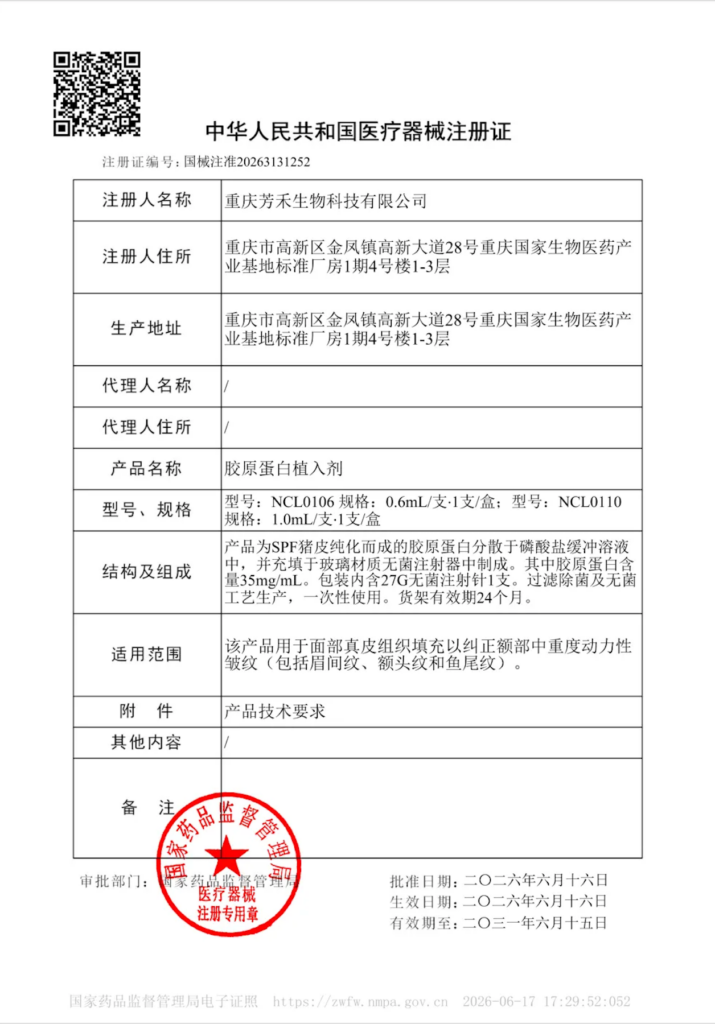
In June 2026, a collagen-based medical aesthetic product made from the skin of SPF Rongchang pigs received China’s Class III medical device registration certificate. It became the country’s first medical device product to use SPF Rongchang pigs as its source material. This breakthrough connects the key stages of the industrial chain, from laboratory pig breeding and bio-purification to standardized farming and medical material manufacturing, marking significant progress in China’s development of high-end pig-derived biomedical materials.
Skin is only one of many potential applications. Researchers are also developing products based on SPF Rongchang pigs for bone repair, artificial skin, artificial corneas and tendon reconstruction. One bone-repair material, derived from the femur and pelvic bone of SPF Rongchang pigs, has undergone multiple processing stages and passed more than 20 tests, including assessments of biocompatibility and cytotoxicity. It has now entered pilot-scale production and may eventually be used to repair extensive bone defects. Other tissues, including porcine lung extracts, also hold potential for further research and development.
The commercialization of research results is also gathering pace. Companies including Chongqing Fanghe Biotechnology are participating in the research, development and industrialization of biomedical materials derived from SPF Rongchang pigs, helping move laboratory discoveries into production. Exclusive licensing agreements for related pig-derived biomedical materials have reached €1.95 million, while the projected technology transfer value of vaccine products developed using laboratory pig resources could reach €12.1 million. These developments demonstrate how the value of the Rongchang pig is expanding beyond breeding stock and food products into laboratory animals, cellular resources and medical materials.
Alongside the growth of the biomedical sector, the traditional Rongchang pig industry is also being upgraded. The region has established a three-tier conservation system consisting of breeding farms, protected areas and a genetic resource bank. Breeding innovation, standardized farming and digital management are being used to strengthen industrial competitiveness. Supported by the national big data center for the swine industry and its digital industry platform, Chongqing is applying technologies such as the Internet of Things and big data to farm management and product traceability, gradually building an integrated system covering breeding, farming, processing and sales.
The Rongchang pig brand is now valued at €1.09 billion, while the output value of its entire industrial chain has exceeded €1.88 billion. Guided by three strategic priorities, genetic resource development, high-quality and safe pork production, and biomedical pigs, Rongchang is promoting the coordinated development of genetic conservation, premium pork production and pig-derived biomedical materials.
On November 5, 2026, the first SPF Rongchang Pig Biomedical Materials Industry Innovation Conference was held in Rongchang. Representatives from government, research institutions and businesses discussed technological innovation, commercialization, industry standards and international market development, further strengthening the region’s industrial ecosystem.
Through genetic conservation, laboratory development and biomedical materials innovation, the Rongchang pig is emerging as an important resource connecting modern animal husbandry with the life sciences industry.
Source: sohu, nctip, yunjianxingxuan, farmer, newsduan