


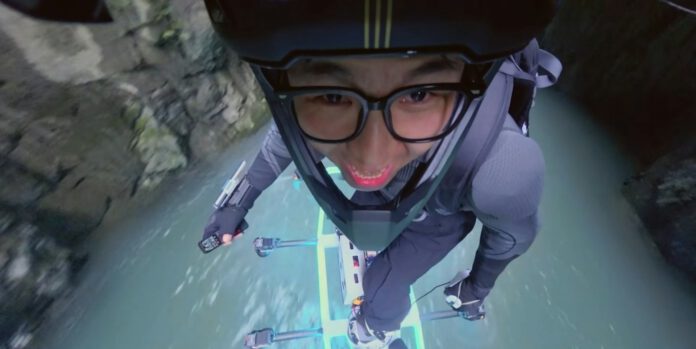
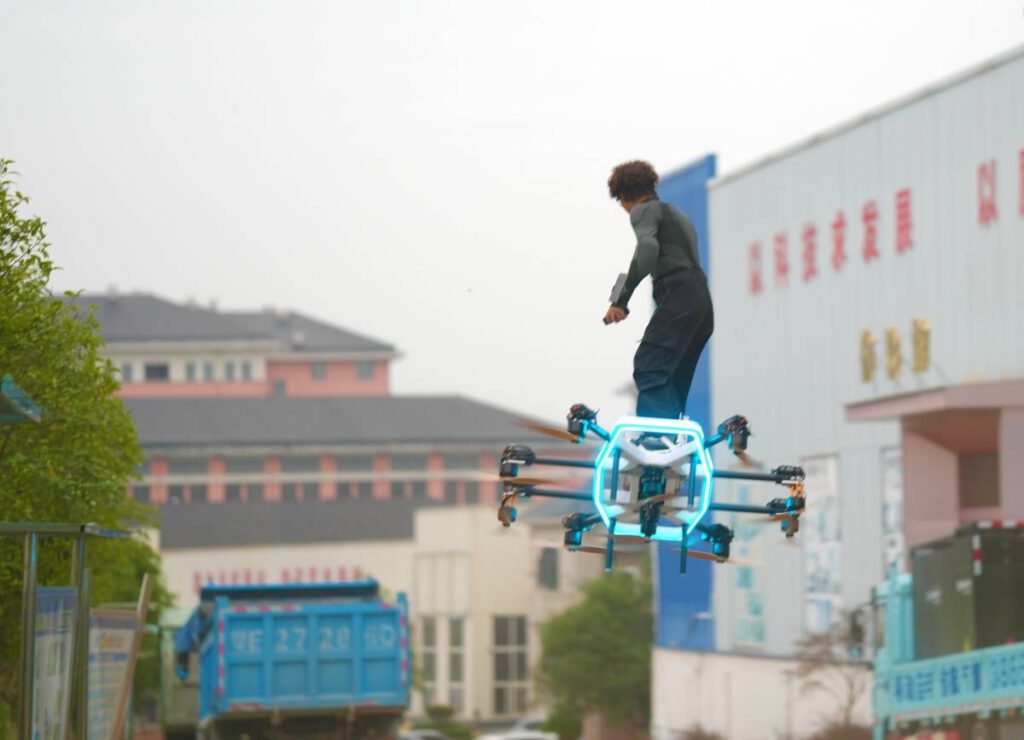
In October 2026, a homemade flying skateboard built by Chinese technology creator Amazing Ayu attracted widespread attention after flying across the Yangtze River. Resembling the Green Goblin’s flying device in Spider-Man 3, the machine can carry an adult into the air and perform maneuvers such as hovering, turning, and moving forward.
On October 22, in response to online allegations that the footage was fake or AI-generated, Ayu demonstrated the device twice in a factory in Yichang, Hubei Province, in front of news reporters. The demonstrations brought the flying skateboard from viral online footage into the physical world, allowing observers to witness its takeoff, maneuvering, and landing firsthand.
The fascination surrounding the project extends beyond the flight itself. Behind the device is a young man whose path into technology began with little more than curiosity and a desire to build things with his own hands. Born in 2000 in a rural family in Badong County, Enshi, Hubei Province, Ayu, whose real name is Song Xingyu, did not attend university or follow a conventional engineering education. Instead, he developed his knowledge of aircraft, mechanical structures, and aerospace technology through self-directed learning, hands-on experimentation, and repeated attempts to turn ideas into working machines. From model aircraft and high-altitude flying wings to homemade spacecraft and a manned flying skateboard, his projects reflect a persistent effort to make imagined technologies tangible.
Ayu’s interest in science and technology began in childhood. He encountered a space shuttle model at an early age and was captivated by the flying skateboard featured in Spider-Man 3. Such images inspired a lasting fascination with flight and mechanical design. Growing up in an ordinary rural household, however, he had limited access to the resources and facilities associated with aerospace engineering. The technologies that captured his imagination seemed distant from everyday life, but that distance did not diminish his interest. As he grew older, he began exploring online communities devoted to drones, gliders, spacecraft, and other flying devices, gradually looking for ways to move beyond watching and learning toward building things himself.
Ayu’s educational and professional journey differed considerably from the conventional route into engineering. He left school at around 14 and began helping with his father’s timber business. He later worked on construction sites and gained experience as a factory apprentice. These jobs exposed him to tools, materials, welding, assembly, and practical manufacturing techniques. At the same time, he continued studying technical subjects through online resources, instructional videos, and communities of enthusiasts. Rather than learning through a structured university curriculum, he approached knowledge through the problems he wanted to solve. Each new project gave him a reason to investigate unfamiliar concepts, understand how components worked, and test his assumptions through practical experimentation.
In 2022, Ayu returned to his hometown, borrowed less than 3000 euros from his father to purchase a second-hand truck, and converted an unused spray-painting workshop into a personal laboratory. He carried out much of the renovation himself, arranging the workspace, installing equipment, and organizing tools within a limited budget. The workshop was not a fully equipped professional research facility, but it gave him a dedicated place to work on mechanical structures, electronic systems, prototypes, and flight experiments. Establishing this space marked an important step in turning his interests from occasional experiments into a sustained program of independent creation.
His early projects demonstrated how he adapted to limited resources. When building model aircraft, he used discarded KT boards and salvaged components to assemble prototypes and explore the principles of flight. As his experience grew, he began attempting more ambitious projects that combined engineering, outdoor testing, and video production. In 2024, he carried out a high-altitude flying-wing jump from approximately 5,000 meters, using a flare effect to create footage resembling a meteor streaking across the sky. The video attracted considerable attention, bringing him approximately 400,000 new followers on Douyin within a month and introducing his work to a much wider audience.
Ayu’s creativity is not limited to speed, altitude, or conventional engineering objectives. In another project, he transformed an ordinary living room into a flying installation, taking a sofa, coffee table, rug, plants, and kitchen equipment to an altitude of around 2,000 meters. The unusual concept combined mechanical experimentation with familiar elements of domestic life, creating a striking contrast between an everyday interior and the aerial environment. Such projects demonstrate his interest in recombining existing materials and objects in unexpected ways. They also require him to consider practical questions involving structural support, equipment performance, and the demands of filming in unusual conditions.
His more ambitious experiments have also encountered significant setbacks. In 2024, Ayu developed a homemade spacecraft known as Echo-1. The plan involved using high-altitude helium balloons to carry the vehicle into the upper atmosphere before releasing it for a separation and ignition sequence. Adverse weather damaged equipment at the launch site, and the project failed to proceed as originally intended. Although the spacecraft did not complete its planned mission, its onboard camera captured images of Earth from high altitude. The experience highlighted the limitations faced by independent engineering projects: imagination can establish a direction for exploration, but reliable performance depends on technical preparation, suitable testing conditions, and repeated validation.
In 2025, Ayu continued experimenting with manned flying devices and large boats, but several projects ended unsuccessfully. The setbacks reportedly left him with debts of approximately 320,000 euros. In December of that year, Insta360’s Think Bold creator-support initiative provided nearly 242,000 euros to help ease his financial burden. The support illustrated both the financial risks associated with ambitious independent projects and the potential role of creator-support programs in sustaining unconventional forms of innovation. Ayu’s work was no longer entirely separate from the commercial world: video production, brand partnerships, and technical experimentation increasingly became interconnected, providing resources and public exposure for subsequent projects.
The manned flying skateboard that brought him widespread attention in 2026 represented another attempt to turn a childhood fascination into a physical machine. The device uses ten electric motors for propulsion. Its battery and motors are commercially purchased components, while some of its exterior and structural parts were designed and manufactured by Ayu using processes including 3D printing, CNC machining, and laser cutting. According to specifications he provided to the media, the device was designed for a pilot weighing approximately 70 kilograms, with a combined motor thrust of around 300 kilograms. Its current flight time is approximately 16 minutes, with battery discharge capacity and heat generation limiting endurance.
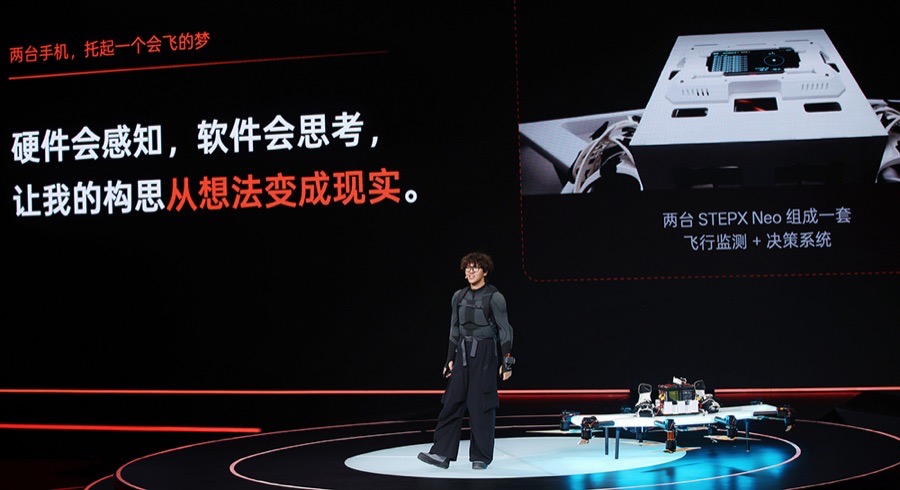
The skateboard’s control system also reflects Ayu’s experimental approach. The pilot uses handheld controllers to regulate the propulsion and turning functions, while balance relies largely on body posture, visual information, and the vestibular system. To make training more effective, Ayu incorporated sensors and gyroscopes to collect flight data and help identify subtle changes in body position. A training system analyzes the measurements and generates reports showing patterns of left and right leaning, allowing the pilot to focus on specific weaknesses during subsequent sessions. According to Ayu, he trained for approximately ten days before mastering basic hovering and forward flight. The system assists with training and posture awareness; it does not replace the pilot by automatically controlling the flight.
A homemade manned aircraft, however, presents challenges far beyond those involved in building a model or demonstrating sufficient thrust. Adequate propulsion is only one requirement. Structural integrity, control stability, battery safety, system redundancy, and emergency procedures are equally important to practical operation. Ayu has stated that the flying skateboard is not intended to become a mass-market consumer product. Instead, he envisions it as a piece of extreme-sports equipment, comparable to wingsuit-flying gear or a parachute system, requiring specialist training and careful handling. His work illustrates the potential of individual experimentation, but the reliability and safety of such equipment still require rigorous testing and verification.
From building model aircraft with salvaged materials to establishing a personal workshop and developing high-altitude flying wings, spacecraft, and a manned flying skateboard, Ayu’s journey demonstrates how sustained curiosity can become a practical pursuit. He did not begin with comprehensive knowledge of mechanics, electronics, or aerospace engineering. His skills developed through a continuing cycle of identifying problems, studying unfamiliar principles, building prototypes, and learning from the results. Not every project succeeded, and financial pressure, technical limitations, and failed experiments remained part of the process. What connects his work is a lasting fascination with flight and a willingness to turn abstract ideas into physical devices.
Source: xinhua net, hubei daily, adquan, hk on cc, cyol, ctdsb