


Since the dawn of agriculture, farmers have had to contend with one persistent problem: weeds.
For centuries, the answer was labor. Farmers pulled weeds by hand or removed them with hoes. As agriculture became mechanised, tractors and cultivators took over much of the work. Chemical herbicides later offered an even more efficient solution, but at the cost of environmental concerns and growing dependence on agricultural chemicals.
Now, another technology is making its way into China’s fields: lasers.
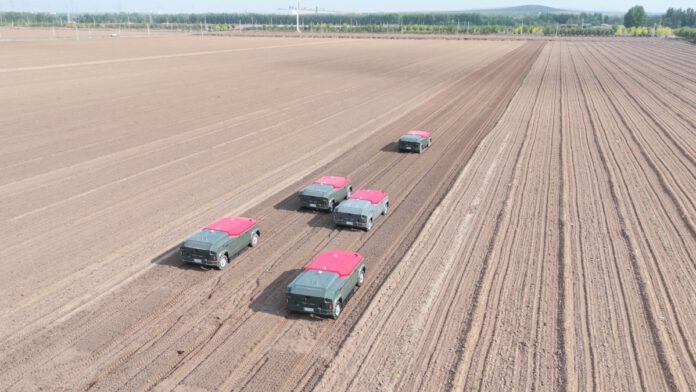
Laser weeding uses cameras, artificial intelligence and high-energy laser beams to identify and destroy weeds without disturbing the surrounding soil. The principle is straightforward. Cameras continuously scan the field, while AI models distinguish crops from weeds. Once a weed is identified, the system directs a laser beam at the target, delivering a burst of energy within milliseconds. The resulting heat rapidly evaporates water in the weed’s cells and damages its chlorophyll and cellular structure, eventually killing the plant.
In essence, laser weeding is still a form of burning. The difference is that it is highly selective: the machine first identifies its target and then applies heat precisely where it is needed.
The technology is advancing rapidly. Some laser-weeding systems developed in China can achieve weed-removal rates above 95 percent, while keeping crop damage below 0.1 percent. Certain systems can process an image and determine the laser target in just a few milliseconds. A machine equipped with a single laser head can eliminate roughly 10,000 weeds an hour; with 32 laser heads operating simultaneously, that capacity can rise to about 320,000 weeds per hour. Large-scale systems have already demonstrated the ability to treat nearly 100 mu, about 16.5 acres, of farmland in a day.
Laser technology is also being adapted for other agricultural tasks. In Xinjiang, a laser-based cotton-topping robot has been developed by Xinjiang University and Xinjiang Jimu Robotics Technology. Equipped with solid-state LiDAR and a machine-vision system, the robot is designed to navigate cotton fields and precisely remove the growing tips of plants.
These developments are part of a broader push to bring robotics and artificial intelligence into Chinese agriculture. Commercial laser weeding itself is still in its early stages. In 2022, US-based Carbon Robotics launched an autonomous laser weeder, helping establish the technology as a commercial agricultural application. But the machines were expensive, with some foreign systems priced at more than $1m.
Chinese researchers and manufacturers soon began working to develop domestic alternatives. Huagong University of Science and Technology, together with the Harbin Institute of Technology, began research into laser-weeding robots, while universities and agricultural research institutes across the country launched their own programmes.
In 2024, a Chinese all-weather intelligent laser-weeding robot entered field trials in Heilongjiang. Since then, domestic equipment has moved steadily towards commercial deployment. Other research teams have progressed from laboratory prototypes to successive generations of engineering machines, improving AI-based crop recognition, positioning accuracy and the ability to operate under changing field conditions.
One of the biggest advantages of this domestic development has been cost. Imported laser-weeding machines can cost between $1.1m and $1.6m. Chinese manufacturers have brought the price of some systems below 1m yuan. Some companies have also begun offering rental models. One such service charges farmers about 50 yuan per mu for an entire growing season, compared with roughly 200 yuan for manual weeding.
The economics become more complicated when laser weeding is compared with chemical herbicides, which can cost only 30-50 yuan per mu. Yet chemical application itself requires labour or machinery, while the environmental costs of herbicide use are harder to capture in a simple price comparison. Laser systems leave no chemical residue, cause little soil disturbance and may be particularly attractive for high-value organic crops and medicinal plants.
The emergence of laser weeding illustrates a broader feature of China’s agricultural technology sector: the speed with which research can move from laboratories into mass production. Chinese research institutions are increasingly supplying the underlying technologies, universities are working with manufacturers to commercialise them, and a mature domestic supply chain is helping companies reduce production costs. The same pattern is visible in other areas of agricultural robotics.
Drones are now routinely used for crop protection, seeding, fertilisation and field mapping. Strawberry-picking robots are being tested and deployed in farms. Automated feeding machines are being introduced into livestock operations. In Henan, Muyuan Foods has built multi-storey pig farms equipped with a digital management system that uses artificial intelligence to process billions of data points and monitor thousands of indicators, including those related to disease and animal health.
The underlying goal is not simply to replace human labour with machines. It is to make farming more precise. That matters because Chinese agriculture faces two structural challenges. The first is labour. Rural populations are aging, while fewer young people are willing to undertake physically demanding agricultural work. Automation can reduce the amount of manual labour required to manage large areas of farmland.
The second is efficiency. Conventional farming often applies water, fertilizer and pesticides across entire fields, even when only part of a field requires treatment. AI and sensors allow farmers to identify individual problem areas and respond accordingly. In principle, this means applying the right input, in the right place, at the right time.
China’s agricultural statistics reflect the broader transformation. The contribution of scientific and technological progress to agricultural growth has risen from 54.5 percent in 2012 to more than 64 percent in 2025. The comprehensive mechanisation rate for crop ploughing, planting and harvesting has increased from 57 percent to 76.7 percent over the same period.
The country’s current five-year planning targets call for the contribution of agricultural science and technology to reach 67 percent by 2030, while the comprehensive mechanisation rate is expected to exceed 80 percent. Policy support has increasingly focused on combining artificial intelligence with agriculture and expanding the use of drones, the Internet of Things and agricultural robots.
The market opportunity is considerable. Global sales of laser-weeding robots were estimated at about $133m in 2025 and are projected to reach roughly $247m by 2032. China’s potential market is still larger. In the country’s northeastern provinces alone, the 237m mu of corn farmland could generate demand for hundreds of thousands, potentially more than one million, laser-weeding machines as the technology matures.
Chinese companies are also beginning to look beyond the domestic market. In July, Huagong Intelligent Agriculture’s Laser Weeder H8, a domestically developed large-scale laser-weeding robot, was shipped to Australia. The export marked an important step in the internationalisation of China’s intelligent agricultural machinery.
The significance of laser weeding therefore extends well beyond the replacement of herbicides. It represents a convergence of several technologies, computer vision, artificial intelligence, robotics, precision manufacturing and lasers, and demonstrates how these technologies can be adapted to one of the world’s oldest industries.
For China, the transformation is being driven by a combination of technological research, government policy, a vast agricultural market and a highly developed manufacturing base. Technologies that were once too expensive for ordinary farms can become commercially viable as domestic production expands and costs fall.
Source: xinhua, sciencenet, 36kr, stdaily, chinadaily