


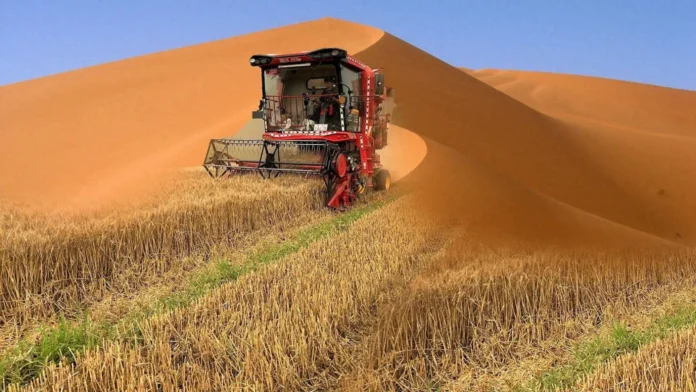
Across the Taklamakan Desert, China’s largest shifting-sand desert, endless golden dunes stretch beneath an extremely harsh climate. Annual rainfall is less than 100 millimeters, while evaporation is immense. For decades, the region was considered unsuitable for conventional agriculture. Yet along the desert’s edges, fields of green wheat are beginning to transform the landscape. Wheat seedlings emerge from the soil, grow into golden ears, and eventually reach harvest. What once seemed almost impossible, growing wheat on the edge of a desert, is now becoming a reality in Xinjiang.
The first challenge is finding the right seeds. Conventional wheat varieties have specific requirements for soil, water, and growing conditions. But the land around the Taklamakan is characterized by severe water shortages, saline-alkali soils, sandy terrain, and poor soil fertility. To achieve reliable harvests in such an environment, researchers must develop wheat varieties capable of adapting to these difficult conditions.
One important breakthrough is Jingmai 189, a hybrid wheat variety developed by the Beijing Academy of Agriculture and Forestry Sciences. The variety has demonstrated strong adaptability and has been tested in saline-alkali fields and desert-edge areas in Maigaiti County, Xinjiang. In 2023, researchers began winter wheat trials along the Taklamakan’s edge.
Through land preparation, irrigation infrastructure, and careful field management, they enabled the crop to complete its growing cycle in sandy conditions. In the summer of 2024, the experimental fields produced their first harvest, with yields reaching 294 kilograms per mu, demonstrating that wheat cultivation is possible in parts of the desert region.
The trials have since continued, with efforts to improve both cultivation techniques and productivity. In a high-yield demonstration field in Maigaiti, Jingmai 189 achieved a measured yield of 768 kilograms per mu. Yields vary depending on soil conditions, irrigation methods, and field management, but the results point to the potential of selected desert-edge land for productive wheat farming when supported by suitable varieties and modern agricultural practices.
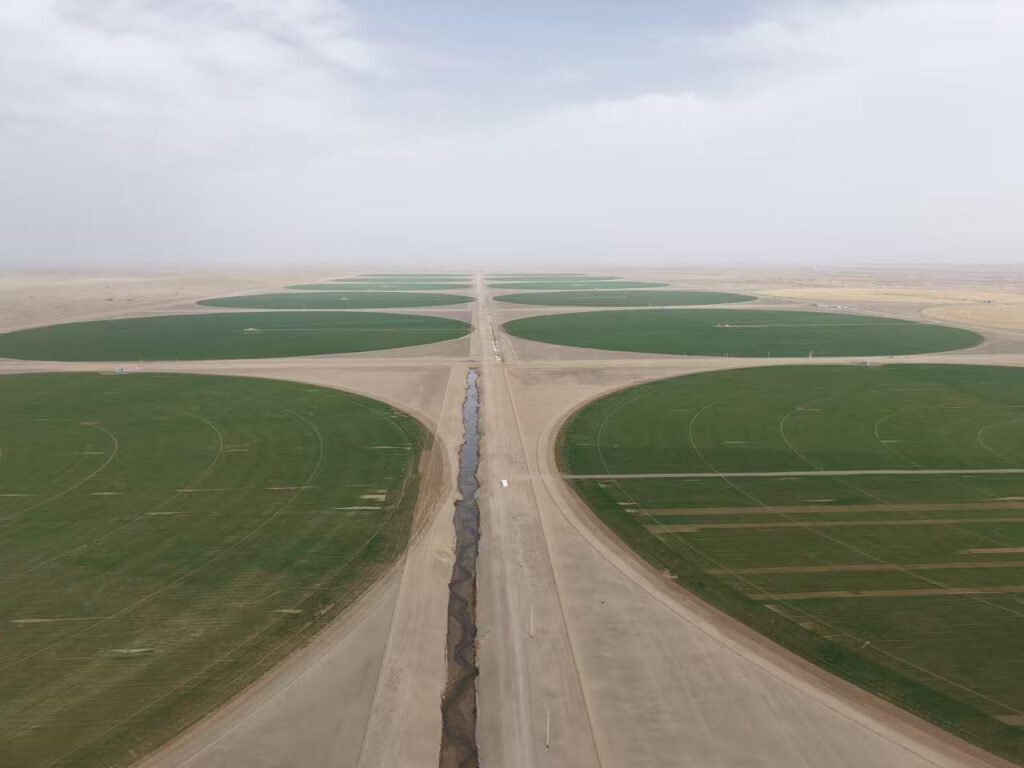
Growing wheat here, however, requires much more than good seeds. Water is the most serious constraint. Traditional flood irrigation consumes large quantities of water and often uses it inefficiently. To address this challenge, some agricultural bases in Xinjiang have introduced center-pivot sprinkler irrigation systems. A machine extending more than 380 meters rotates around a central point, distributing water and fertilizer evenly across the fields. Automated controls reduce labor requirements and help ensure that wheat receives a more consistent water supply during critical stages of growth.
At an agricultural base in the 224th Regiment of Kunyu City, irrigation infrastructure is integrated with a local water-management system. Meltwater from the Kunlun Mountains is collected and transported through reservoirs, sedimentation facilities, and filtration systems before reaching farmland. In some areas, differences in elevation are used to support gravity-fed irrigation. Project data indicate that center-pivot sprinklers can reduce water consumption by more than 20 percent compared with traditional flood irrigation. In a region where water is exceptionally scarce, every drop saved matters to the future of wheat cultivation.
Wind and drifting sand pose another major threat. Strong winds can bury young seedlings, while blowing sand and high temperatures accelerate soil moisture loss. To protect farmland, local authorities and farmers have established multiple layers of windbreaks, including shelterbelt forests, straw checkerboard barriers, and tall sand-control fences. These measures help reduce wind speed near the ground and create more stable conditions for wheat to emerge, develop, and mature. Additional tree belts around fields provide further protection from encroaching dunes.
Soil improvement is equally important. In Bachu County, triticale, a hybrid of wheat and rye, is being cultivated on newly developed saline-alkali land. More tolerant of salt than many conventional crops, triticale can be harvested for both grain and forage. Trial data show that soil salinity in some planting areas declined from 1.4 percent to 0.76 percent. Although triticale is not the same as ordinary wheat, it offers a useful approach to improving saline soils and expanding agricultural options, potentially creating better conditions for future wheat cultivation.
In Tumushuk, another method of land improvement is being explored. Silt dredged from a local reservoir is used to cover areas of barren, gravelly land, helping create a more suitable soil base for agriculture. The project aims to improve 23,000 mu of land, with approximately 11,000 mu already treated. Properly assessed and processed sediment can improve soil structure and water retention. However, its long-term agricultural use requires continued monitoring of salinity, potential contaminants, and overall soil quality.
Taken together, these efforts show that wheat cultivation on the edge of the Taklamakan is no longer simply a matter of scattering seeds across sandy ground. It involves an integrated agricultural system built around adapted wheat varieties, efficient irrigation, wind and sand control, and soil improvement. Mechanized planting, automated watering, and large-scale field management are gradually making selected areas that were once difficult to cultivate suitable for modern agriculture.
Yet growing wheat in the desert does not mean that farmland can expand without limits. Water remains the fundamental constraint on agricultural development around the Taklamakan. Meltwater from the Kunlun Mountains must also support local communities and surrounding ecosystems. Long-term irrigation must be carefully managed to prevent groundwater depletion and the accumulation of salts in the soil. The sustainability of desert-edge wheat farming therefore cannot be judged by the size of a single harvest alone. It also depends on whether water resources, soil quality, and the ecological environment can be maintained over time.
From experimental plots to expanding demonstration farms, wheat cultivation along the Taklamakan is showing how agricultural science can adapt to some of the world’s harshest growing conditions.
Source: cyol, paper people, altxw, tidenews,sohu