


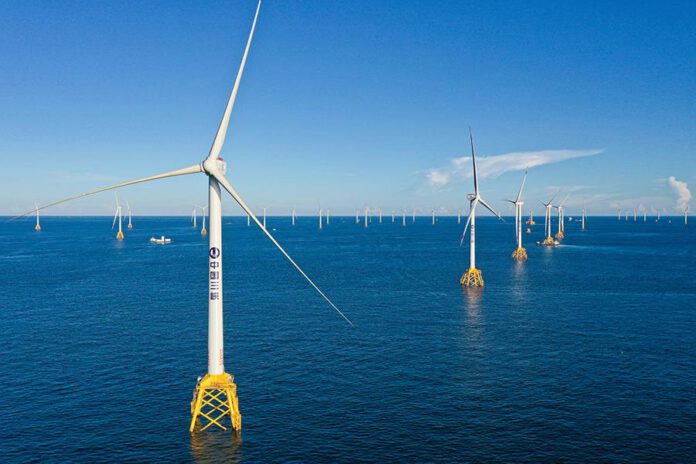
Along the coast of the South China Sea, rows of offshore wind turbines turn steadily in the sea breeze, transforming abundant wind resources into clean electricity. From large-scale offshore wind development and advanced equipment manufacturing to deep-sea technological innovation and international exports, Yangjiang, a coastal city in western Guangdong Province, is accelerating the development of a comprehensive green energy industry. By integrating renewable energy with advanced manufacturing, the city is forging a distinctive path toward industrial transformation and sustainable growth.
A major offshore wind power project in Yangjiang recently reached a significant milestone. In waters off Yangxi County, the subsea cable transmission project serving the China Three Gorges Corporation’s Yangjiang Qingzhou V and VII offshore wind farms successfully completed a key stage of construction. The ±500-kilovolt flexible direct-current submarine cables passed their withstand-voltage tests, while construction of the offshore converter station platform was completed. The entire transmission system is now ready for energization, marking a major step toward connecting the project to the power grid.
The progress reflects not only the development of a major infrastructure project but also China’s broader efforts to advance offshore wind power into deeper waters, increase generating capacity and improve transmission efficiency. Supported by abundant marine wind resources, an increasingly complete industrial supply chain and growing technological capabilities, Yangjiang is evolving from an offshore wind development base into an industrial hub integrating energy production, equipment manufacturing, research and development, port logistics and green energy applications.
Yangjiang’s rise as an offshore wind power center began with its natural advantages. The city has a coastline stretching approximately 458 kilometers and a marine area of around 11,900 square kilometers. Favorable wind conditions, extensive offshore resources and proximity to the Guangdong-Hong Kong-Macao Greater Bay Area, one of China’s major electricity consumption centers, provide a strong foundation for large-scale offshore wind development.
In September 2017, the 400-megawatt Yangjiang Nanpeng Island offshore wind power project developed by China General Nuclear Power Group received approval, marking the beginning of Yangjiang’s journey toward large-scale offshore wind development. Over the following years, major energy companies invested in a growing portfolio of projects, creating a development model in which offshore wind farms drive demand for equipment manufacturing and related services, while the expansion of the industrial supply chain further strengthens the city’s capacity to develop and operate wind power projects.
Today, Yangjiang has a planned offshore wind power capacity of 20 gigawatts, with more than 7 gigawatts connected to the grid. Projects under construction or planned to begin construction account for approximately 6 gigawatts, placing the city among China’s leading offshore wind development centers. According to local development plans, Yangjiang’s grid-connected offshore wind capacity is expected to exceed 13 gigawatts in 2026, potentially making it the country’s first offshore wind power base with more than 10 gigawatts of installed capacity.
Behind these figures lies a deliberate effort to build an integrated industrial ecosystem. Yangjiang has attracted major energy developers, including China Three Gorges Corporation, China Huadian Corporation and China General Nuclear Power Group, while encouraging manufacturers and supporting businesses to establish local operations. This approach has helped transform project investment into a broader industrial development opportunity, creating demand for wind turbines, blades, submarine cables, towers, offshore engineering equipment and technical services.
The Guangdong (Yangjiang) International Wind Power City has become a central platform for this transformation. A growing number of manufacturers are establishing operations in the area, strengthening local capabilities across the wind power value chain. From turbine assembly and component manufacturing to cable production, structural engineering and maintenance services, the industrial network is becoming increasingly comprehensive.
This development is changing the economic significance of offshore wind power in Yangjiang. The industry is no longer defined solely by electricity generation. It is also creating opportunities in advanced manufacturing, engineering services, technological innovation and international trade. As the supply chain becomes more complete, companies benefit from closer coordination, improved delivery efficiency and stronger access to technical support.
The development of public service platforms has further strengthened the industrial ecosystem. Yangjiang is gradually establishing a service network known as “One Port and Four Centers,” encompassing an offshore wind equipment logistics and maintenance hub, a national quality inspection and testing center for offshore wind equipment, a big-data center, an integrated operations and maintenance center, and the Yangjiang Offshore Wind Power Laboratory. Together, these facilities provide support throughout the equipment lifecycle, from research and testing to manufacturing, installation and maintenance.
Universities and research institutions are also playing an increasingly important role. Guangdong Ocean University’s Yangjiang campus and other local research organizations are working with companies through joint laboratories, practical training programs and collaborative research initiatives. These partnerships help develop skilled professionals while bringing industrial challenges directly into the research environment.
As Yangjiang’s industrial base expands, technological innovation is becoming increasingly important. Offshore wind development is moving toward deeper waters and more distant offshore locations, where wind resources can be substantial but engineering conditions are considerably more demanding. Greater water depths, stronger waves, severe typhoons and more complex maintenance requirements place higher demands on equipment reliability, structural design and operational efficiency.
Floating offshore wind technology offers a promising solution. Unlike conventional fixed-bottom turbines, floating turbines are supported by buoyant platforms secured to the seabed with mooring lines. This approach can reduce the need for expensive seabed foundations and make wind power development possible in deeper waters.
Yangjiang has become an important testing ground for this technology. The Three Gorges-led “Three Gorges Pioneer” floating offshore wind turbine, which entered operation in late 2021, demonstrated the potential of floating wind technology in typhoon-prone waters. More recently, the “Mingyang Tiancheng,” a floating wind power unit featuring two turbines mounted on a single platform, was connected to the grid in the Qingzhou waters of Yangjiang. With a combined turbine capacity of 16.6 megawatts, the installation represents a significant advance in large-scale floating wind technology.
These projects provide valuable experience in platform stability, typhoon resistance, intelligent monitoring and long-term offshore operations. They also help establish a technical foundation for the future commercial deployment of floating wind farms.
Power transmission is another critical challenge as offshore wind farms move farther from shore. Traditional alternating-current transmission can face limitations in long-distance submarine cable applications, while high-voltage direct-current systems offer advantages for transmitting large amounts of electricity over extended distances.
The Yangjiang Qingzhou V and VII offshore wind project demonstrates how this technology can support deepwater development. With a planned generating capacity of 2 gigawatts and a location approximately 70 kilometers offshore, the project uses a ±500-kilovolt flexible direct-current transmission system. Electricity generated by the turbines is collected through submarine cables and sent to an offshore converter station, where it is converted into high-voltage direct current. It is then transmitted to an onshore control center before being converted back into alternating current for connection to the grid.
The project includes two direct-current submarine cables, each more than 90 kilometers long. Once fully operational, it is expected to supply approximately 6 billion kilowatt-hours of clean electricity to the Greater Bay Area annually and reduce carbon dioxide emissions by around 5 million tonnes a year.
The project illustrates how advances in offshore generation and transmission must progress together. Larger turbines alone cannot unlock the full potential of deepwater wind resources; reliable transmission infrastructure is equally essential. By developing both technologies, Yangjiang is helping establish practical solutions for the next stage of offshore wind expansion.
Innovation is also taking place in materials science, equipment testing and intelligent operations. Offshore wind turbines operate in environments characterized by high humidity, salt corrosion, powerful winds and persistent wave action. These conditions demand materials with exceptional strength and durability, as well as monitoring systems capable of identifying equipment problems before they lead to failures.
Local research teams have been working on high-performance underwater grouting materials, submarine cable protection systems, floating wind technology and intelligent maintenance solutions. Research institutions and companies are increasingly collaborating to address engineering problems identified in real projects, allowing promising technologies to be tested and applied more quickly.
This close connection between research and industrial practice is helping Yangjiang move beyond expansion driven primarily by installed capacity. The city is building capabilities in technological development, product reliability and full-lifecycle equipment management, all of which will be essential to maintaining competitiveness as offshore wind development becomes more technically demanding.
Another major priority is ensuring that the electricity generated offshore can be transmitted efficiently and consumed reliably. Wind power output varies with weather conditions, creating challenges for grid stability and electricity balancing as installed capacity increases. Yangjiang’s diversified energy mix, which includes wind, thermal, hydroelectric, nuclear and solar power, provides favorable conditions for developing a more flexible power system.
One approach is to coordinate wind power generation with controllable thermal power generation. When wind output is high, thermal generation can be reduced; when wind output declines, thermal generation can be increased to help balance electricity supply. Energy storage provides another means of managing fluctuations. Electricity can be stored when wind generation is abundant and released when demand rises or transmission capacity becomes constrained.
Yangjiang has begun applying these approaches through coordinated power generation and independent energy storage projects. Such measures can help reduce electricity curtailment, improve grid flexibility and make better use of renewable energy resources.
The city is also exploring ways to turn its green electricity resources into an advantage for advanced manufacturing. As international markets increasingly emphasize carbon footprints and sustainable supply chains, access to reliable low-carbon electricity is becoming an important consideration for export-oriented industries.
Yangjiang is promoting green industrial parks, direct green electricity supply and carbon management systems to encourage closer integration between renewable energy and manufacturing. These initiatives aim to attract businesses involved in energy storage, clean energy equipment and other emerging industries while helping existing manufacturers reduce their carbon emissions.
This approach expands the role of offshore wind power beyond electricity generation. Renewable energy can become the foundation for a broader industrial transformation, supporting energy storage, hydrogen production, low-carbon manufacturing and other emerging applications. By increasing the local utilization of green electricity, Yangjiang can create additional economic value while contributing to the decarbonization of industry.
Yangjiang’s industrial capabilities are also opening new opportunities in international markets. As countries accelerate the energy transition, demand for wind power equipment and related engineering services continues to create opportunities for manufacturers with competitive products and reliable delivery capabilities.
The city is increasingly using its manufacturing base and port infrastructure to connect local production with overseas projects. In September 2025, the vessel Tianhui departed Yangjiang Port carrying nine sets of wind turbine equipment bound for Italy. Produced by a local manufacturer, the shipment included turbines, hubs, blades, towers and associated components, with a total value exceeding RMB 130 million.
Yangjiang Port has also handled shipments of complete wind turbine equipment destined for Vietnam. These operations demonstrate the growing ability of the port to accommodate oversized, heavy industrial cargo and support the export of high-value renewable energy equipment.
Transporting wind power equipment requires specialized port facilities, heavy-lifting capacity, careful vessel scheduling and efficient customs clearance. Yangjiang has been improving its port infrastructure and introducing more coordinated services for wind equipment exports. These efforts help reduce logistics costs, improve shipment efficiency and strengthen the city’s ability to serve international customers.
The growing export business represents an important extension of Yangjiang’s industrial development. Offshore wind projects generate demand for equipment, manufacturing attracts suppliers and technical services, research institutions support innovation, and port logistics connect the entire industrial chain with global markets. Together, these elements are helping establish Yangjiang as a participant in the international division of labor in the wind power industry.
Despite its progress, Yangjiang still faces significant challenges as offshore wind development moves farther into the deep sea. Floating wind technology requires further improvement before it can be deployed at a much larger commercial scale. Offshore construction and maintenance remain expensive, while the long-term reliability of equipment operating in harsh marine environments requires continued testing and technological development.
The local supply chain also needs to strengthen its capabilities in certain high-value components, including advanced bearings, gearboxes and specialized offshore engineering equipment. Improving domestic production of these components would enhance supply chain resilience and increase the proportion of value retained within the local economy.
Addressing these challenges will require continued investment in research and development, closer collaboration between manufacturers and research institutions, and improvements in offshore installation, inspection and maintenance services. At the same time, the expansion of wind power capacity must be coordinated with grid development, energy storage and electricity consumption to ensure that new generating capacity can be used efficiently.
Looking ahead, Yangjiang plans to further strengthen its industrial supply chain, improve deepwater maintenance capabilities and accelerate the development of a comprehensive green energy system. Its longer-term ambitions include integrating wind power with other renewable energy sources, energy storage and hydrogen production, while using clean electricity to support the development of low-carbon industrial clusters.
From the approval of its first major offshore wind project in 2017 to the development of an integrated industrial ecosystem today, Yangjiang has undergone a remarkable transformation in just eight years. The city is turning marine wind resources into clean electricity, project demand into manufacturing capacity, research into practical technological advances, and local production into an increasingly international business.
As offshore wind technology continues to advance and global demand for clean energy grows, Yangjiang is positioned to play an increasingly important role in China’s offshore wind industry. Its experience demonstrates how natural resource advantages can be transformed into industrial strength through coordinated investment, technological innovation, infrastructure development and market expansion.
From nearshore waters to the deep sea, from electricity generation to advanced manufacturing, and from local production to global markets, Yangjiang is pursuing a development model that links the energy transition with industrial upgrading. Along the shores of the South China Sea, the city is turning the power of the wind into a lasting source of economic opportunity and a contribution to a greener future.
Source: xinhua, people, 21jingji, nfnews, yicai