


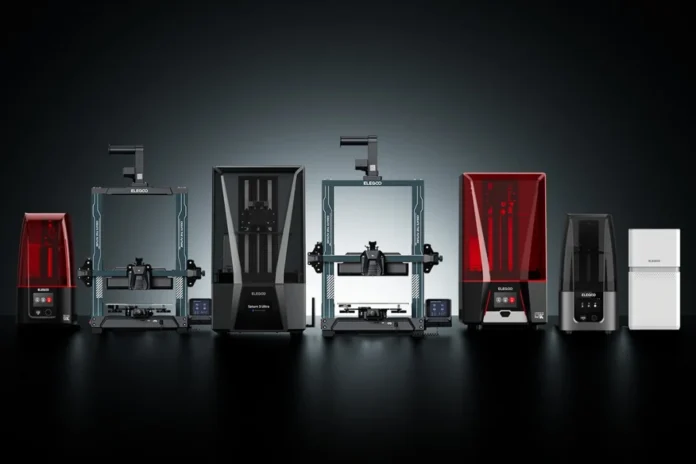
Nearly nine out of every ten consumer 3D printers sold worldwide are made by companies based in Shenzhen. Behind this extraordinary market position is a decade-long transformation that has turned a once-niche technology into a global consumer industry, and made Shenzhen its leading manufacturing and innovation hub.
The rise did not happen overnight. It began with a group of entrepreneurs who recognised an opportunity in making 3D printing smaller, cheaper and easier to use. It was then accelerated by Shenzhen’s manufacturing ecosystem, global e-commerce networks and a new generation of technology companies willing to rethink how people interact with machines.
In 2014, when consumer 3D printing was still largely associated with professional users and technology enthusiasts, Creality started in a small office of approximately 20 square metres in Longhua, Shenzhen. At the time, 3D printers were expensive, difficult to operate and far from accessible to ordinary consumers. Creality saw an opportunity to change that.
Its CR-10 printer, launched in 2016 at around US$500, became an important milestone. With a relatively large printing volume and an affordable price, it attracted users in overseas markets and helped demonstrate that consumer 3D printing could become a viable mass-market product. Rather than competing exclusively on advanced technology, Creality focused on affordability, usability and the needs of everyday makers. This early strategy laid the foundation for Shenzhen’s consumer 3D printing industry.
Other companies soon followed, each finding a different route into the market. Anycubic, founded in 2015, developed its Photon series and established a strong position in resin-based printing. Elegoo entered the market with its Mars series in 2019, offering resin printers at around US$299 and significantly lowering the cost of entry. Bambu Lab, founded in 2020 by a team with experience at DJI, took a more technology-driven approach. Its X1 series, launched in 2022, introduced high-speed printing, automation and multi-colour capabilities that raised expectations for the entire consumer market.
These companies became known as Shenzhen’s four leading consumer 3D printing brands: Creality, Elegoo, Anycubic and Bambu Lab. Together, they account for approximately 90% of global consumer 3D printer shipments, according to industry estimates cited in the supplied reports. Their success reflects different strengths: Creality’s early-mover advantage and broad product portfolio, Elegoo’s strength in resin printing, Anycubic’s international reach, and Bambu Lab’s emphasis on automation and user experience.
The market figures illustrate how rapidly the industry has expanded. According to CONTEXT, global entry-level 3D printer shipments exceeded one million units in the first quarter of 2025, up 15% year on year, with Chinese suppliers accounting for approximately 95% of the market. Creality held a reported 39% share, while Bambu Lab recorded year-on-year growth of 64%.
Shenzhen’s advantage, however, cannot be explained by individual companies alone. The city has developed an unusually concentrated industrial ecosystem that connects research and development, component manufacturing, materials, production and international distribution. The geographical structure of the industry is particularly important. Creality and Elegoo are rooted in Longhua, Bambu Lab operates in Nanshan, and Anycubic is associated with Longgang. These districts form a closely connected industrial corridor, where suppliers and manufacturers can collaborate with remarkable speed. In Longhua, for example, more than 60% of some companies’ suppliers are reportedly within a two-hour reach. This proximity allows manufacturers to source components, test new designs and solve production problems without the delays associated with more fragmented supply chains.
For a product as technically demanding as a 3D printer, this is a significant advantage. A machine must coordinate motors, circuit boards, motion systems, extruders, sensors, materials and software. Improving any one component can require adjustments across the entire product. Shenzhen’s dense manufacturing network makes this process faster and more flexible, allowing companies to shorten development cycles and move rapidly from prototypes to mass production.
The city also benefits from a deep pool of engineering talent and experience accumulated through its electronics and advanced manufacturing industries. Bambu Lab’s founders, for instance, brought product development experience from DJI into consumer 3D printing, applying a more integrated approach to hardware, software and user experience. This cross-industry exchange has helped push the sector beyond basic equipment manufacturing towards more sophisticated consumer technology.
Another decisive factor has been Shenzhen’s ability to connect manufacturing with global markets. From their early stages, many local 3D printing companies targeted overseas customers, particularly in Europe and North America. Crowdfunding platforms, independent websites, Amazon and social media allowed them to reach consumers directly, while online communities and creator networks helped build brand awareness.
The international orientation of these businesses is reflected in their scale. Elegoo has expanded into more than 100 countries and regions, while Anycubic products are sold in more than 200 markets. Overseas sales account for a substantial proportion of revenue at several leading companies. Creality has also developed beyond printers into 3D scanners, laser engraving equipment and online creative services.
Capital investment has further strengthened the sector. Leading companies have attracted support from investors and strategic partners including Tencent, Shenzhen Capital Group, DJI, Meituan and Hillhouse Investment. This funding has enabled businesses to invest in research, expand production capacity and develop products with longer innovation cycles. Bambu Lab’s planned manufacturing base in Guangming, designed for an annual production capacity of more than three million units, is one example of the industry’s growing scale.
The next stage of competition is already taking shape. As hardware becomes more capable and prices become increasingly competitive, companies are looking beyond the printer itself. Digital models, software, materials and creator communities are becoming essential parts of the business.
Bambu Lab’s MakerWorld and Creality Cloud illustrate this shift. These platforms connect users with downloadable models, design resources and other creators, encouraging people to keep printing after purchasing their machines. Creality has also been exploring AI-powered modelling tools, while other companies are working to make the process of turning an idea into a printable object much simpler.
Artificial intelligence could become the industry’s next major growth driver. AI can generate 3D models from photographs or text descriptions, recommend printing parameters, optimize production schedules and identify defects during manufacturing. In Shenzhen, companies such as Creality and JLC Group are already exploring applications across model creation, printing services, automated quotation and production planning. AI is also creating opportunities in materials development, where algorithms can help predict performance and optimise formulations.
This matters because the biggest barrier to widespread 3D printing adoption has never been simply the price of the machine. It has also been the technical knowledge required to design, prepare and print an object. If AI can make these steps accessible to ordinary consumers, 3D printing could move beyond the maker community and become a practical tool for personalised manufacturing.
Challenges remain. Multi-colour printing still faces cost and reliability constraints; AI-generated models must be made suitable for physical production; and better materials, industry standards and easier operating experiences are still needed. As the market expands into homes, schools and small businesses, safety, stability and simplicity will become just as important as printing speed and technical specifications.
Nevertheless, Shenzhen has a powerful foundation for tackling these challenges. Its manufacturing clusters can support rapid product iteration, its engineering talent can drive technological improvements, its international sales networks provide access to global consumers, and its capital ecosystem can support long-term investment.
Shenzhen’s story is therefore not simply one of making more 3D printers than anywhere else. It is the story of how a manufacturing city built an entire industry around an emerging technology, from affordable hardware and global brands to digital platforms, AI-powered design and personalised production.
The next generation of 3D printing may be defined not by how many machines a company sells, but by how easily people can turn their ideas into physical products. Shenzhen has already established itself as the centre of the industry’s first major wave. Its ability to lead the next one will depend on how successfully it transforms that manufacturing advantage into a complete innovation ecosystem.
Source: 21jingji, sz gov cn, ce cn, parkworld, sohu, scmp