


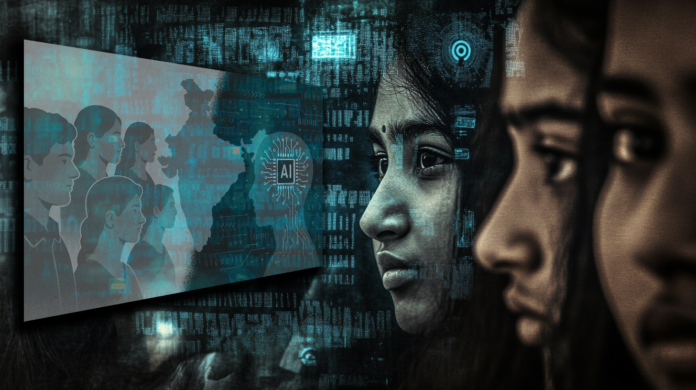
Since the beginning of 2025, India’s vaunted IT industry has suffered two shocks. The first came from DeepSeek, the Chinese open-source AI model whose rapid rise forced Indian policymakers and technology executives to confront an uncomfortable question: why has a country celebrated for decades as the world’s software and IT-services hub failed to produce a comparable frontier AI model?
The second came from Tata Consultancy Services (TCS), India’s largest IT-services company, which announced plans to cut roughly 12,000 jobs, or about 2 percent of its workforce. The two developments point to a deeper structural problem. Artificial intelligence is not merely disrupting India’s IT industry; it is beginning to undermine the comparative advantage on which much of that industry was built.
Since the 1990s, India has pursued a distinctive path of economic development by moving directly into services rather than following the traditional sequence from agriculture to manufacturing and then to advanced services. Its IT industry became the flagship of this strategy.
India combined a large pool of English-speaking engineers with relatively low labor costs and established itself as a major provider of software development, testing, maintenance, business-process outsourcing and consulting services to Western corporations. Companies such as TCS, Infosys and Wipro grew into global giants, while IT and related services became a crucial source of export earnings and foreign exchange.
This success was real, but it contained a fundamental weakness: India became exceptionally good at delivering technology without becoming equally good at creating the technologies themselves.
For three decades, much of the Indian IT industry operated on a model of labor arbitrage. Western companies supplied the capital, intellectual property and technological platforms; Indian firms supplied large numbers of engineers at lower cost. The business model rewarded scale, efficiency and reliability more than technological risk-taking. India therefore accumulated a huge software workforce without developing an equally powerful ecosystem of globally dominant software products, operating systems, platforms or foundational technologies.
This helps explain the paradox at the heart of India’s IT success. The country has produced millions of programmers and a remarkable number of senior executives in Silicon Valley, yet very few Indian companies have created globally dominant consumer or enterprise technology platforms.
The problem is not simply a shortage of talent. India has plenty of talented engineers. The deeper problem lies in how talent, capital and corporate incentives have been organized. The most ambitious researchers and engineers often migrate to the United States or Europe, while domestic firms have generally found it more profitable to scale service delivery than to finance long, uncertain and expensive R&D programs.
Artificial intelligence changes this equation. For years, India’s principal advantage was the availability of relatively inexpensive human intelligence. Generative AI is now turning many forms of cognitive labor into software. Basic coding, testing, documentation, customer support, data processing and routine consulting can increasingly be performed by AI systems at a fraction of the previous cost. The issue, therefore, is not simply whether AI will eliminate IT jobs. It is whether AI will reduce the economic value of the very labor arbitrage that made Indian IT services globally competitive.
This is why the significance of TCS’s layoffs goes beyond the number of jobs involved. The important question is whether the traditional relationship between headcount and revenue is beginning to break down. In the old model, expanding a contract often meant hiring more programmers. In the emerging model, the same work may be performed by a smaller number of highly skilled employees working with increasingly capable AI systems.
The competitive advantage shifts from the ability to mobilize large quantities of relatively inexpensive labor to the ability to combine advanced technology with scarce high-end talent.
DeepSeek exposed a second vulnerability. India is deeply integrated into the global technology economy, but integration is not the same as technological sovereignty.
Frontier AI requires much more than programmers. It requires computing power, advanced chips, data, research institutions, venture capital, foundational software and companies capable of turning scientific breakthroughs into scalable products. India has important pieces of this ecosystem, but they have not yet been integrated into a globally competitive AI industry.
There is, however, no reason to conclude that India is destined to lose. Its enormous engineering workforce remains a major asset. The rapid expansion of global capability centers in India also shows that multinational corporations increasingly trust the country with higher-value functions such as R&D, engineering, finance and advanced business services.
The Indian government’s push to expand domestic computing capacity and develop indigenous AI models suggests that policymakers understand the scale of the challenge.
The decisive question is whether India can convert its traditional advantage in human capital into technological capabilities of its own.
If it can, AI could become a productivity multiplier and help India move from being a supplier of digital labor to a creator of digital products. If it cannot, the same workforce that once powered India’s rise could become vulnerable to technological substitution.
The risks extend beyond the technology sector. India’s IT and business-services exports are important sources of foreign exchange and high-skilled employment, while the industry supports a large urban middle class. A simultaneous decline in demand for labor-intensive outsourcing and a tightening of access to major Western markets could therefore put pressure on employment, external balances and urban incomes.
India is not being “shorted” by a particular country or a particular AI company. It is being challenged by a change in the economics of technology itself. For thirty years, India prospered by providing the people needed to operate the global digital economy. The next phase of the digital economy may reward those who build the machines that replace part of that labor.
The central question for India is therefore no longer how many programmers it can supply to the world, but how many technologies, platforms and companies it can build for the world. That transition will determine whether AI becomes the next engine of India’s rise, or the force that exposes the limits of its previous development model.
Source: jjdkzz, ifeng, cnyes, xpert