


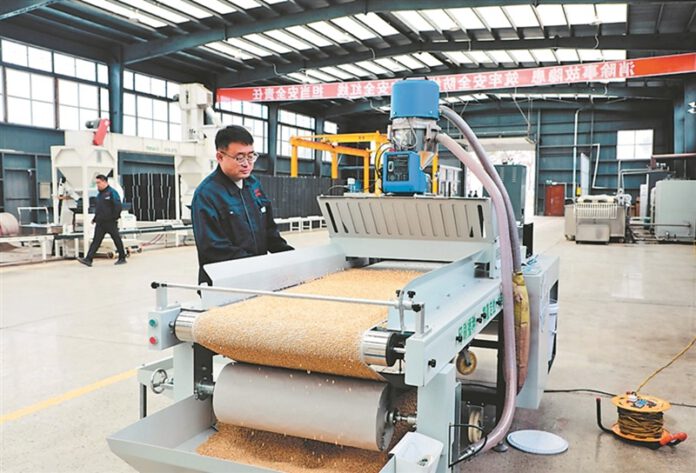
A thin sheet of paper moves slowly through a machine. Moments later, rows of rice seeds appear on its surface, each one fixed at a carefully measured position. It looks like a printing process, but this is happening in a rice nursery.
Known in China as “printing sowing,” the technology is being tested and adopted in several rice-growing regions, from the vast black-soil fields of Heilongjiang in the northeast to the double-cropping rice areas of Jiangxi and the modern agricultural cooperatives of Shanghai. By precisely positioning seeds on biodegradable nursery paper, the technology is helping farmers reduce seed use, save labor and produce stronger seedlings.
It is a small change at the beginning of the production chain, but one that reflects a much larger transformation in Chinese agriculture, from farming based largely on experience to farming increasingly driven by precision equipment, data and intelligent management.
The principle behind printing sowing is relatively simple. Inside a precision machine, small dots of plant-based adhesive are placed on biodegradable nursery paper at predetermined intervals. Rice seeds are then released onto the paper. One or two seeds adhere to each glue point, while excess seeds are removed through vibration and screening. The seeds are thus arranged in neat rows and at controlled distances before the paper is rolled up for storage or transportation.
When the paper is later laid onto seedling trays or nursery beds and watered, it softens and allows the seeds to germinate. As the seedlings grow, the paper gradually decomposes.
The technology addresses a long-standing problem in conventional rice nurseries: uneven sowing. In traditional mechanized planting, some holes in a seedling tray may contain several seeds, while others contain none. Crowded seedlings compete for nutrients, light and space, often resulting in weak stems and poorly developed roots. Too few seeds, meanwhile, can reduce the number of effective seedlings.
Precision positioning changes that equation. By controlling both the number and location of seeds, farmers can create more uniform growing conditions from the very beginning.
The economic benefits are also attracting attention.
At the Qixing branch of Beidahuang Agricultural Holdings in Heilongjiang, printing sowing has become part of an increasingly automated rice nursery system. Local agricultural officials say the method can reduce seed consumption by about 20 percent compared with conventional tray-based nurseries. A single printing-sowing machine can produce enough nursery paper for roughly 55 to 60 mu of rice fields in about an hour. One mu is approximately 0.067 hectares.
In Shanghai’s Pudong New Area, a farmers’ cooperative in Shuyuan Town has also introduced the technology. According to the cooperative, precision printing sowing can save more than 30 percent of rice seed in some applications, while reducing labor requirements. The printed paper can also be mechanically laid onto seedling trays, with soil covering carried out in the same process.
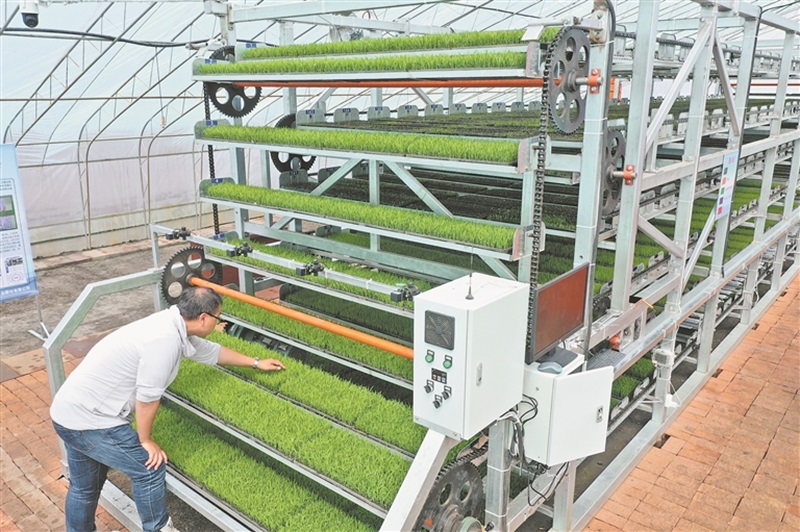
For large-scale farming, such savings can quickly add up. In Jiangxi Province, this technology offers another advantage: time. Rice farmers in southern China often face a particularly demanding agricultural calendar. During the summer “double-rush” season, early rice must be harvested and late rice planted within a narrow window. If seedlings remain in trays for too long, they can become overgrown and weak, reducing their ability to recover after transplanting.
In July 2025, at a rice nursery center in Wanzai County, Jiangxi, farmers were preparing seedlings for late-season rice using printing sowing. Company manager Chang Chuiming said printed nursery paper could be rolled into cylinders and stored until needed, giving farmers greater flexibility in scheduling their work.
Field trials were encouraging. Farmers who participated in a 100-mu trial reported that the seedlings were stronger and recovered after transplanting about five days earlier than conventional seedlings.
The nursery paper itself is another part of the innovation. In different applications, bamboo fiber and other plant-based biodegradable materials are used to make the paper, while starch-based and other plant-derived adhesives hold the seeds in place. Once exposed to water and the growing environment, the paper gradually breaks down. This combination of precision sowing and biodegradable materials gives the technology an environmental dimension as well as an economic one.
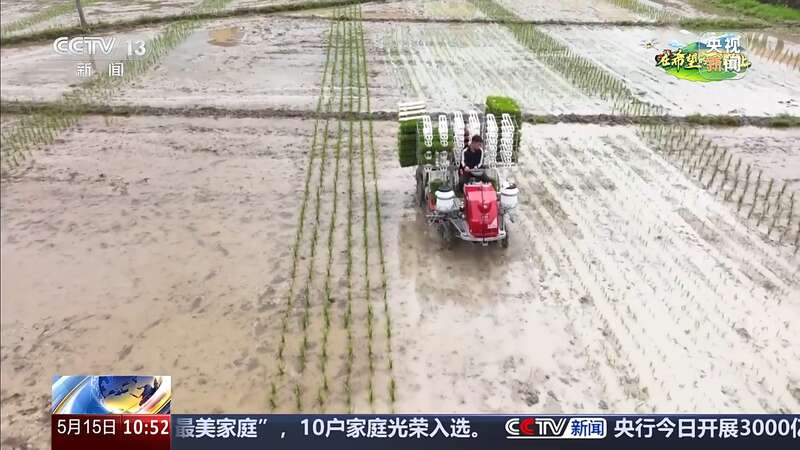
At Qixing in Heilongjiang, however, printing sowing is only one element of a much broader agricultural transformation. The local intelligent nursery facilities connect soil filling, precision sowing, covering, watering and tray transportation through automated systems. Robotic arms move trays, automated forklifts transport them, and environmental control systems regulate temperature and humidity. In 2025, one intelligent nursery factory produced 260,000 trays of seedlings in 14 days, enough to serve about 8,000 mu of rice fields.
Other technologies are also entering the fields. Intelligent inspection robots equipped with cameras and artificial intelligence can monitor seedlings and identify potential diseases. Sensors collect environmental data, while automated systems help adjust growing conditions. Unmanned agricultural machinery guided by China’s BeiDou satellite navigation system is increasingly being used for field operations.
Together, these technologies are changing what farming looks like. The farmer is no longer relying solely on visual judgment to decide how much seed to use, when to irrigate or where to operate machinery. Increasingly, those decisions can be supported by sensors, algorithms and automated equipment.
Yet printing sowing is not a universal solution that can simply be copied from one region to another. China’s rice-growing areas differ widely in climate, varieties, cultivation systems and production scales. Heilongjiang’s vast mechanized farms have different priorities from Jiangxi’s double-cropping rice fields, while Shanghai’s agricultural cooperatives face different labor and cost pressures.
The technology therefore remains a work in progress, requiring further adaptation to local varieties, nursery systems, transplanting machinery and cultivation practices. Still, its significance lies in what it represents.
Source: nyncw sh gov cn, hlj gov cn, paper, china jsj, xinhua, cyol