


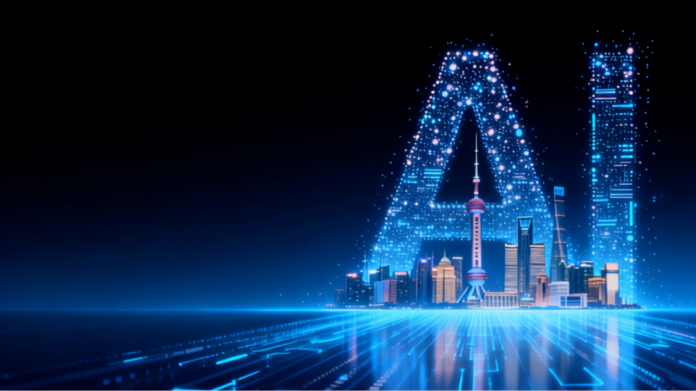
Shanghai’s artificial intelligence industry is gathering pace as the city’s long-term investment in computing power, capital, data and real-world applications begins to translate into faster growth.
On July 20, the Shanghai Municipal Bureau of Statistics reported that the city’s GDP reached 27.89 trillion yuan ($3.89 trillion) in the first half of 2026, up 5.6% year on year in real terms.
Industry remained an important driver. Output from manufacturing in Shanghai’s three strategic emerging industries rose 14.5% from a year earlier. Integrated-circuit manufacturing increased 19.5%, AI manufacturing jumped 21.8%, and biopharmaceutical manufacturing grew 7.2%. Output of railway, shipbuilding, aerospace and other transportation equipment also expanded 15.6%.
Foreign trade provided another source of momentum. Shanghai’s total imports and exports reached 2.55 trillion yuan in the first half, a record for the period. Imports rose 17.4% and exports 20.1%. Trade in high-tech products increased 21.6% to 662.14 billion yuan.
The acceleration of AI, however, reflects more than a strong technology cycle. It is the result of years of investment and policy experimentation coming together at a critical moment.
“Shanghai’s AI industry accelerated in the first half of the year because multiple conditions that had been accumulating for years are now being released at the same time,” said Zhong Huiyong, an associate researcher at Antai College of Economics and Management and the China Institute for Development Studies at Shanghai Jiao Tong University.
The city has been building up computing capacity, attracting investment, opening application scenarios and developing innovation platforms. Together, these efforts are lowering the cost of experimentation for companies and shortening the path from technology to commercial use.
Shanghai’s upgraded “Model Shanghai” initiative focuses on three basic inputs for AI development: computing power, data and capital. The city has developed several domestic intelligent-computing chips, is investing in advanced networking technologies and is building a unified citywide intelligent-computing network.
Data infrastructure is expanding as well. Shanghai has established what it describes as China’s first data-content operation platform and has assembled datasets totaling 10,000 terabytes in fields including scientific research and industrial manufacturing.
“Shanghai has spent years developing high-performance domestic computing clusters, public data platforms and open-source developer communities,” said Wu Yiping, a distinguished researcher at the Institute for Chinese Modernization Studies at Shanghai University of Finance and Economics. The concentration of universities, research institutes, investors and start-ups, he said, has strengthened the supply of talent and cutting-edge technology.
The government is also using financial incentives to reduce the cost of innovation. Shanghai provides 1 billion yuan a year in vouchers for computing power, AI models and data, allowing companies to use the resources first and pay later. The city has also attracted a national AI fund with a total size of 60 billion yuan and established a municipal AI leading-industry fund worth 22.5 billion yuan.
The objective is increasingly to build an ecosystem rather than simply subsidise individual companies.
“Technology, capital and industry are beginning to form a virtuous cycle,” Wu said. Public funds are working with private investors to channel capital into areas such as intelligent chips, autonomous driving and embodied intelligence.
Perhaps the most distinctive part of Shanghai’s strategy is its emphasis on real-world applications.
At Zhangjiang AI Innovation Town, a two-square-kilometre core area has effectively become a testing ground for emerging technologies. Autonomous patrol vehicles operate around the clock, working with drones to provide coordinated air-and-ground monitoring. Autonomous boats monitor an 11.8-kilometre waterway, while autonomous buses are preparing to operate on 329 kilometres of open roads.
These are not laboratory simulations. They involve real roads, real users and real feedback, allowing companies to test and refine their products in operating environments.
That approach was also visible during the “WAIC City Walk 2026”, held from July 15 to 20 alongside the World Artificial Intelligence Conference. Six industry-themed routes and eight open-access locations connected laboratories, industrial parks and innovation spaces across Shanghai, bringing AI out of exhibition halls and into the city.
Shanghai is increasingly looking to industrial pain points to determine where AI should be deployed. Its “AI + manufacturing” programme focuses on industries such as electronics, advanced equipment and automobiles, while efforts in consumer technology are targeting products including AI glasses and AI smartphones. In services, the city is promoting AI applications in areas such as finance, consulting and auditing.
The city’s state-owned enterprises have also been asked to accelerate the adoption of AI. A programme launched in March identified 50 urgent, high-value business scenarios across finance, manufacturing, transportation and construction, covering processes such as design, quality control, production scheduling, maintenance and dispatch.
“Shanghai has a rich range of application scenarios in manufacturing, finance, healthcare, automobiles and urban governance,” Zhong said. “AI technologies can enter actual business processes relatively quickly, creating a cycle of technological breakthroughs, scenario validation, product iteration and industrial value creation.”
Shanghai is simultaneously trying to build an ecosystem that is attractive to developers.
Its “1+3+N” model framework combines Shanghai AI Laboratory’s open-source InternLM series with three commercial foundation-model providers—StepFun, MiniMax and SenseTime—and a growing number of industry-specific models for sectors such as manufacturing, healthcare and finance.
The city is also experimenting with new approaches to talent development and entrepreneurship. Shanghai Innovation Institute, for example, is exploring an integrated model linking research, innovation and education, while using an “investment-incubation-exit” mechanism to support promising projects. More than 20 high-valued innovative companies have already been incubated under the programme.
Physical proximity is another part of the strategy. Innovation hubs such as ModelSpeed Space and Model Power Community aim to put developers, investors and industrial partners within easy reach of one another. The Zhangjiang and Beiyang AI Innovation Towns are designed to strengthen industrial clustering and create complementary innovation hubs.
The logic is straightforward: reducing the friction between an idea and a commercial product can be just as important as providing money or computing power.
The 2026 World Artificial Intelligence Conference offered a vivid example. More than 1,100 companies took part, showcasing over 3,000 products, with more than 300 making their global debut.
The conference is not merely a showcase for the latest technology. It also reduces the costs of finding information, identifying partners and understanding where the industry is heading. Chipmakers, model developers, application companies, investors and industrial users can meet in the same physical space, turning what might otherwise take months of searching and negotiation into a much shorter process.
Shanghai’s AI strategy is therefore becoming less about building technology for its own sake and more about making technology useful.
Its competitive advantage may ultimately lie not in any single model, chip or application, but in the ecosystem being built around them: abundant computing power, accessible data, patient capital, open application scenarios, concentrated talent and dense industrial networks.
As these elements reinforce one another, Shanghai is attempting to create a shorter and cheaper route from technological breakthrough to commercial value.
The acceleration of its AI industry is consequently not the product of one policy or one breakthrough. It is the result of years of groundwork reaching a point where infrastructure, capital, policy and demand are beginning to move in the same direction. For Shanghai, turning the city itself into a testing ground may be the next step in turning AI from technological promise into measurable economic value.
Source: paper, sohu, sina, people, yahoo, xinhuanet, sh gov cn