


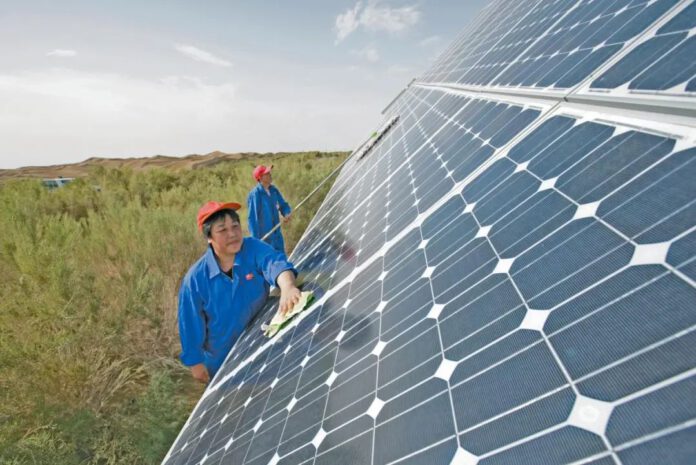
As of May 4, 2026, the Tarim Desert Highway Zero-Carbon Demonstration Project, developed by PetroChina Tarim Oilfield, has generated more than 15 million kilowatt-hours (kWh) of green electricity since it was commissioned. The project has replaced the consumption of more than 4,100 tonnes of diesel fuel, reduced approximately 14,200 tonnes of carbon dioxide emissions, and achieved an average daily power generation exceeding 11,000 kWh. This pioneering project has become a successful model for zero-carbon operation of desert highways while providing valuable experience for desertification control and low-carbon development in China.
In recent years, Xinjiang has accelerated the green transformation of its economy in line with China’s carbon peaking and carbon neutrality goals. As part of the region’s efforts to promote industrial green development, the oil and gas production and processing sector has actively explored the integration of traditional energy resources with renewable energy.
The Tarim Desert Highway Zero-Carbon Demonstration Project represents one of the most significant achievements of this strategy, combining photovoltaic power generation with ecological restoration to realize coordinated economic, environmental, and social benefits.
The Taklimakan Desert, often referred to as the “Sea of Death,” covers approximately 330,000 square kilometers, making it the world’s second-largest shifting sand desert. Despite its harsh environment, it contains abundant oil and gas resources.
To support exploration, development, and transportation activities, the Tarim Desert Highway, stretching 522 kilometers, was completed in 1995. It became the world’s longest graded highway crossing a shifting desert, significantly shortening travel distances between southern Xinjiang and Urumqi while providing vital transportation infrastructure for energy development.
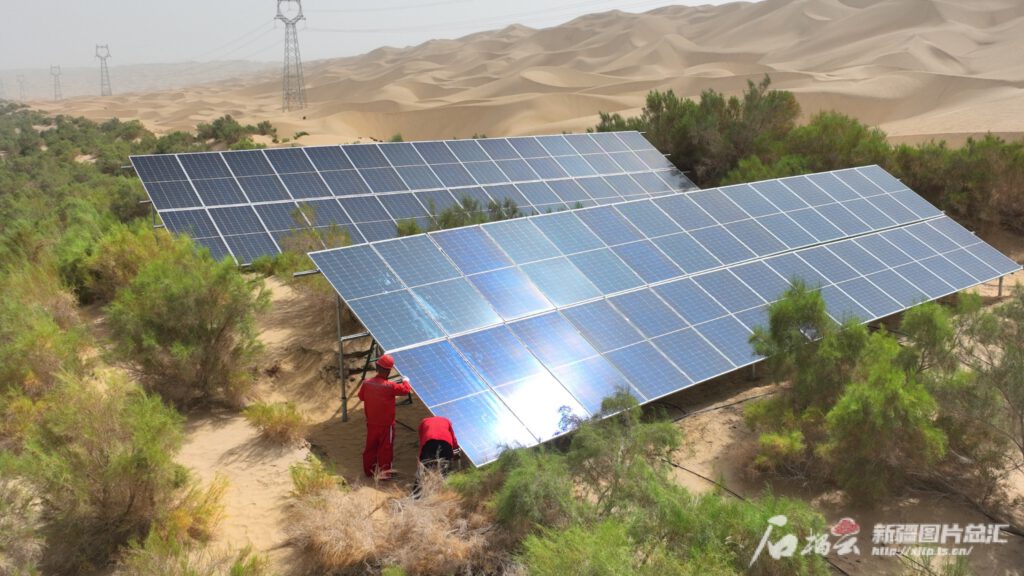
Building the highway was only the beginning. Protecting it from relentless sand encroachment proved to be an even greater challenge. In 2003, construction began on the Tarim Desert Highway Ecological Shelterbelt Project. Completed in 2006, the project established a 436-kilometer-long ecological shelterbelt covering more than 3,100 hectares along both sides of the highway. More than 20 million drought- and salt-tolerant shrubs, including saxaul, tamarisk, and Calligonum, were planted.
A network of 109 water wells, supplied by shallow, highly mineralized groundwater and operated through drip irrigation systems, was built to sustain the vegetation. After more than two decades of maintenance, this green corridor has become the world’s first ecological forest successfully established across a shifting desert, effectively controlling sand movement and ensuring the long-term safety of the highway.
Responding to China’s initiative to accelerate the development of large-scale renewable energy bases in deserts, the Gobi, and other arid regions, PetroChina Tarim Oilfield launched the Zero-Carbon Demonstration Project in 2022. Remarkably, the entire project was completed and commissioned in just over 140 days.
The project constructed 86 distributed photovoltaic power stations along the 436-kilometer shelterbelt, with a total installed capacity of 3.54 megawatts (MW). Solar power has completely replaced diesel generators that previously supplied electricity for pumping irrigation water to the shelterbelt. Before the upgrade, the remote desert location prevented access to the national power grid, making diesel generators the only available power source.
This approach involved high fuel transportation costs, difficult equipment maintenance under extreme desert conditions, and significant carbon emissions. The photovoltaic system has eliminated these challenges while enabling the shelterbelt to operate entirely on clean energy.
Today, rows of solar panels stand beside the highway alongside white-and-red well houses and flourishing vegetation, creating a striking contrast against the vast desert landscape. The renewable energy system supplies all the electricity required for daily irrigation, allowing the shelterbelt to thrive entirely on solar power.
The photovoltaic facilities generate more than 3 million kWh of electricity annually, enough to meet the irrigation demand of the ecological shelterbelt. Each year, the system saves over 1,000 tonnes of diesel fuel and reduces carbon emissions by approximately 3,000 tonnes. Meanwhile, the shelterbelt itself absorbs an estimated 20,000 tonnes of carbon dioxide annually. This carbon sequestration not only offsets the project’s own emissions but also neutralizes emissions produced by nearly 90,000 vehicle trips along the highway each year, enabling the project to achieve net-negative carbon performance.
The cumulative generation of over 15 million kWh of green electricity demonstrates the project’s long-term effectiveness. It has become a benchmark for integrating renewable energy, ecological conservation, and transportation infrastructure in extreme environments.
To date, PetroChina Tarim Oilfield has also completed five large-scale ground-mounted photovoltaic power stations and 239 distributed solar projects across the Tarim Basin, with a total installed renewable energy capacity of 2.6 gigawatts (GW). The Desert Highway Zero-Carbon Demonstration Project was recognized as one of the “Top Ten Super Projects of Central State-owned Enterprises in 2022” by China’s State-owned Assets Supervision and Administration Commission.
From constructing the desert highway, to establishing the world’s first ecological shelterbelt across a shifting desert, and finally achieving zero-carbon irrigation powered entirely by solar energy, the Tarim Oilfield has pioneered an innovative model that integrates transportation infrastructure, ecological restoration, and renewable energy development.
Today, travelers crossing the Taklimakan Desert encounter not only endless sand dunes but also thriving green corridors and rows of photovoltaic panels, an inspiring symbol of China’s commitment to sustainable development and ecological civilization. The Tarim Desert Highway Zero-Carbon Demonstration Project now serves as a replicable model for zero-carbon infrastructure and desertification control both in China and beyond.
Source: xinjiang gov, china daily, xinhua, cgtn, nea gov cn, altxw