


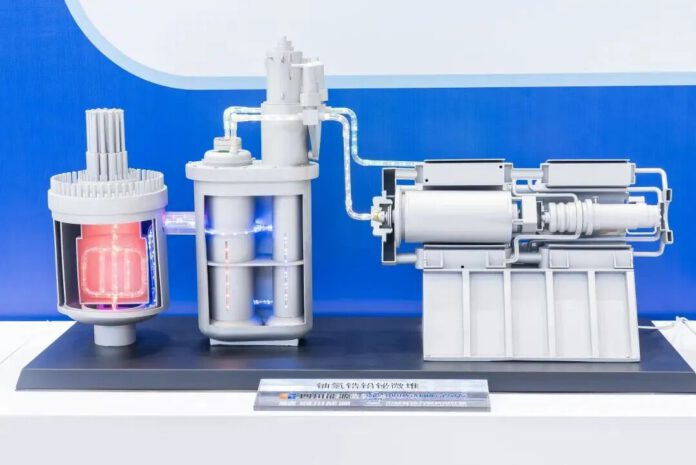
How small can a nuclear reactor be? China is exploring a new answer: a reactor core roughly the size of a household refrigerator, with the entire power generation system compact enough to fit into just two or three shipping containers.
It can be transported by truck, aircraft, or ship and deployed in locations such as remote islands, offshore platforms, and isolated mining areas. This is the concept behind China’s advanced microreactor technology.
On October 20, 2026, Sichuan Energy Nuclear Industry Co., Ltd. was officially inaugurated. The company was jointly established by the Nuclear Power Institute of China (NPIC) and Sichuan Energy Development Group, with a core focus on the research, development, and industrialization of advanced microreactors. Its establishment marks an important step in China’s transition from laboratory research toward engineering development and industrial application, opening up a new direction for the country’s nuclear energy sector.
A microreactor is not simply a scaled-down version of a conventional nuclear power plant. Rather, it is an advanced nuclear energy system designed from the outset around compactness, modularity, and inherent safety. Its electrical output typically does not exceed 10 megawatts (MW), more than two orders of magnitude lower than that of a conventional nuclear power unit rated at one million kilowatts.
With a lower power output, the amount of nuclear fuel required, the heat that must be removed, and the total quantity of fission products that must be contained are all reduced. Consequently, the number and size of supporting systems and equipment can also be significantly minimized. The purpose of microreactors is not to replace large nuclear power plants, but to provide a stable and reliable energy supply to locations where conventional power grids are difficult or expensive to extend and diesel generation is costly.
The key to achieving such a high degree of integration lies in an innovative technological approach combining uranium-zirconium hydride fuel with lead-bismuth coolant. This technology route was first proposed globally by the Nuclear Power Institute of China. Its central innovation is the integration of nuclear fuel and neutron moderation, together with a redesigned cooling system.
In conventional reactors, nuclear fuel and neutron moderators are generally arranged as separate components. Uranium-zirconium hydride fuel, however, incorporates hydrogen directly into the fuel, allowing hydrogen to serve as a neutron moderator. By integrating the fuel and moderator into a single material, the design reduces the space required within the reactor core and creates favorable conditions for further miniaturization.
The cooling system uses liquid lead-bismuth alloy. Unlike conventional pressurized water reactors, which rely on high-pressure water circulation to remove heat, lead-bismuth coolant can operate under atmospheric pressure. This eliminates the need for large and complex high-pressure systems, allowing for a more compact, integrated reactor design.
Miniaturization, however, does not mean compromising safety. On the contrary, as nuclear energy systems are potentially deployed closer to actual energy consumers, including islands, mining areas, and industrial parks, safety becomes an even more critical design priority. China’s microreactor technology adopts a dual approach to inherent safety, combining fuel characteristics with reactor design to take advantage of natural physical feedback mechanisms rather than relying entirely on external control systems or human intervention.
One of the most important features is the prompt negative feedback effect of uranium-zirconium hydride fuel. When the reactor core experiences an abnormal increase in temperature, changes in the physical properties of hydrogen within the fuel help suppress the nuclear fission chain reaction, causing reactor power to decrease. Because hydrogen is incorporated directly into the fuel, this feedback process can occur extremely rapidly, providing the reactor with an automatic self-regulating mechanism.
Meanwhile, lead-bismuth coolant offers excellent thermal conductivity and heat removal capabilities. It also provides a degree of radiation shielding, further enhancing the overall safety of the system.
This inherent-safety-oriented design may also make it possible to simplify certain conventional nuclear safety facilities, reducing engineering complexity and operating and maintenance requirements. Combined with modular manufacturing, transportation, and installation, the proposed technology aims to shorten the overall construction period to approximately 30 months.
This compares favorably with the construction timelines of conventional nuclear power plants, which typically take several years. Nevertheless, individual projects must still undergo equipment manufacturing, nuclear safety reviews, licensing procedures, and on-site construction. The establishment of an industrial platform does not mean that a demonstration project has already been completed or that commercial electricity generation has begun.
In terms of practical applications, one of the most promising roles for China’s microreactors is addressing energy supply challenges in areas that are difficult or uneconomical to serve through conventional infrastructure.
For offshore platforms and remote islands, laying submarine power cables can be extremely expensive, while long-term maintenance is also challenging. Diesel generation, meanwhile, faces difficulties related to fuel transportation, supply stability, and operating costs.
Microreactors could be transported to designated locations by ship and provide a continuous and reliable electricity supply. According to proposed technical specifications, a 2 MW microreactor could have a design service life of more than 40 years and operate continuously for five to ten years on a single fuel load.
When integrated with seawater desalination facilities, it could also provide both electricity and fresh water, helping address the energy and water supply challenges faced by remote offshore communities.
On land, microreactors could also serve high-altitude regions, deserts, remote forests, mining areas, and large industrial parks, where extending and maintaining conventional power grids can be prohibitively expensive. They could function as independent energy units, supplying stable baseload electricity to local microgrids while complementing renewable sources such as wind and solar power.
In addition, the heat generated by nuclear reactions could be used for industrial steam production, seawater desalination, and hydrogen production, enabling the comprehensive utilization of both electricity and thermal energy. As artificial intelligence and data center industries continue to expand, demand for reliable, round-the-clock electricity is increasing. Microreactors may therefore become a potential supplementary energy solution for distributed power systems.
In fact, China’s technological experience in microreactors predates the establishment of the new industrial platform by several decades. As early as the 1980s and 1990s, Chinese research institutions and engineering teams had already begun developing and applying microreactor technologies. China’s earlier exports of miniature neutron source reactors became an important example of the country’s international cooperation in peaceful nuclear technology.
It is important to distinguish these earlier miniature neutron source reactors from the advanced electricity-generating microreactors currently under development. Miniature neutron source reactors are primarily designed to provide neutron sources for scientific research and experimental applications, rather than to generate electricity. They are therefore fundamentally different from the uranium-zirconium hydride-fueled, lead-bismuth-cooled power microreactors now being developed.
China also played an important role in international efforts to convert research reactors from highly enriched uranium (HEU) to low-enriched uranium (LEU) fuel. In the past, some miniature neutron source reactors used HEU fuel, raising concerns about nuclear material proliferation.
In response to initiatives by the International Atomic Energy Agency (IAEA) to reduce the civilian use of HEU, Chinese research teams began studying the feasibility of replacing HEU with LEU in 2006. Without changing the original reactor core dimensions, they redesigned the fuel assemblies and carried out extensive physical calculations, structural analyses, and experimental verification.
In March 2016, China successfully completed the LEU conversion of its prototype microreactor, establishing valuable technical experience across the entire process, from design to engineering implementation.
China subsequently worked with Ghana, the United States, and the IAEA on the conversion of Ghana’s miniature neutron source reactor. Originally designed and built by China in 1995, the Ghana research reactor successfully resumed full-power operation following its conversion to LEU fuel in 2017. The original HEU fuel, which had been used for 22 years, was subsequently returned to China. In 2018, the LEU conversion project for Nigeria’s research reactor was also successfully completed.
These projects not only contributed to reducing the civilian use of HEU, but also enabled China to accumulate extensive experience in reactor design, fuel manufacturing, fuel handling, operational testing, and international cooperation. This experience has provided a valuable foundation for the country’s subsequent development of advanced microreactor technology.
Globally, microreactors are becoming an increasingly important area of competition in advanced nuclear energy technology. The United States, Russia, Canada, and other countries are advancing the development of small modular reactors (SMRs) and microreactors, with potential applications expanding into military installations, data centers, remote mining operations, and industrial facilities.
The IAEA has identified a large number of small modular reactor designs, while several countries have incorporated small-scale nuclear energy into their national energy strategies.
At the same time, significant challenges remain before microreactors can be deployed on a large scale. These include the safe transportation of nuclear fuel, remote operational monitoring, cybersecurity, nuclear material protection, and the management and disposal of spent nuclear fuel.
For China, the key challenge is no longer limited to achieving individual technological breakthroughs. It is now about transforming existing research achievements into nuclear energy products that can be manufactured reliably, operated safely, and commercialized competitively.
The establishment of Sichuan Energy Nuclear Industry Co., Ltd. represents an important step in this transition. The company aims to develop an integrated industrial ecosystem covering microreactor research and development, project incubation, and industrial investment. Through cooperation among research institutions, equipment manufacturers, local energy companies, and private investors, it seeks to connect technological innovation with equipment manufacturing and practical engineering applications.
From the independent development and international deployment of miniature neutron source reactors, to participation in global LEU conversion initiatives, and now to the industrialization of uranium-zirconium hydride-fueled, lead-bismuth-cooled power microreactors, China’s microreactor technology is undergoing a sustained evolution from scientific research and engineering validation to industrial development.
Source: stdaily, xinhua, itsdw, smzdm, people, sohu