


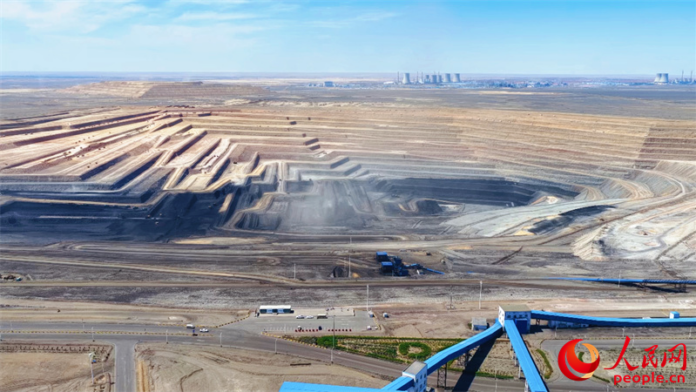
Deep beneath the vast Gobi Desert in northwestern China lies one of the world’s largest untapped coal resources: the Zhundong Coalfield in Xinjiang. Stretching approximately 220 kilometers from east to west and 60 kilometers from north to south, the coalfield holds an estimated 390 billion tons of coal, accounting for roughly 7% of China’s total projected coal resources. Based on China’s recent annual coal consumption, its reserves theoretically represent decades of national supply.
With such an enormous resource underground, one question naturally arises: Why did it take more than four decades for this coalfield to begin unlocking its full potential? The answer reveals a much larger story about China’s energy development, technological innovation, industrial transformation, and national energy security.
The story began in 1982, when geological exploration teams first drilled into the remote wilderness of eastern Xinjiang. At the time, the area was little more than an uninhabited stretch of desert. Roads, electricity, transportation infrastructure, and basic living facilities were largely absent. Although early exploration revealed significant coal deposits, discovering resources was only the beginning. Large-scale development required substantial investment, advanced mining technology, reliable transportation networks, and sufficient demand from the industrial economy.
During the 1980s and 1990s, China did not yet have all the necessary conditions to develop such a remote and enormous coalfield economically. As a result, Zhundong remained largely dormant for years.The turning point came in the early 2000s, when Xinjiang began accelerating its resource development strategy. In 2004, major companies entered the region, investing heavily in exploration and infrastructure. By 2005, further exploration had confirmed the coalfield’s extraordinary potential. In 2012, the State Council approved the establishment of the Xinjiang Zhundong Economic and Technological Development Zone, giving the region a new platform for large-scale industrial development.
Yet even with its enormous reserves, Zhundong faced an unexpected obstacle: its coal was difficult to use. The coalfield has exceptionally thick seams, averaging approximately 43 meters, with some exceeding 80 meters. Much of the resource is suitable for open-pit mining, which is generally more efficient and less expensive than conventional underground extraction.
However, Zhundong coal contains relatively high levels of alkali metals, particularly sodium and potassium. During combustion, these elements can cause severe slagging, deposits on boiler surfaces, and high-temperature corrosion. They also create significant difficulties for coal gasification, a key process in producing chemical feedstocks and synthetic natural gas.
For years, the industry faced two major limitations: high-alkali coal could not be burned reliably on its own, and its potential for advanced chemical processing remained largely untapped.
In other words, China possessed an enormous coal resource but lacked the technology to fully exploit it. One of the companies that helped change this situation was Xinjiang Yihua Chemical. After years of research, its technical team discovered that carefully blending bentonite into the coal ash could raise its melting temperature and prevent slag formation and deposits inside industrial equipment. This breakthrough enabled Zhundong’s high-alkali coal to be burned stably at 100% concentration.
The company then pushed further into coal chemical processing. In 2018, it collaborated with the Chinese Academy of Sciences to develop a new circulating fluidized-bed gasification technology, opening the door to more sophisticated uses of the region’s coal.
Subsequent advances in coal-ash regulation technology further improved industrial efficiency. In one major development, daily coal-processing capacity per gasification furnace increased from 750 tons to 4,000 tons.
What had once been considered a major disadvantage was gradually transformed into an opportunity for technological innovation. But the transformation of Zhundong goes beyond solving the chemistry of its coal. The way it is mined is changing just as dramatically.
Traditionally, open-pit coal mines relied on large fleets of diesel-powered trucks operated by human drivers. These operations required significant labor, consumed substantial amounts of fuel, and presented considerable safety and management challenges.
Today, autonomous mining trucks are reshaping the industry. At several major mining sites in Zhundong, driverless vehicles follow high-definition digital maps and operate according to intelligent dispatching systems. They can independently carry out loading, transportation, and dumping operations, while workers monitor the entire fleet remotely from centralized control rooms.
Some mining companies are also introducing pure-electric and methanol-powered range-extended trucks, combining cleaner energy technologies with autonomous driving.
According to reported figures, 13 open-pit mines in the development zone have deployed approximately 1,400 autonomous mining trucks. This marks a significant transition: Zhundong is no longer simply extracting coal. It is building a technologically advanced mining ecosystem that combines automation, clean energy, and intelligent equipment manufacturing.
The next stage of its development is even more ambitious. For decades, coal was primarily treated as a fuel to be extracted and transported elsewhere. Zhundong is now attempting to transform it into a much wider range of industrial products. Its emerging industrial system integrates coal mining, electricity generation, modern coal chemicals, advanced materials, and new energy technologies.
Some coal is burned in local power plants, with electricity transmitted thousands of kilometers east through the ±1,100-kilovolt Zhundong–Wannan ultra-high-voltage transmission project, connecting Xinjiang’s energy base with major electricity-consuming regions in eastern China. Other portions are processed into chemical products such as olefins, fertilizers, and industrial materials.
Perhaps most strategically important is the development of coal-to-natural-gas technology.
China’s National Development and Reform Commission and National Energy Administration have identified Xinjiang Zhundong as an important location for strategic coal-to-oil and coal-to-gas development.
Several large-scale coal-to-gas projects are now being advanced by major Chinese energy companies. Current plans envisage coal-to-natural-gas production capacity reaching 14 billion cubic meters annually by 2030.
This technology offers another way to use domestic coal resources: converting solid fuel into synthetic natural gas that can be transported through pipeline infrastructure and supplied to industrial users and households. Its strategic significance becomes particularly clear when viewed against the background of international energy uncertainty.
Global oil and gas markets remain vulnerable to geopolitical tensions, shipping disruptions, and supply-chain risks. The Strait of Hormuz, for example, is a critical maritime passage through which a substantial share of internationally traded oil and gas flows. Although coal and petroleum are not interchangeable, developing domestic coal-to-gas capabilities provides China with an additional source of energy supply that does not depend on importing natural gas through international shipping routes.
This is why Zhundong is sometimes described as China’s own “New Middle East.” The comparison is not simply about the size of its underground reserves. It reflects the strategic importance of having a vast domestic energy resource that can be developed, processed, and transported largely within China’s own territory.
Nevertheless, enormous reserves do not automatically guarantee sustainable development.
Zhundong is located in an arid desert environment where water resources are scarce and ecological conditions are fragile. Coal mining and chemical processing require substantial amounts of water and energy. Managing pollution, reducing carbon emissions, and improving resource efficiency will therefore remain essential challenges.
The region must also overcome its geographical disadvantages. Its distance from China’s major industrial and consumer markets means that railways, electricity transmission lines, and natural gas pipelines require substantial investment. Ultimately, Zhundong’s future competitiveness will depend not simply on how much coal it possesses, but on how effectively it combines technological innovation, industrial development, infrastructure investment, and environmental protection.
From the first exploratory drilling in 1982 to today’s autonomous mining fleets, from coal that was once difficult to burn to advanced gasification technologies, and from exporting raw coal to producing electricity, natural gas, and industrial materials, Zhundong has undergone a remarkable transformation over more than four decades. Its estimated 390 billion tons of coal represent an extraordinary resource base. But the real value of this coalfield lies in what China can create from it.
Source: stdaily, sohu, china daily, people