


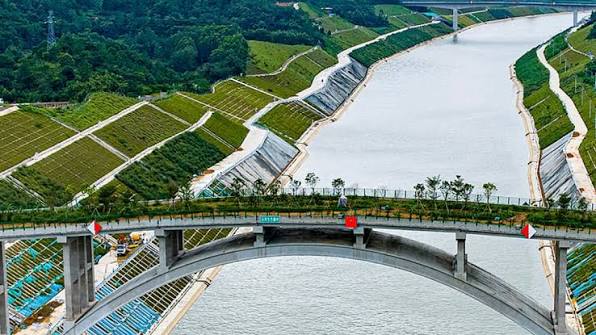
On September 16, after four years of construction and an investment of approximately RMB 72.7 billion, the Pinglu Canal officially opened to navigation. Stretching 134.2 kilometers, the canal begins at the mouth of the Ping Tang River in Hengzhou, Nanning, Guangxi, passes through Luwu in Lingshan County, Qinzhou, and follows the Qinjiang River to the Beibu Gulf. It is the first inland waterway canal since the founding of the People’s Republic of China to be centrally planned and developed at the national level to connect inland waterways directly with the sea.
Built to Class I inland waterway standards, the canal can accommodate vessels of up to 5,000 tonnes. Its significance extends beyond the opening of a new shipping route: it has the potential to reshape logistics networks, industrial development and regional openness across southwestern China, while establishing new approaches to modern canal engineering and maritime safety management.
On September 16, the vessel Guangxing 798 departed from Berth 10 at the Liujing operating area of Nanning Port, beginning its maiden voyage through the Pinglu Canal to Yangpu Port in Hainan. The departure marked a major step in transforming Nanning Port from a traditional inland port into a departure point and distribution hub for river–sea intermodal transport. It also created a new southern maritime outlet for cargo originating in Guangxi and neighboring provinces and municipalities, including Yunnan, Guizhou, Sichuan and Chongqing.
For years, cargo from southwestern China heading south toward overseas markets has relied primarily on railways, highways and the Xijiang River shipping network, often passing through ports in Guangdong. The Pinglu Canal offers an alternative route, allowing vessels to travel from the Xijiang River through the canal to Qinzhou Port and the Beibu Gulf. This is expected to shorten shipping distances and improve access to Southeast Asia and other international markets.
According to shipping and logistics companies operating in the region, the journey from Nanning to Hai Phong, Vietnam, via the canal could take approximately one day, while transport to Ho Chi Minh City could take around three days. Shipping to other Southeast Asian destinations could generally be completed within a week. For businesses in Sichuan, combining rail transport with inland waterway shipping has also demonstrated the potential to reduce container transportation costs compared with previous rail-based routes.
The canal’s economic value is increasingly extending beyond transportation to industrial development. Businesses associated with Nanning Port have noted that expectations of lower logistics costs and easier access to overseas markets have become important considerations in investment decisions. Major projects, including BYD’s battery production facilities and Sun Paper’s integrated forestry, pulp and paper operations, illustrate how the canal’s development can encourage industrial investment along its route.
As the port’s cargo hinterland expands beyond its immediate surroundings to include mineral resources from Yunnan and Guizhou and automotive components from the Chengdu–Chongqing region, a more diversified cargo base is expected to emerge. Products such as paper, new-energy equipment, battery storage units and industrial components could benefit from improved connections between inland production centers, coastal ports and international markets.
Yunnan is also preparing to capitalize on the new route. The construction of Funing Port in Wenshan has progressed alongside the Pinglu Canal project, while Yunnan is strengthening coordination with Guangxi and Guangdong on navigation management, emergency response, vessel standardization, port operations and service standards. In the longer term, closer integration of railways, inland waterways and maritime shipping could give southwestern China more flexible transport options and strengthen connections between regional industries and global supply chains.
However, the opening of the canal is only the beginning. Its long-term economic impact will depend on whether cargo volumes can grow sustainably, industries can upgrade along the route, and port and shipping services can develop into an integrated network. For businesses, choosing a transport route involves more than comparing freight rates. The number of cargo transfers, delivery schedules, risks of damage, customs procedures and reliability during extreme weather all influence logistics decisions. The canal must therefore demonstrate its practical advantages in transfer efficiency, lock transit times and container handling before companies can fully transition from established transport arrangements.
Future development will require not only improvements to port facilities and railway connections, including the railway-port facilities at Liujing, but also a shift in the role of shipping and logistics companies. Rather than simply providing berths and transportation, they will need to offer end-to-end supply chain services covering procurement, warehousing, transportation, delivery and overseas distribution.
Integrated multimodal transport documentation, through-freight pricing, cargo tracking, bonded warehousing and supply chain finance could help reduce overall logistics costs, lower inventory requirements and improve delivery reliability. Establishing stable and replicable cargo categories and shipping routes will be more important in the early stages than pursuing short-term growth in throughput alone.
As an artificial waterway, the Pinglu Canal also offers engineering advantages over natural rivers. Its curves, channel dimensions and bridge clearances have been designed around the requirements of vessels carrying up to 5,000 tonnes. With hundreds of advanced technical indicators supporting its operation, the canal represents more than a conventional excavation project. It embodies an approach to modern navigation that combines purpose-built infrastructure with intelligent and data-driven management, making vessel movements more predictable and controllable.
Alongside construction, the development of a dedicated regulatory framework has become another major achievement. Because the Pinglu Canal connects inland waterways directly with the sea, it must accommodate two distinct navigation systems. Differences between inland and maritime rules have historically created uncertainties regarding jurisdiction, vessel eligibility and collision avoidance at river–sea boundaries. To address these challenges, the Guangxi Maritime Safety Administration led the drafting of the Regulations on Navigation Safety Management of the Pinglu Canal, establishing a dedicated framework for safe navigation.
The regulations designate the Qinjiang Bridge on the G75 Lanzhou–Haikou Expressway as the boundary between inland waters to the north and maritime waters to the south. They also establish a designated “equivalent Class A navigation zone” in specific waters of Qinzhou Bay, allowing eligible inland vessels to enter the designated maritime area once the required certification endorsements have been obtained. Across the canal, a unified traffic-separation system and common navigation rules are intended to reduce conflicting interpretations between inland and seagoing vessels.
Another important innovation is the conversion of general safety principles into measurable operating requirements. The regulations specify navigation speeds, minimum safety distances, under-keel clearance, bridge clearance and thresholds for suspending navigation during adverse weather. They also prohibit several high-risk maneuvers. By replacing vague instructions with quantifiable standards, the framework seeks to make safety decisions more consistent, transparent and enforceable.
From the completion of the physical waterway to the establishment of a dedicated regulatory system, the Pinglu Canal is creating more than a new maritime corridor for southwestern China. It is building a foundation for closer coordination among infrastructure, industrial development, logistics services and navigation governance. As operations mature, cargo flows stabilize and industries cluster along the route, the canal has the potential to become a vital link between China’s southwestern hinterland and international markets, providing fresh momentum for the development of the New International Land–Sea Trade Corridor and more balanced regional growth.
Source: 21jingji, CGTN, xinhua, cctv, people