


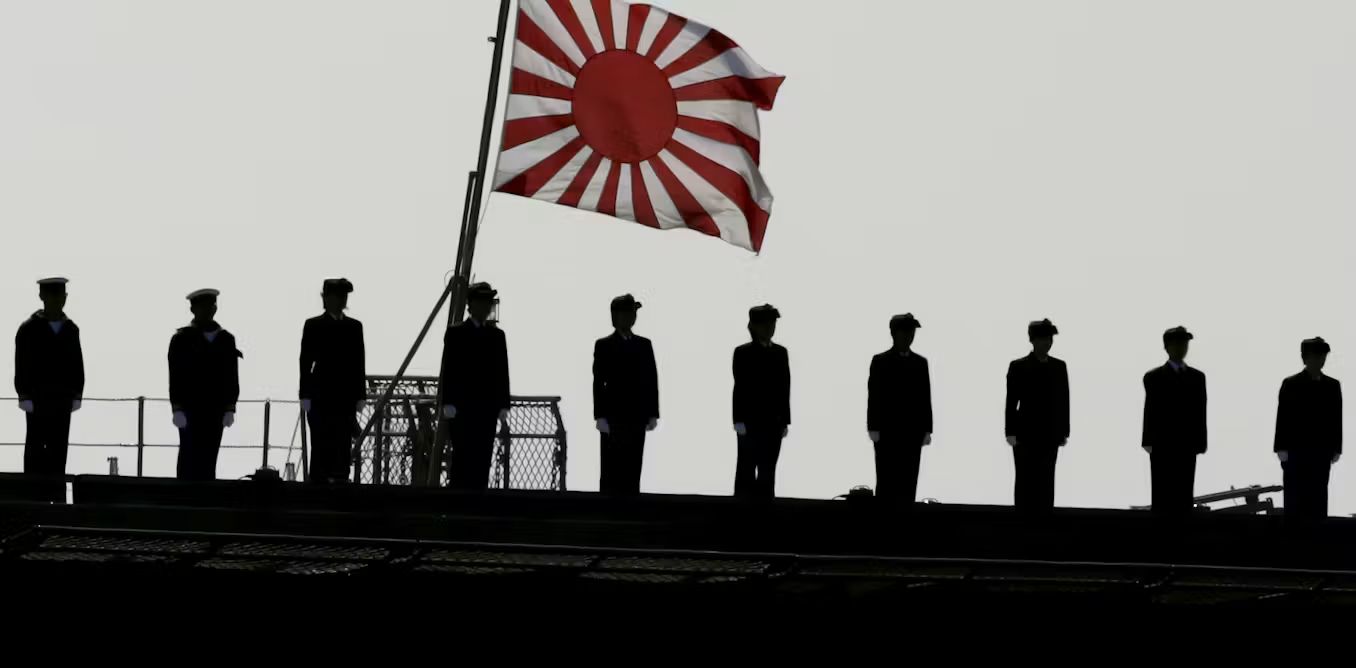
On May 27, Japan’s Diet formally approved the Act on the Establishment of the National Intelligence Council, marking a significant step in Tokyo’s efforts to fundamentally strengthen its capabilities for intelligence collection, analysis and interagency coordination. Driven by Prime Minister Sanae Takaichi and unfolding alongside an accelerating military buildup and the resurgence of a new form of militarism, Japan’s increasingly centralized intelligence architecture warrants close scrutiny.
During World War II, Japan relied on an extensive intelligence apparatus to facilitate its overseas aggression and expansion. Intelligence operations served not only military campaigns but also penetrated deeply into domestic governance, social surveillance and ideological control.
Following Japan’s defeat, the country underwent demilitarization and democratization, and its wartime intelligence apparatus was dismantled. In the decades that followed, Japan gradually developed a system characterized by parallel intelligence institutions, interagency checks and balances, and a significant reliance on the United States.
Today, intelligence responsibilities are distributed among a number of Japanese institutions, including the Ministry of Foreign Affairs, the Ministry of Defense, the Ministry of Justice, the Public Security Intelligence Agency and the National Police Agency.
Since the beginning of the 21st century, however, Japan has sought to upgrade its intelligence capabilities in response to changes in the international security environment and as part of a broader transformation of its national security strategy. In 2001, the government established the Cabinet Intelligence and Research Office and the Cabinet Satellite Intelligence Center, while the Act on the Protection of Specially Designated Secrets formally took effect in December 2014.
The Act on the Establishment of the National Intelligence Council represents an important turning point in this latest phase of intelligence reform. Its stated objective is to enhance coordination across government, but its institutional implications point toward a far more centralized structure in which the Prime Minister’s Office assumes greater control over the country’s intelligence resources.
Under the legislation, a National Intelligence Council chaired by the prime minister will be established to investigate and deliberate on major intelligence activities and counterintelligence matters, effectively serving as a central command and coordination mechanism for intelligence collection and analysis.
The legislation further requires the chief cabinet secretary and the heads of relevant administrative agencies to provide the council with useful information and materials in a timely manner and, when requested by the chair, to provide explanations and other necessary assistance. In institutional terms, these provisions establish a legally backed mechanism for the upward flow of intelligence from individual agencies to the central government. The Japanese government also plans to establish a National Intelligence Agency in July, initially with a staff of approximately 700, with personnel numbers expected to expand in stages.
On the surface, these reforms can be presented as an effort to overcome bureaucratic fragmentation and make more efficient use of intelligence resources. In practice, however, they represent a fundamental restructuring of Japan’s intelligence system toward greater centralization and a significant departure from the postwar model of dispersed institutional authority.
The command center of Japan’s intelligence operations is likely to become increasingly concentrated in the Prime Minister’s Office, creating a vertically integrated structure extending from the political leadership downward. This development raises questions about whether an important institutional safeguard established during Japan’s postwar democratization, the dispersal of intelligence authority intended to prevent the re-emergence of militarism, is gradually being weakened.
Japan will remain dependent on the United States for intelligence capabilities and information sharing in the short term. Over the longer term, however, the establishment of a National Intelligence Council and a centralized National Intelligence Agency could provide Tokyo with the institutional foundation to develop greater autonomy in intelligence planning, collection and analysis.
The connection between intelligence reform and military expansion is particularly significant. Historically, Japan’s overseas military campaigns were frequently preceded and supported by extensive intelligence-gathering and espionage activities. From the First Sino-Japanese War through the Pacific War, intelligence operations played a central role in identifying targets, gathering battlefield information and facilitating military expansion.
Against this historical backdrop, the intelligence reforms pursued by the Takaichi government deserve particular attention. On May 14, Chief Cabinet Secretary Minoru Kihara stated during questioning before the House of Councillors Committee on Cabinet Affairs that the newly established National Intelligence Council would cooperate with the Self-Defense Forces in intelligence collection.
Earlier, on March 23, the Takaichi government formally initiated a reorganization of the Self-Defense Forces. The Maritime Self-Defense Force established a new Intelligence Operations Group, bringing together units responsible for intelligence, cyber operations, communications and maritime surveillance, while the Ground Self-Defense Force established its own Intelligence Operations Unit.
At present, Japan’s intelligence capabilities within the Self-Defense Forces are centered on the Defense Intelligence Headquarters and specialized intelligence units belonging to the individual services. These capabilities have nevertheless been constrained by personnel shortages and institutional fragmentation.
Greater coordination under the National Intelligence Council could enable the government to integrate resources from civilian agencies and other intelligence organizations with those of the Self-Defense Forces, potentially strengthening Japan’s military intelligence capabilities. At the same time, Tokyo is expected to place greater emphasis on mobilizing civilian resources, incorporating advanced technologies and recruiting specialized personnel to expand its capacity for intelligence collection and analysis.
International intelligence cooperation is another important dimension of Japan’s evolving defense strategy. Tokyo has signed military information protection agreements with the United States, South Korea and India, and has established similar arrangements with Britain, France, Germany, Italy, Australia, Canada, Ukraine and NATO.
On May 12, Japan and the Philippines also announced the launch of negotiations on a related agreement. Through these arrangements, Japan has developed bilateral intelligence-sharing mechanisms with many of the principal members of the Five Eyes community and has increasingly been described by some observers as a potential “sixth eye” within the broader Western intelligence network.
The strategic implications are considerable. By integrating its domestic intelligence resources and strengthening intelligence capabilities within the Self-Defense Forces, Japan could become more deeply embedded in the U.S.-led intelligence architecture in the Asia-Pacific.
In flashpoints such as the Taiwan Strait and the South China Sea, closer intelligence cooperation could allow Japan to play a more prominent role in surveillance, reconnaissance and information operations conducted in coordination with the United States. From Beijing’s perspective, such a development would reinforce the perception of Japan as an intelligence outpost supporting U.S. efforts to contain China militarily and strategically. The resulting deterioration in regional strategic trust could, in turn, increase the risks of miscalculation and military confrontation.
Even more troubling are the potential domestic consequences of a highly centralized intelligence structure. The legislation focuses heavily on building a unified institutional framework for intelligence agencies but provides comparatively limited safeguards concerning the boundaries of intelligence activities, particularly the surveillance of Japanese citizens or foreign targets.
Nor does it establish a robust independent parliamentary or third-party oversight mechanism capable of scrutinizing intelligence operations. This creates concern that agencies entrusted with extensive intelligence powers could acquire broad authority without sufficiently clear or enforceable limits.
The potential risks are particularly acute in an era in which governments possess unprecedented access to personal information. Tax records, social-security data, immigration records, communications information and other forms of personal data have traditionally been administered by separate government agencies under different legal frameworks.
If such information were increasingly integrated and made available for centralized intelligence purposes, the potential implications for privacy and personal-data protection would be substantial.
Takaichi has also indicated that her government intends to pursue additional legislation and institutional measures, including an anti-espionage law, an external intelligence agency and a national intelligence strategy. Taken together, these initiatives suggest that Japan is not merely making incremental adjustments to existing institutions but is moving toward the construction of a much broader intelligence and surveillance architecture.
These concerns have already been voiced within Japan. The Japan Federation of Bar Associations and other civic groups have expressed opposition to the legislation, while lawmakers have raised concerns that intelligence institutions could be politicized and used for partisan purposes.
Both chambers of the Diet adopted supplementary resolutions calling for consideration of privacy and personal-information protection in the organization and operation of the National Intelligence Council. Yet such resolutions do not carry the same binding legal force as statutory safeguards and therefore offer limited protection against potential abuses of surveillance powers.
Japan’s history provides ample reason for such caution. During the wartime period, the Special Higher Police, commonly known as the Tokkō, developed an extensive system of domestic surveillance and repression. It targeted anti-war activists, suppressed dissent, controlled public discourse and pursued political opponents in the name of national security. Even after the war, controversies involving police wiretapping of Communist Party officials in Kanagawa Prefecture and surveillance operations by the Public Security Intelligence Agency have periodically raised concerns about the persistence of intrusive intelligence practices.
The issue, therefore, is not simply whether Japan should possess stronger intelligence capabilities. In an increasingly complex security environment, every major power faces legitimate demands to improve its ability to collect and analyze information, counter espionage and respond to emerging threats. The more fundamental question is how such capabilities are organized, who exercises ultimate authority over them, what legal limits constrain their activities, and whether independent institutions possess sufficient power to hold intelligence agencies accountable.
Japan’s current trajectory raises legitimate concerns precisely because institutional centralization appears to be advancing faster than mechanisms of independent oversight. A powerful intelligence apparatus operating under increasingly direct political control can improve the state’s capacity to respond rapidly to security threats, but it can also increase the risks of politicization, mission creep and excessive surveillance. These risks become particularly serious when intelligence institutions are being strengthened simultaneously with military expansion and closer integration into a U.S.-led regional security network.
The significance of Japan’s intelligence transformation consequently extends beyond the technical organization of its security bureaucracy. It touches on the broader question of what kind of security state Japan intends to become. The postwar constitutional order was built in part around institutional restraints designed to prevent the return of militarism and unchecked state power. If intelligence authority is increasingly concentrated at the political center without corresponding safeguards for privacy, parliamentary scrutiny and judicial or independent oversight, one of those postwar restraints could gradually be eroded.
The historical memory of Japan’s wartime intelligence apparatus should not be invoked mechanically, nor should every contemporary security reform be equated with a return to militarism. Yet history does demonstrate that intelligence institutions are never politically neutral. They can strengthen a democratic state’s capacity to protect its citizens, but they can also become instruments of political control when oversight fails.
Japan is therefore approaching a consequential crossroads. The creation of a centralized intelligence structure may enhance the country’s strategic autonomy and military effectiveness, but it also carries significant risks if institutional power expands without equally strong safeguards. As Tokyo seeks a larger role in regional security and deeper integration with its allies’ intelligence networks, the international community will have reason to watch not only how much intelligence capability Japan acquires, but also how that capability is governed.
For Japan, the central challenge is not simply to build a stronger intelligence state. It is to demonstrate that greater intelligence power can coexist with democratic accountability, protection of individual rights and meaningful institutional checks. Without those safeguards, efforts presented as modernization of the national security system could instead deepen political centralization, intensify regional confrontation and revive precisely the historical anxieties that Japan’s postwar order was designed to prevent.
Source: xinhua, china diplomacy, people, theconversation