


The United States is entering a new phase in its debate over open and closed artificial intelligence models. As Chinese AI companies continue to release open-weight models that approach the performance of leading proprietary systems, Washington and Silicon Valley are increasingly treating openness not simply as a question of technology policy, but as an issue of national competitiveness.
The shift is revealing. For years, leading American AI companies emphasized the risks associated with highly capable models, including misuse, intellectual-property concerns and the difficulty of controlling systems once their capabilities are widely distributed. Yet major technology and infrastructure companies are now making the case that excessive restrictions on open-weight models could undermine America’s position in the global AI market.
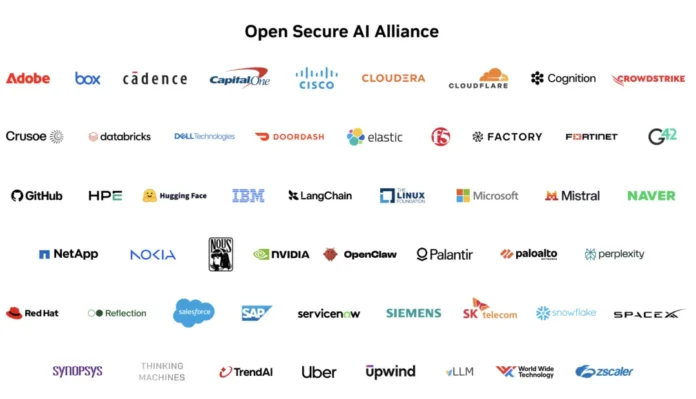
On July 24, Nvidia, Microsoft, Meta and other companies and organizations jointly issued a statement titled “Open Weights and American AI Leadership,” urging policymakers not to impose premature restrictions on open-weight models. Three days later, Nvidia joined Microsoft, IBM, the Linux Foundation and others in launching the Open Secure AI Alliance, extending the discussion from model weights to AI agents, security tools and cyber-defense technologies.
These initiatives should not be interpreted as a sudden embrace of traditional open-source ideals. Rather, they reflect a broader strategic adjustment: the United States increasingly recognizes that technological leadership depends not only on producing the world’s most capable models, but also on ensuring that its technologies become the foundation on which the rest of the world builds.
There is an important distinction between “open source” and “open weights.” In conventional open-source software, developers receive source code, dependencies and build instructions, allowing them to understand, modify and reproduce the software. AI models are fundamentally different. Their capabilities emerge from the interaction of architecture, training data, data-processing methods, training code, computing resources and model parameters.
Under the stricter definition promoted by the Open Source Initiative, merely releasing model weights does not constitute fully open-source AI. A genuinely open AI system would require sufficient access to code, data information and training processes to allow qualified researchers to build a substantially equivalent system. Many models marketed as “open” therefore fall more accurately into the category of open-weight systems.
Yet for businesses, the distinction does not eliminate the strategic value of openness. An open-weight model can be downloaded, deployed locally, fine-tuned, quantized and adapted to specific industries without requiring constant access to a proprietary API. It can therefore turn AI from a service controlled by a small number of companies into a component that can be integrated into a much wider range of organizations and industries.
This is particularly important for Nvidia. The company’s core business is not selling AI models. Its principal sources of revenue are GPUs, networking equipment, computing systems and software platforms. From this perspective, the proliferation of AI models is not necessarily a threat. It can be an opportunity.
Whether developers use models from OpenAI, Meta, Chinese companies or Nvidia itself, training, fine-tuning and inference require computing infrastructure. The more models are deployed, and the more widely AI applications spread, the greater the potential demand for Nvidia’s hardware and software ecosystem.
Nvidia’s strategy therefore illustrates a classic platform-economy principle: open the complementary products in order to strengthen the core platform. The company does not need to control every model. It can instead benefit by becoming the infrastructure on which competing models are trained and deployed.
The geopolitical dimension, however, is becoming equally important. Chinese AI companies have demonstrated that open models can spread rapidly across the global developer community. Models such as Qwen and DeepSeek have challenged the assumption that open systems must necessarily lag far behind the best proprietary models.
This changes the nature of the competition. If open models remain significantly weaker than proprietary systems, the debate is primarily about business models and product positioning. But once open models approach frontier performance, the competition moves beyond benchmark scores. Cost, deployment flexibility, fine-tuning, developer adoption, licensing, hardware compatibility and ecosystem effects become increasingly important. That is precisely where openness acquires strategic significance.
The United States’ AI policy has already recognized that global leadership cannot be measured solely by the performance of individual models. America’s AI strategy increasingly emphasizes the importance of technological ecosystems, international standards and global adoption. An open model can travel much further than a proprietary API. It can be downloaded, modified, distilled, translated and embedded into local systems. Developers can build tools around it, companies can adapt it to specific industries, and third countries can deploy it without depending entirely on an American service provider.
Once an open model becomes widely adopted, its influence can extend well beyond the model itself. Interfaces, evaluation methods, development tools, licenses and infrastructure may gradually become de facto standards.
This is why the American debate over openness is increasingly linked to competition with China. Washington has an interest in preventing Chinese open models from becoming the default foundation for developers and enterprises around the world. At the same time, American infrastructure companies have an interest in ensuring that the global expansion of AI continues to run through technologies, standards and computing platforms in which American firms remain dominant.
The result is a distinctly dual-track strategy. Proprietary frontier models remain essential. They allow companies to preserve technological advantages, protect intellectual property, maintain high-value commercial services and exercise centralized control over safety measures. Open-weight models serve a different purpose: they expand the developer base, lower deployment costs, support local and sovereign AI systems, encourage experimentation and help establish technical standards.
The two models are therefore not necessarily competitors. They can function as complementary components of a broader industrial strategy: frontier control at the top and broad diffusion underneath. This represents a broader redefinition of technological leadership. In the past, technological power was largely associated with possessing capabilities that others did not have. Increasingly, leadership also means persuading others to build on your technology.
The first model of leadership depends on scarcity. The second depends on adoption and ecosystem effects. A country that can achieve both may enjoy a more durable technological advantage than one that excels at only one.
The implications for China are equally significant. The next stage of competition will not be determined simply by which country produces the strongest model. It will also depend on whose models are easier to obtain, modify and deploy; whose licenses are more attractive; whose developer communities grow faster; whose models work across different chips and cloud platforms; and whose safety and evaluation standards gain international credibility.
This means that open AI should not be understood merely as a mechanism for sharing technology. It is increasingly becoming an instrument of technological diffusion, industrial organization and geopolitical competition.
At the same time, openness should not be confused with safety. Once model weights are released, they can be difficult to recall. Users may remove safeguards, conduct malicious fine-tuning or connect models to systems capable of causing real-world harm. Proprietary systems, meanwhile, are not inherently safe. They can also be abused, attacked or deployed without sufficient transparency, while excessive dependence on a small number of providers can create its own systemic vulnerabilities.
The policy debate should therefore move beyond the simplistic choice between “open” and “closed.” AI governance should instead take a layered approach that considers at least four factors: the capabilities of the model, the degree of information being released, the environment in which the model is deployed, and the distribution of responsibility among developers, distributors and users.
A highly capable model connected to the internet, financial systems or physical infrastructure presents a very different risk from the same model used for offline research. Likewise, releasing weights alone creates a different set of risks and benefits from releasing training data, code and complete development pipelines.
The central question, therefore, is not whether AI should be open or closed. It is who will control the technological frontier, who will shape the process of global diffusion, and whose standards will become embedded in the infrastructure of the AI economy.
America’s current embrace of open weights should be understood in this broader context. It does not represent a retreat from proprietary AI. Nor does it mean that American companies have abandoned commercial control. Rather, the United States appears increasingly determined to compete on both fronts: preserving its lead in frontier proprietary systems while using open models to expand its developer ecosystem, infrastructure footprint and influence over global standards.
The emerging contest between the United States and China will therefore be fought not only in laboratories and benchmark rankings. It will also be fought in developer communities, cloud platforms, chip architectures, licensing systems, safety standards and enterprise deployments.
The ultimate winner may not be the country with the single most powerful AI model. It may be the country whose models, tools, infrastructure and rules become the default foundation on which the rest of the world chooses to build.
Source: IPP, guancha