


Aviation is one of the hardest sectors to decarbonize. Unlike road transport, long-haul aviation cannot readily transition to battery-powered systems at scale, leaving conventional jet fuel essential for decades to come. Sustainable aviation fuel (SAF) is therefore a critical pathway toward reducing aviation emissions. When produced and certified to the required standards, SAF can be blended with conventional jet fuel and used in existing aircraft without fundamental engine modifications. Depending on its feedstock and production pathway, SAF can significantly reduce lifecycle greenhouse gas emissions.
For China, SAF is not merely an environmental issue; it is also a question of energy security, industrial upgrading and international competitiveness. With annual aviation fuel consumption estimated at around 30 million tonnes, even a modest blending rate could generate substantial demand. International aviation climate initiatives and blending requirements in markets such as the European Union are accelerating the transition. China has launched SAF application trials and is expanding its production capacity, but large-scale commercialization remains constrained by high costs, limited feedstock availability and the need for reliable supply chains.
Today, commercial SAF production relies heavily on biological feedstocks such as waste oils and fats, processed through technologies including hydrotreatment. Yet these feedstocks are limited and cannot necessarily meet future aviation demand on their own. This is why routes that combine carbon dioxide with green hydrogen are attracting attention. By using captured CO₂ and hydrogen produced with renewable energy, synthetic aviation fuel could expand beyond the constraints of conventional biomass feedstocks. Its climate benefits, however, depend on the carbon intensity of hydrogen and electricity, process energy consumption and lifecycle emissions.
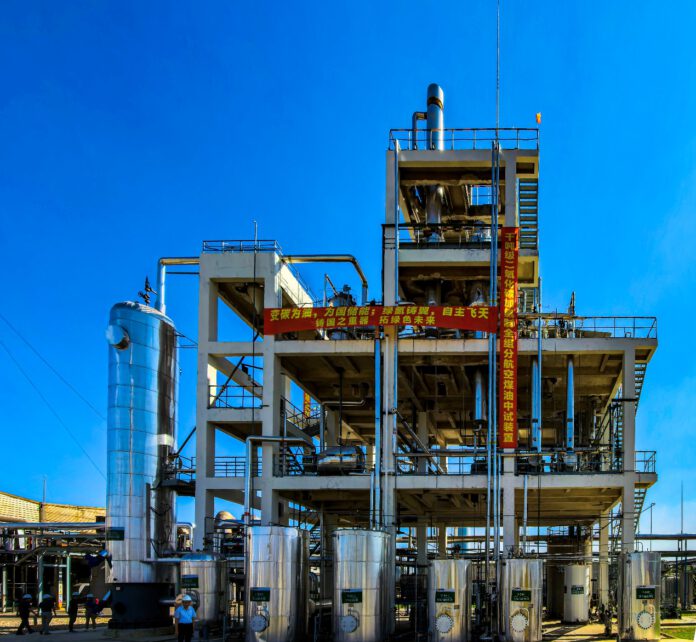
China has recently made an important advance in this field. A thousand-tonne-scale CO₂-to-SAF technology, led by a team from Tsinghua University and developed with industry partners, passed a scientific and technological achievement evaluation organized by the China Petroleum and Chemical Industry Federation.
The researchers developed a bifunctional catalyst combining nanoscale spinel and molecular sieves, coordinating CO₂ activation and carbon–carbon coupling before subsequent hydrogenation produces jet-fuel components. They also addressed key engineering challenges involving high-pressure fluidized-bed reactors, moving the process beyond laboratory chemistry toward industrial demonstration.
The breakthrough matters because it addresses two central questions for SAF: whether the carbon feedstock can be expanded and whether the conversion process can operate efficiently. According to the project data, the pilot plant in Meishan, Sichuan, has accumulated more than 2,000 operating hours. During a continuous 72-hour assessment, it ran steadily at full load, achieving a total CO₂ conversion rate of 97.37% and a selectivity of 92.37% for jet-fuel components.
The resulting fuel reportedly met all indicators under China’s GB 6537 – 2025 No. 3 Jet Fuel Standard. The evaluation committee judged the overall technology to be internationally advanced and suitable for the design and construction of a ten-thousand-tonne-scale industrial demonstration.
Economics will ultimately determine whether technology can transform the market. Under the project’s stated assumptions for green hydrogen, CO₂, electricity and steam prices, estimated production costs are over 1000 euros per tonne, with a projected static payback period of around 2.5 years for a plant producing 100,000 tonnes annually. These are scenario-based estimates, not guaranteed commercial outcomes. Green hydrogen prices, renewable electricity availability, capital expenditure, energy consumption and future SAF prices will all shape actual profitability.
This breakthrough does not mean aviation’s decarbonization challenge has been solved. Rather, it offers China another potential way to expand SAF supply. If subsequent industrial demonstrations confirm long-term operational stability, competitive costs and genuine lifecycle emissions reductions, CO₂-to-SAF technology could complement biomass-based pathways.
Its broader significance lies not simply in converting a greenhouse gas into aviation fuel, but in linking carbon capture, green hydrogen, renewable energy and aviation into an integrated industrial ecosystem. Ultimately, its success will depend not only on conversion rates above 97%, but on whether it can deliver certified aviation fuel that is affordable, scalable and demonstrably lower-carbon.
Source: global net zero, tsinghua, paper people, sohu, ideacarbon