


As China accelerates the development of artificial intelligence, computing power has become a critical foundation for economic growth, industrial upgrading, and public services. The rapid expansion of large language models, AI training, and intelligent inference is reshaping the geographical distribution of computing infrastructure.
In this transformation, Tibet is emerging as a distinctive location for China’s computing industry. Its high altitude, low temperatures, relatively abundant land, and potential for clean energy development offer opportunities to build green data centers and intelligent computing facilities. From an economy traditionally rooted in agriculture, animal husbandry, and tourism to the rapid development of data centers, domestic AI chips, and large-scale computing clusters, Tibet is exploring new ways to convert its natural advantages into digital economic growth.
For generations, Tibet’s economic development has been closely connected to its unique geographical environment. Traditional agriculture and animal husbandry, including highland barley cultivation and yak herding, remain important to the regional economy, alongside its distinctive cultural and natural tourism resources. However, the region’s high altitude, dispersed population, relatively limited industrial base, and distance from major commercial centers have created challenges for infrastructure development, market access, and talent recruitment.
The rise of the digital economy offers an additional development pathway. Rather than relying exclusively on the expansion of traditional industries, Tibet can use computing infrastructure to transform its climate, energy resources, and available land into productive assets and participate in China’s broader digital economy.
This transformation is closely linked to China’s national strategy of “Eastern Data, Western Computing,” which seeks to optimize the geographical distribution of computing resources. Eastern China has concentrated demand for AI applications, abundant data resources, and strong technological capabilities, but land constraints, electricity costs, cooling requirements, and operating expenses can make further expansion challenging.
Western regions, by contrast, offer different resource advantages and opportunities to accommodate computing workloads through cross-regional networks. Tibet’s particular strengths include its naturally cool climate and potential for renewable energy development. Lower ambient temperatures can reduce the energy required for data-center cooling, while solar, hydropower, and other clean energy resources offer opportunities to support greener computing operations. Its relatively spacious geography can also facilitate infrastructure construction and expansion.
These advantages, however, do not automatically guarantee competitiveness. Low atmospheric pressure, significant temperature fluctuations, equipment reliability, power security, network latency, and shortages of specialized technical personnel all present challenges. Tibet’s computing industry therefore depends not only on favorable natural conditions, but also on engineering innovation, reliable infrastructure, network connectivity, and the development of a sustainable commercial ecosystem.
A major milestone in Tibet’s strategic planning was the introduction of the Action Plan for High-Quality Development of “Computing Power Everest” (2024–2026). Jointly issued by the Tibet Communications Administration and relevant regional departments, the plan sets a target of reaching 100 petaflops (PFLOPS) of computing capacity by 2026, with intelligent computing accounting for 60 percent. It also aims to exceed 350 petabytes of total storage capacity, ensure that advanced storage accounts for more than 40 percent, and achieve 90 percent optical transport network coverage at key application sites. The plan calls for the development of at least five application benchmarks across energy, industry, education, healthcare, and tourism.
To support these goals, Tibet has proposed a regional computing network based on a “1+2+3” structure. Lhasa will serve as the region’s principal computing hub; Nyingchi will develop a specialized computing node centered on clean energy; and Qamdo will serve as a connectivity node linked to the national computing infrastructure serving Sichuan and Chongqing. Additional edge-computing nodes will be developed in Shigatse, Nagqu, and Ngari according to demand. This structure is intended to integrate centralized computing resources with specialized regional facilities and distributed computing services, enabling Tibet to become a functional part of China’s national computing network rather than remaining on its digital periphery.
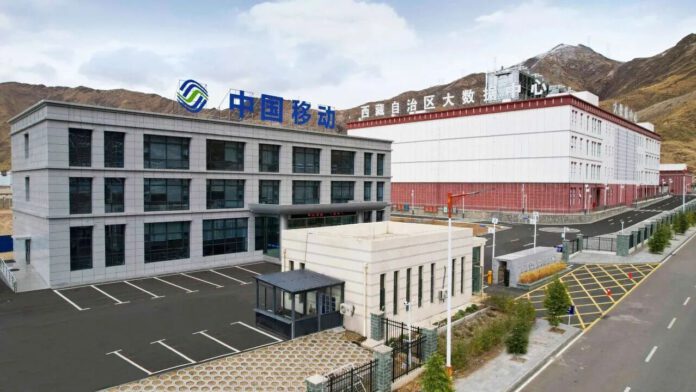
China Mobile’s Lhasa Data Center is a key component of this strategy. Covering approximately 63 mu, or 4.2 hectares, the facility is being developed in three phases. Its first phase began construction in 2018 and entered operation in October 2022. It provides 50 megawatts of power capacity for data-center racks and has been designated the Tibet Autonomous Region’s Big Data Center. More than 30 government agencies, public institutions, and enterprises have established a presence there. In December 2024, China Mobile Tibet established a dedicated computing business subsidiary to strengthen specialized operations and develop services for regional AI applications and computing demand from outside Tibet.
Green energy efficiency is central to the facility’s development. As Tibet’s first water-cooled data center, the facility uses a closed-loop chilled-water cooling system and large thermal-storage tanks to improve cooling efficiency and operational resilience. According to project materials, the center is also advancing liquid-cooling upgrades to accommodate increasingly power-intensive AI servers while exploring pilot applications involving solar and wind power. Multiple power-supply safeguards, environmental monitoring systems, and security infrastructure help address the operational challenges associated with high-altitude conditions. For large-scale AI training and inference, these systems are essential: cooling efficiency, uninterrupted power, and reliable maintenance directly affect whether computing resources can operate consistently.
Local companies are also exploring ways to integrate computing infrastructure with Tibet’s existing economic activities. NingSuan Technology Group, a Tibet-based data-center operator, has established a facility covering approximately 85,000 square meters, with capacity for 10,000 server racks. The company has explored combining waste-heat recovery with fresh-air cooling to reduce energy consumption and reuse excess heat for greenhouse agriculture and aquaculture. Server heat, rather than being treated solely as waste, can potentially become a source of energy for other productive activities. This approach illustrates how computing infrastructure could create links between the digital economy, renewable energy, agriculture, and animal husbandry, while supporting more efficient resource utilization.
Alongside these green data-center initiatives, the deployment of domestically developed AI chips and intelligent computing clusters is moving Tibet beyond conventional data storage and hosting services toward high-performance computing. In March 2026, a domestically developed intelligent computing project with an investment of approximately RMB 120 million and a capacity of 150 petaflops entered operation, according to the supplied project materials. The project incorporates domestic AI computing chips and advances the deployment of a thousand-card RISC-V architecture computing cluster, targeting applications including the integration of AI and the energy sector.
China Mobile Tibet has also announced the delivery and operation of Tibet’s first thousand-card RISC-V architecture computing cluster, developed in collaboration with Xcalibyte Computing. Built using the company’s independently developed STCP950L NPU AI accelerator cards, the cluster completed delivery, deployment, activation, and acceptance testing within 20 days.
Following a 30-day trial operation, it reportedly demonstrated stable performance and supported the deployment of large language models ranging from 7 billion to 671 billion parameters. Its intended applications include batch inference, real-time AI services, and AI agents. These developments indicate that Tibet’s computing industry is beginning to progress from basic data-center services toward domestic AI computing infrastructure and support for advanced AI applications.
Another major project is the “Yajiang No. 1” Advanced Artificial Intelligence Computing Center in Naidong District, Shannan. Officially launched on June 18, 2025, the center represents another significant step in the development of large-scale intelligent computing infrastructure in Tibet. Its first phase was planned around a computing capacity of 2,000 petaflops. The project has been incorporated into Tibet’s “Computing Power Everest” development framework and is intended to become an important node in the regional computing network.
The center adopts a phased construction strategy and plans to combine renewable energy, waste-heat recovery, and efficient cooling technologies to reduce operating costs and environmental impacts. Its broader development agenda also includes technical training, cooperation with universities, and exploration of applications such as high-altitude ecological monitoring and autonomous-driving algorithm training. It is important to distinguish planned capacity from operational capacity: the 2,000-petaflop figure represents the project’s planned scale, not necessarily the amount already installed and available for commercial use.
Its eventual economic impact will depend on subsequent deployment, operational reliability, customer demand, and the conversion of computing resources into practical applications.
As infrastructure expands, potential applications are emerging across multiple sectors. In government services, AI can support document processing, administrative approvals, and digital governance. In education and healthcare, computing infrastructure can help expand remote services and improve access to specialized resources across geographically dispersed communities. In agriculture and animal husbandry, AI-based systems could assist with grassland monitoring, livestock health management, disease detection, and agricultural production. In environmental protection, AI and remote-sensing analysis can support monitoring of glaciers, permafrost, water resources, and grassland degradation. Tourism businesses could also benefit from intelligent visitor services, multilingual assistance, and visitor-flow analysis.
The ultimate value of computing infrastructure lies not in the number of servers installed, but in whether computing capacity can generate measurable improvements in public services, industrial productivity, and economic activity. Developing these applications will require cooperation among data-center operators, technology companies, government departments, universities, and local businesses. It will also require solutions tailored to Tibet’s particular environmental conditions and economic needs, rather than simply reproducing AI applications developed for major eastern cities.
The relationship between computing and clean energy may become another important source of competitive advantage. AI infrastructure requires a stable, continuous supply of electricity, and its environmental footprint depends heavily on energy sources, cooling systems, and equipment utilization. By coordinating data-center development with renewable energy generation, energy storage, and efficient power management, Tibet could develop a model in which clean energy supports the digital industry while computing demand helps create markets for regional energy resources. Cross-regional cooperation with eastern provinces, including Hubei and Wuhan, could also connect Tibet’s computing capacity with customers and applications elsewhere in China.
Nevertheless, such a model depends on more than infrastructure investment. Network bandwidth, transmission latency, electricity costs, data security, and the commercial availability of computing services will determine which workloads can be served competitively from Tibet. Applications requiring extremely low latency may remain better suited to facilities closer to end users, while suitable training and batch-processing workloads may offer greater opportunities for geographical flexibility. Building a successful computing hub therefore requires careful matching of computing demand with regional capabilities.
The development of computing infrastructure could also create new employment opportunities and support the upgrading of traditional industries. Data-center operations, chip adaptation, network engineering, AI application development, and technical maintenance all require specialized skills. Partnerships with universities and training institutions can help cultivate a local workforce, reducing long-term dependence on outside technical teams. At the same time, digital tools can help traditional agricultural and pastoral industries improve productivity, expand market access, and strengthen environmental management. In this sense, computing infrastructure need not replace Tibet’s traditional economic foundations; it can provide additional capabilities that help them evolve.
Significant challenges remain. Tibet faces constraints in its supply of highly skilled technical personnel, the development of local AI demand, and the connectivity required to serve customers across distant regions. Large-scale computing facilities also require sustained demand and high equipment utilization to justify their investment. Without sufficient customers, even substantial installed capacity can create financial pressure rather than generate lasting economic returns. Environmental considerations are equally important. Tibet’s ecosystems are fragile, and the construction and operation of large computing facilities must be assessed carefully in terms of electricity consumption, water requirements, and their wider environmental impact.
Source: stdaily, xinjiang gov cn, cww, tibet news, bjnews