


The automotive industry has reached a defining moment in 2026. After years of rapid advances in large language models, the AI industry has arrived at a shared realization: intelligence confined to a screen is ultimately limited. To unlock its full potential, AI must move beyond generating information and begin interacting with the physical world. It needs a body.
The evolution of AI is therefore entering a new phase. While foundation models and AI agents have transformed digital experiences, the next frontier is Embodied AI, intelligence capable of perceiving, reasoning, and acting in real-world environments. This marks a shift away from competing solely on model size and cloud computing power toward integrating AI deeply with physical products. Among all intelligent devices, the automobile has emerged as the most compelling platform for this transition.
Unlike smartphones or smart home devices, which are largely limited to touchscreens and voice interfaces, vehicles combine rich multimodal perception, powerful onboard computing, mobility, and precise physical control. They are uniquely positioned to connect digital intelligence with real-world execution.
This transformation is far more significant than introducing a smarter voice assistant into the cabin. It fundamentally redefines the relationship between people and their vehicles. Traditional in-car systems require users to adapt to predefined commands and rigid interaction logic. A true AI agent reverses that relationship. Instead of demanding precise instructions, it understands human intent, interprets context, anticipates needs, and responds proactively. It recognizes fatigue, stress, urgency, and changing circumstances, enabling a more natural, intuitive, and human-centered driving experience.
This vision became tangible when Geely introduced its cockpit-driving integrated AI agent, Super EVA, and brought it into mass production on the Zeekr 8X. Rather than treating AI as another software feature, Geely positioned it as the central intelligence that connects perception, decision-making, vehicle control, and digital services into one unified experience.
As AI enters the automotive industry, not every approach is equally meaningful. Many manufacturers have simply integrated third-party large language models into their infotainment systems, enabling conversations, content generation, or entertainment while marketing these capabilities as intelligent transformation. However, the future of automotive AI extends far beyond conversational interfaces.
The intelligent agent is becoming the primary gateway through which users interact with every aspect of the vehicle, from hardware and chassis control to navigation, mobility services, payments, and an expanding ecosystem of digital experiences. Whoever controls this layer controls the user’s intent. Relying entirely on external AI providers risks reducing automakers to hardware manufacturers while strategic control over user experience shifts elsewhere.
Geely has pursued a different path. Super EVA is built upon the company’s long-term investment in self-developed voice technologies, integrated with StepFun’s Step 3.7 end-to-end foundation model and customized automotive AI agents. This combination allows Geely to retain ownership of interaction design, safety boundaries, engineering optimization, and long-term service evolution while leveraging the reasoning capabilities of advanced foundation models.
Building an automotive AI agent, however, is fundamentally different from developing consumer software. Unlike digital applications, every AI decision inside a vehicle has physical consequences. The challenge is not simply making AI more intelligent in the cloud, but ensuring that every decision can be translated into safe, reliable, real-time vehicle actions.
Achieving this requires deep integration between the intelligent cockpit and autonomous driving systems. The cockpit must understand driving scenarios, road regulations, and vehicle dynamics, while autonomous driving systems must expose decision-making processes that have traditionally remained within black-box architectures. Only through this two-way integration can AI move seamlessly from understanding human intent to executing safe physical actions.
Equally important is the underlying engineering foundation. High-bandwidth communication, cross-domain computing, real-time scheduling, and multiple layers of safety redundancy are essential prerequisites for turning AI reasoning into physical vehicle control.
Geely’s ability to commercialize this vision is the result of years of investment across the full AI technology stack. Its service-oriented vehicle architecture, Xingrui Intelligent Computing Center with 23.5 EFLOPS of computing power, millions of newly collected real-world driving data points every year, and continuous development of proprietary voice technologies and AI algorithms together form the infrastructure that enables fast, reliable, and safe cross-domain collaboration.
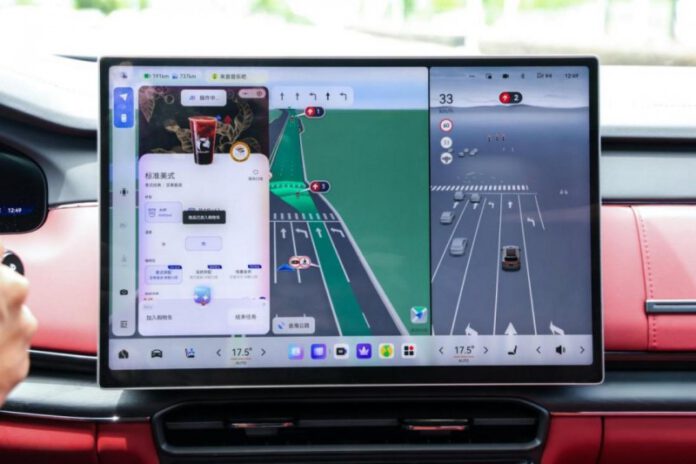
The value of this integration becomes clear in everyday situations. Imagine driving to work on a busy Monday morning with an important meeting approaching. You simply say, “Hi Super EVA, I need to arrive before nine. I’m feeling tired, please drive me to the office.” During the journey, you add, “Order me an iced Americano along the way.”
Without requiring multiple separate commands, the AI understands your priorities, plans the optimal route, activates intelligent driving assistance where appropriate, coordinates the journey, locates a nearby coffee shop, places the order, completes payment, and ensures everything aligns with your arrival time. Instead of executing isolated instructions, the AI orchestrates multiple services across the physical and digital worlds to complete an entire mobility task on your behalf.
This represents a fundamental shift from reactive software to proactive intelligence.
The AI industry has never lacked ambitious visions. Tesla’s integration of Grok into its broader ecosystem points toward a future in which automotive AI and humanoid robotics share common intelligence. Across the industry, demonstrations of AI agents have become common at major auto shows and technology events.
Yet the automotive industry is ultimately defined not by demonstrations, but by production.
Mass production remains the only meaningful benchmark capable of separating technological breakthroughs from conceptual hype. Automotive AI must perform consistently not just in ideal testing environments, but across millions of kilometers, countless weather conditions, unpredictable traffic situations, and complex long-tail scenarios while maintaining uncompromising safety standards.
This is where engineering discipline becomes more important than marketing narratives.
Super EVA has already moved beyond the demonstration stage into large-scale deployment. Following its production launch on the Zeekr 8X, the system is scheduled to reach hundreds of thousands of existing Zeekr owners through over-the-air updates before expanding across Lynk & Co and Geely models. Such rapid deployment across multiple brands and vehicle platforms reflects not only technological maturity but also manufacturing capability, software validation, supply chain coordination, and organizational execution at scale.
Ultimately, the significance of automotive AI extends beyond the vehicle itself.
As discussions around embodied intelligence continue, many ask whether future digital experiences will revolve around smartphones or automobiles. The answer is increasingly that they will complement one another. Smartphones remain indispensable companions for everyday digital life, while vehicles occupy a unique role as intelligent physical spaces capable of movement, perception, and real-world interaction.
The automobile therefore becomes the bridge connecting people, vehicles, homes, and services into one continuous intelligent ecosystem. Super EVA represents more than a new product or feature. It demonstrates how AI can move beyond conversation and begin creating tangible value in the physical world. More importantly, it reflects a broader direction for the industry, one in which intelligence is measured not by how convincingly it talks, but by how safely, reliably, and naturally it acts.
As the era of Physical AI begins, the companies that will shape the future are unlikely to be those with the loudest announcements or the most impressive demonstrations. They will be the ones capable of translating advanced intelligence into products that millions of people can trust and use every day. In that sense, the journey from digital intelligence to physical execution has already begun, and the automobile is emerging as its most important proving ground.
Source: 36kr, zgqcdt, sina, sohu, zhihu