


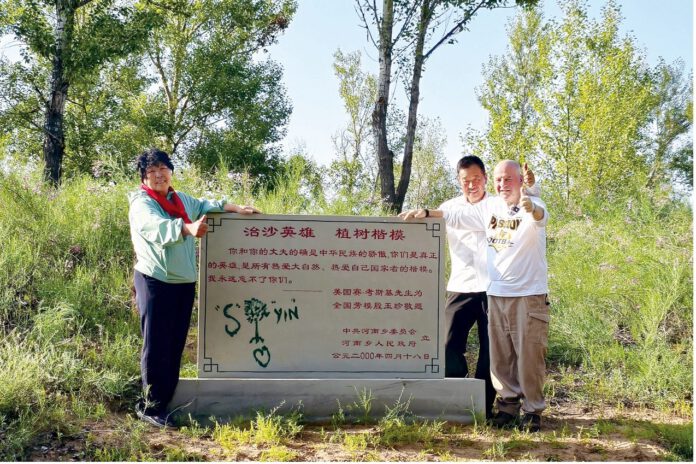
A $5,000 donation made more than two decades ago has grown into more than 50,000 trees in the Mu Us Desert, while also becoming a lasting symbol of friendship between people in China and the United States.
In 1999, Ronald Sakolsky, an American teacher participating in a China-U.S. teacher exchange program, arrived in Luoyang, Henan Province, to teach at Luoyang Foreign Language School. During his stay, he came across a television report about Yin Yuzhen, a Chinese farmer who had spent years planting trees and fighting desertification in the Mu Us Desert of Inner Mongolia.
The story deeply moved Sakolsky. At the time, he did not know Yin personally, yet he began contacting organizations in the United States in an effort to raise funds for her efforts to combat desertification. Eventually, a foundation in Boston provided $5,000 to support her tree-planting work.
In 2000, Sakolsky traveled to the Mu Us Desert and met Yin Yuzhen and her husband, Bai Wanxiang. Together, they planted young trees in the desert. The seedlings were no thicker than a finger, and water had to be carried from considerable distances. The landscape was still dominated by sand, with little sign that a forest could take root there.
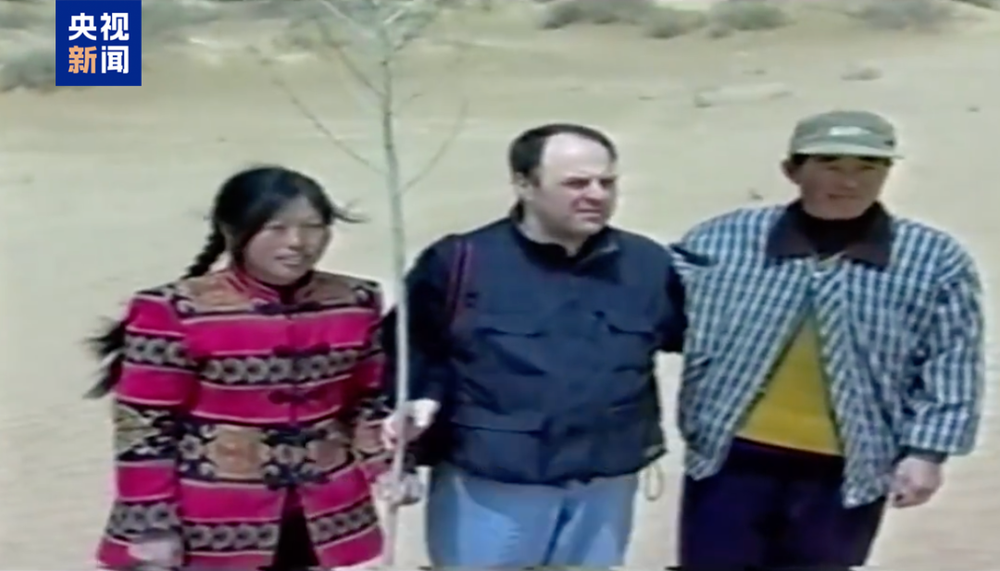
More than two decades later, those seedlings have grown into mature trees. The woodland supported by the donation has expanded to more than 50,000 trees, transforming a once-barren landscape into a dense stretch of greenery.
The significance of the $5,000 donation lies not simply in the number of trees it helped plant. It represents the power of an individual act of kindness to cross national borders and outlast the circumstances in which it began. What started as a teacher’s response to a story he encountered in a Chinese classroom community eventually became part of a much larger story of ecological restoration, human perseverance and people-to-people friendship.
Yin Yuzhen is only one of the many people who have devoted themselves to combating desertification in the Mu Us Desert. Her experience reflects the determination of generations of local residents who have struggled to protect their homes and livelihoods from advancing sand.
When Yin married into the Mu Us region in the 1980s, the landscape around her home was dominated by shifting dunes. Wind and sand could block doorways overnight and severely restrict agricultural production. In 1986, she sold sheep to purchase 600 tree seedlings and planted them around her home. After a major storm, fewer than 10 survived.
Instead of seeing the failed planting as proof that trees could not survive, Yin regarded the surviving seedlings as evidence that restoration was possible. She and her husband continued experimenting with different species, planting techniques and methods of conserving water. Over time, they learned how to stabilize moving sand, which plants were best suited to the local environment and how vegetation could be established gradually rather than through a single large-scale intervention.
Her approach was consistent with a broader transformation in China’s understanding of desertification control. Early efforts often depended heavily on manual labor, with local communities planting trees and constructing straw checkerboard barriers to stabilize dunes. As scientific research expanded, desertification control increasingly became a systematic undertaking involving ecological science, plant breeding, hydrology, soil research and large-scale engineering.
The Mu Us Desert is one of China’s major areas of desertification control, extending across parts of Inner Mongolia, Shaanxi and Ningxia. At the founding of the People’s Republic of China, severe desertification posed a major threat to local communities. In northern Shaanxi, for example, advancing sand and soil erosion contributed enormous quantities of sediment to the Yellow River. The desert was not merely an environmental problem; it was closely connected with poverty, agricultural productivity, infrastructure and the security of local communities.
For more than 70 years, successive generations of local residents, researchers, government officials and ecological workers have worked to reverse that trend.
The transformation did not happen through one technique or one generation. Researchers established field stations and experimental sites across the region, studying the relationships among vegetation, soil, water and climate. Tree and grass species were tested extensively. Techniques such as aerial seeding were developed to reach areas that were difficult to access by conventional means. Straw checkerboard barriers were used to slow the movement of sand, while shrubs and grasses were introduced as pioneer vegetation capable of surviving under harsh conditions.
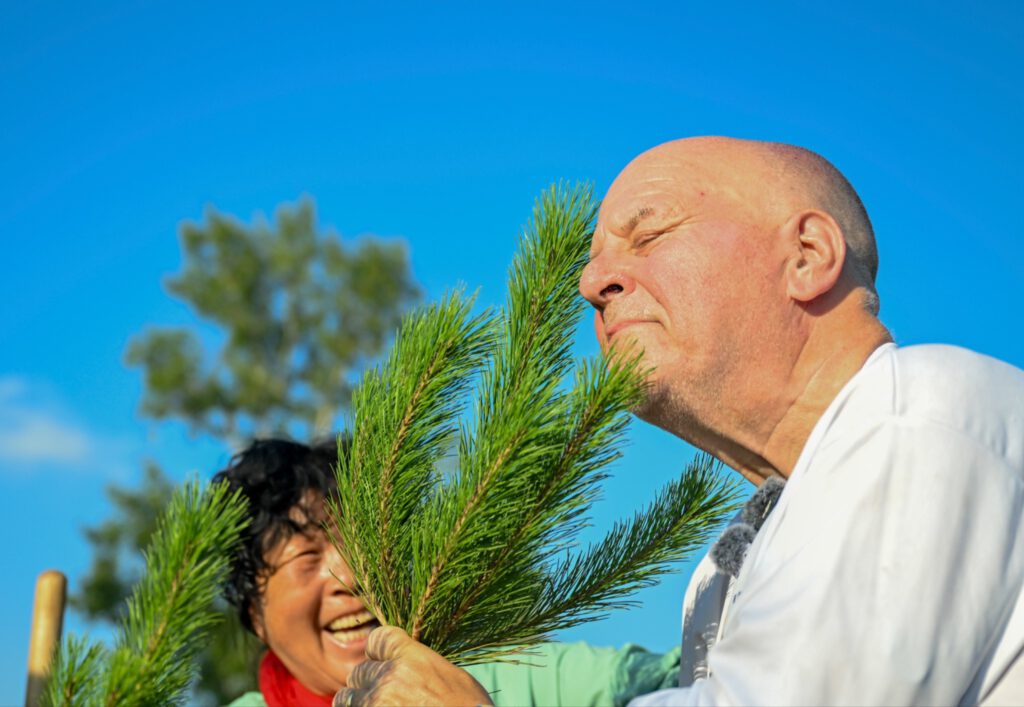
Among the important discoveries was the suitability of Mongolian Scots pine, a species not originally native to the Mu Us region. After years of research and experimentation, scientists found that the species could adapt to local conditions and play an important role in stabilizing degraded land.
The science of desertification control has continued to evolve. Earlier approaches sometimes emphasized simply increasing vegetation coverage. Modern ecological thinking places greater emphasis on water availability, biodiversity, ecosystem stability and the natural characteristics of different landscapes.
The goal is no longer to turn every area of desert into dense forest. Instead, the principle is increasingly one of matching vegetation to local environmental capacity: trees where trees are appropriate, shrubs where shrubs are more suitable, grass where grass can thrive, and natural sandy landscapes where maintaining sand is part of a healthy ecosystem.
This shift reflects a deeper understanding of the desert as an ecological system rather than simply an enemy to be eliminated.
The Mu Us Desert has achieved remarkable ecological improvements. In Uxin Banner, where Yin Yuzhen’s home is located, the area of treated desertification land has reached more than 8.39 million mu, with a treatment rate of about 85 percent. Forest coverage has risen to 32.92 percent, while vegetation coverage has reached approximately 85 percent.
Across Yulin in Shaanxi Province, extensive desertification-control projects have significantly reduced the movement of sand and sediment. Areas that were once characterized by barren dunes have developed forests, grasslands and more diverse ecosystems. River sediment has declined, local environmental conditions have improved, and ecological restoration has increasingly become connected with economic and social development.
The benefits extend beyond vegetation itself. In many desertification-control areas, ecological restoration has improved agricultural conditions, supported rural development, created opportunities for tourism and contributed to better living environments. The transformation of the landscape has also helped communities move away from the cycle in which environmental degradation and poverty reinforced one another. Yet the achievements of the Mu Us Desert do not mean that desertification has been permanently defeated.
Ecological restoration in arid and semi-arid regions remains a long-term process. Some tree species require more water than local ecosystems can sustainably provide. Dense plantations may appear successful for a period of time but can become vulnerable to drought, disease and ecological degradation. Certain areas that once emphasized rapid greening have therefore shifted toward more cautious approaches based on water availability and ecological carrying capacity.
Researchers now increasingly advocate nature-based solutions and near-natural restoration. Pioneer plants can stabilize exposed sand, improve soil conditions and create microclimates that allow other species to establish themselves. Over time, some early-stage vegetation may naturally decline as a more diverse and stable ecological community develops.
The ultimate objective is not simply a landscape that looks green from a distance. It is an ecosystem capable of maintaining itself. This distinction is important because the Mu Us Desert remains a fragile environment. Its annual precipitation varies significantly from place to place, and water resources are limited. Effective ecological restoration must therefore take account of local hydrology, soil conditions and vegetation succession.
The emerging philosophy of desertification control can be summarized in a simple principle: treat the desert according to its natural conditions. The transformation of the Mu Us Desert is therefore best understood not as a victory over nature, but as a gradual process of learning how to coexist with it.
For decades, researchers have worked in field stations scattered across the region, often under harsh conditions. Generations of scientists have spent years collecting data, testing plant species and observing changes that cannot be fully understood within a single season or even a single professional career.
Some trees planted by one generation will outlive the people who planted them. Ecological systems develop according to timescales that are often much longer than human careers. This has required patience as much as technology. The people who have worked in the Mu Us Desert have consequently become part of a long continuum. Earlier generations established the foundations of desertification control; later researchers refined the scientific understanding; local communities continued the work on the ground; and newer approaches have increasingly emphasized ecosystem quality, biodiversity and sustainability.
Yin Yuzhen’s experience belongs to this larger history. Her decades of planting trees demonstrate the persistence of individual action, while the transformation surrounding her home demonstrates what individual perseverance can achieve when combined with scientific research, public investment and long-term ecological policy.
The same landscape that once seemed incapable of supporting trees now contains forests, grasslands and restored habitats. In some areas, ecological recovery has allowed wildlife to return and has created landscapes capable of supporting more diverse forms of life. The change has also reshaped the relationship between local communities and the desert. What was once regarded primarily as a threat to survival is increasingly understood as an ecological system that must be protected and managed according to its own laws.
The $5,000 provided by Ronald Sakolsky in 1999 therefore represents only one small contribution to a transformation measured in millions of acres and decades of effort. But its symbolism is unusually powerful. A donation made by an American teacher to support a Chinese farmer’s tree planting became part of a forest. The forest became a reminder of what sustained effort can accomplish. And the friendship created around those trees became a quiet example of how ordinary people can build connections across national boundaries.
When Sakolsky returned to China more than 20 years after his first visit, the trees he had helped plant had grown tall. The landscape had changed, but so had the meaning of the original gesture. The story of the Mu Us Desert is ultimately larger than one person, one family or one donation. It is the story of a region transformed through more than seven decades of persistence, scientific experimentation, public policy and community participation.
It is also a story about time. A seed does not become a forest overnight. An ecosystem cannot be restored in a single campaign. Knowledge accumulates through repeated experiments, including failures. And trust between people from different countries is often built through small acts that acquire greater meaning only after many years.
The trees planted in the Mu Us Desert more than two decades ago have become living markers of that process. Their roots hold the soil, their branches rise above the sand, and their growth records a transformation that reaches far beyond the original $5,000.
What began with a simple act of kindness has become part of a much larger landscape of green. The Mu Us Desert has not ceased to be a desert, nor should it. Its future depends on maintaining the balance between ecological restoration and the natural limits of the land. But the region has demonstrated that even severely degraded ecosystems can recover when human determination is guided by science and sustained across generations.
In that sense, the story of Ronald Sakolsky and Yin Yuzhen offers a particularly human entry point into China’s long campaign against desertification. One person offered support from across the Pacific. Another devoted a lifetime to planting trees. Scientists developed new methods. Communities continued the work. Governments provided long-term support.
Together, those efforts turned scattered seedlings into forests and a once-threatened landscape into one of the world’s most significant examples of large-scale ecological restoration.
Source: forestry gov cn, xinhua, people, sohu, wenweibo, cnr, ifeng, kinliu