


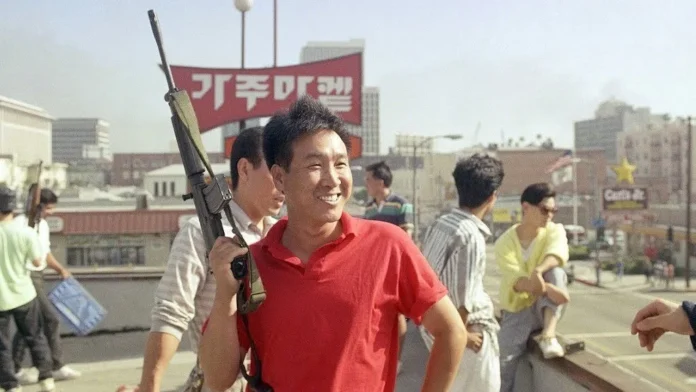
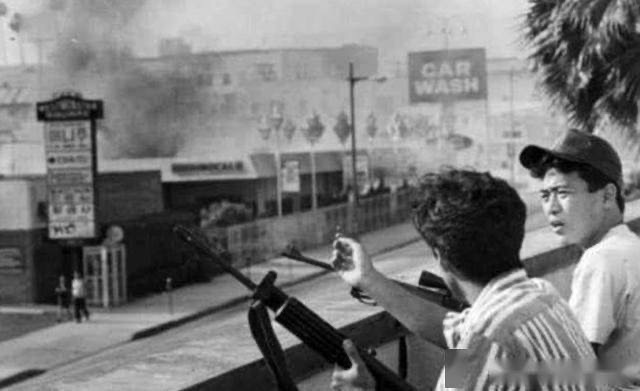
The 1992 Los Angeles uprising is often remembered through two images: the beating of Rodney King by Los Angeles police officers and the Korean American shopkeepers who stood on rooftops with firearms to protect their businesses. The latter image later produced the controversial label “Roof Koreans,” a term that has been repeatedly invoked as a symbol of immigrant self-reliance, armed resistance, and distrust of the state.
Yet to understand what happened in Los Angeles, it is not enough to celebrate or condemn the people on those rooftops. Their presence was the visible consequence of a much deeper crisis involving policing, racial segregation, immigration, class inequality, and the failure of the American state to provide equal protection to all of its residents.
The uprising followed the acquittal of police officers involved in the beating of Rodney King, whose assault had been captured on videotape and circulated widely. The verdict was experienced by many Black Americans as confirmation of a long-standing reality: police violence against Black communities could be documented and still go largely unpunished.
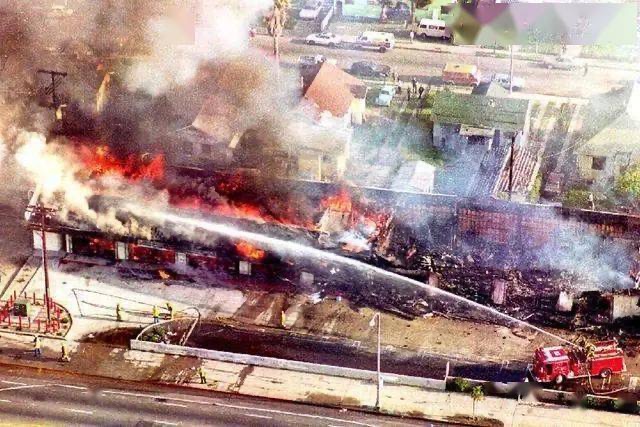
The subsequent unrest was therefore not simply a spontaneous eruption of anger. It reflected decades of racial segregation, unemployment, poverty, discriminatory policing, and unequal political power. Los Angeles presented itself as a multicultural metropolis, but its neighborhoods were deeply divided by race and class. Communities could live only a few blocks apart while inhabiting entirely different social and economic worlds.
Korean American business owners became particularly vulnerable within this structure. During the decades before the uprising, many Korean immigrants had entered small-business sectors such as liquor stores, grocery stores, clothing shops, and other neighborhood businesses.
These enterprises were often located in predominantly Black or Latino neighborhoods, partly because commercial property was more affordable there and partly because immigrant entrepreneurs faced barriers in entering established professional and corporate sectors. The result was an uncomfortable proximity: Korean immigrants operated businesses in communities whose residents were frequently economically disadvantaged, while the immigrants themselves were often struggling to establish a foothold in American society.
This proximity sometimes generated resentment. Korean shopkeepers could be perceived as outsiders extracting income from local communities, while Korean immigrants could perceive their customers and surrounding neighborhoods primarily through the lens of crime, insecurity, and economic survival.
Neither perception adequately explained the underlying structure. The problem was not simply “Black prejudice against Koreans” or “Korean prejudice against Black people.” Both communities were being positioned within an unequal urban economy in which access to capital, property, political influence, and public protection was distributed unevenly.
The killing of fifteen-year-old Latasha Harlins by Korean American store owner Soon Ja Du in 1991 became an especially important symbol of this tension. Du was convicted of voluntary manslaughter but received probation rather than a prison sentence. For many Black residents, the sentence reinforced the belief that the legal system valued Korean property owners and white institutions more highly than Black lives. For Korean Americans, however, the case existed alongside their own experience of racial vulnerability and economic insecurity. The tragedy therefore became part of a larger pattern in which the grievances of one marginalized community could easily be directed toward another.
This is one of the most important lessons of 1992. American racial politics can encourage subordinate groups to compete with one another for limited economic resources, security, and recognition. It is tempting to describe this simply as a deliberate strategy by “America” to make different racial groups fight each other, but the historical reality is more complicated.
The conflict emerged from institutional arrangements: residential segregation, unequal schools, concentrated poverty, discriminatory policing, restricted access to capital, and a political system in which different communities competed for scarce resources. When these structural forces are translated into everyday encounters, systemic inequality can appear as interpersonal or cultural conflict. The result is what might be called horizontal racial conflict: communities that share experiences of marginalization become rivals rather than political allies.
The “Roof Koreans” phenomenon has to be understood within this context. The sight of armed Korean Americans defending their stores is sometimes presented as evidence that Koreans possessed an instinctive willingness to defend themselves that other communities lacked. Such an interpretation is misleading. The armed response was shaped by a combination of circumstances: the weakness of police protection during the unrest, the concentration of Korean-owned businesses in affected neighborhoods, immigrant distrust of public institutions, and a cultural background in which military service had been a significant part of male socialization.
South Korea is a society deeply shaped by the experience of war and national division. Under the country’s conscription system, South Korean men have historically been subject to mandatory military service, although the exact obligations have varied by generation and individual status. Many Korean men of the generation who immigrated to the United States before or around the 1990s had military experience.
This does not mean that Koreans are “naturally militaristic,” nor does military service automatically make a person willing to use violence. It does, however, mean that firearms, uniforms, defensive formations, and the basic idea of responding to a security threat were not entirely unfamiliar concepts to many first-generation Korean men.
That background interacted with another uniquely American reality: the widespread presence of civilian firearms and the cultural legitimacy of armed self-defense in the United States. The “Roof Koreans” were therefore produced by the intersection of Korean military socialization and American gun culture. Their behavior should not be interpreted as proof of an inherent Korean character. It was a historical response to a specific environment in which immigrants believed that the state could no longer guarantee the safety of their families and livelihoods.

The deeper irony is that many Korean immigrants had come to the United States precisely because they believed it offered security, freedom, and opportunity. Korean immigration after the Immigration and Nationality Act of 1965 expanded dramatically, as the abolition of the old national-origins quota system opened the door to larger-scale Asian immigration.
Migrants arrived for many different reasons: economic opportunity, education, family reunification, political uncertainty, and the desire for a different future for their children. Yet immigration did not necessarily mean upward mobility. Many highly educated immigrants experienced professional deskilling, while others entered small businesses because racial discrimination and the structure of the American labor market limited their alternatives.
The Korean American relationship with the United States has therefore never been simply one of admiration or rejection. For South Korea, the United States represented military protection, economic power, technological modernity, and access to a global system dominated by American institutions.
At the same time, American military and political power has also been a source of historical criticism. The U.S.–South Korean alliance developed within the Cold War, alongside American involvement in a South Korean political order that was for long periods authoritarian. For many Koreans, particularly among generations shaped by the democratic movements of the 1970s and 1980s, the United States could simultaneously be viewed as protector, hegemon, economic model, military power, and political actor deserving criticism.
American popular culture itself contains evidence of this contradiction. Television programs such as MASH*, although produced in the United States and nominally set during the Korean War, used that war to criticize militarism, bureaucracy, and the absurdity of organized violence. This tradition of American self-criticism matters because the United States is not simply an external oppressor standing outside its own society.
It is a country whose institutions, media, and citizens have repeatedly argued about the meaning of American power. The Korean American experience consequently developed within an ambivalent relationship with America: immigrants could depend upon the country, admire its opportunities, criticize its racism, and challenge its foreign policy at the same time.
The same contradiction appears in the concept of the “model minority.” Korean Americans and other Asian Americans were increasingly represented as evidence that racial minorities could succeed through discipline, education, family values, and hard work. On the surface, this appeared to be a positive image. In reality, the model-minority stereotype served an important political function.
It transformed structural questions into individual ones. If one minority group could supposedly succeed through hard work, then poverty and inequality among other minorities could be interpreted as failures of culture or personal responsibility rather than consequences of discrimination and unequal institutions.
The comparison between Asian Americans and Black Americans was especially damaging. It encouraged the idea that the success of one minority proved the failure of another. Korean immigrants could be told that they represented the disciplined immigrant ideal, while Black communities were implicitly presented as examples of social dysfunction. Such comparisons ignored the radically different histories of immigration, slavery, segregation, property ownership, and access to political power that shaped each group.
The 1992 uprising exposed the weakness of this framework. Korean Americans were neither simply privileged Americans nor powerless victims. They occupied an intermediate and unstable position within the American racial hierarchy. They could experience racism while simultaneously benefiting from certain forms of racialization. They could be economically successful while remaining politically marginalized. They could identify strongly with the American dream while discovering that the state did not necessarily protect them when that dream was threatened.
For Korean Americans, 1992 therefore represented more than the destruction of businesses. It forced a reconsideration of what it meant to be an immigrant community in America. The question was no longer simply how Koreans could accumulate wealth and protect their families. It was also how they should participate in American political life, how they should relate to Black and Latino communities, and whether immigrant security could be achieved through private defense alone. In the years that followed, Korean American political participation and community organizing increasingly reflected a recognition that isolation offered limited protection.
The historical significance of the “Roof Koreans” lies precisely in this contradiction. They were armed because they were afraid; they distrusted the state because they had experienced its absence; they defended private property because economic survival was closely tied to that property.
Their story is neither a simple celebration of immigrant toughness nor a simple indictment of Korean Americans. It is a picture of what happens when an unequal society forces vulnerable communities to protect themselves within a system that has failed to provide equal security.
Seen from this perspective, the central story of Los Angeles in 1992 was not Black people versus Korean people. It was a broader crisis of the American racial and economic order. The conflict between communities was real, and its consequences were devastating, but treating it as a cultural clash between two ethnic groups obscures the institutions that produced the conditions for that clash. The more uncomfortable question is why communities with different histories of marginalization were repeatedly placed in competition with one another while the larger structures of policing, segregation, poverty, and political inequality remained intact.
The image of Koreans standing on rooftops with guns has survived because it is visually powerful and politically convenient. It turns a complicated historical crisis into a simple story about courage, self-reliance, and racial conflict. But history demands a more difficult interpretation. The rooftop was not merely a symbol of Korean toughness. It was also a symbol of state failure, immigrant insecurity, racial fragmentation, and the contradictions of the American dream.
The United States, a society capable of offering extraordinary opportunity while reproducing profound inequalities, a country that celebrates multiculturalism while allowing racial groups to be separated by class and geography, and a political system in which marginalized communities can be encouraged, sometimes through institutions, sometimes through public narratives, and often simply through economic necessity, to fight horizontally rather than confront the structures that divide them.
The legacy of 1992 should consequently not be reduced to a question of who was right or who was wrong. Its enduring lesson is that racial conflict cannot be understood apart from political economy and state power.
The history of Korean Americans demonstrates how immigrants can move from outsiders to business owners, from victims to participants in racial politics, and eventually toward a more complicated understanding of America. The rooftop remains a powerful image precisely because it contains all of these contradictions: fear and confidence, dependence and self-reliance, assimilation and alienation, the American dream and the failure of the American state to deliver it equally.
Source: savoirtw, rooftopshooting, sohu, filed ethos, koreatown storytelling program