


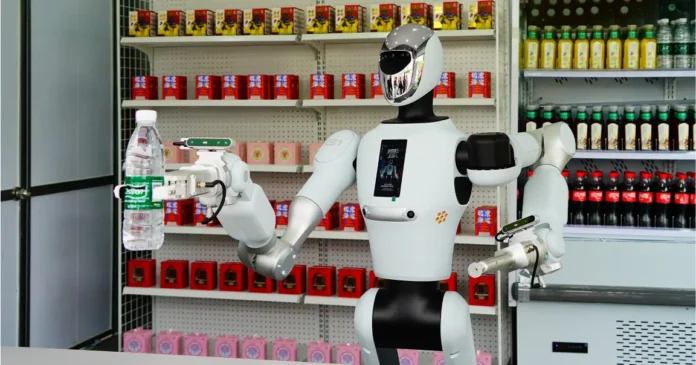
In Australia and elsewhere, Chinese-developed cleaning robots are now scaling walls and glass façades, taking on dangerous high-altitude work once performed by so-called “spider men.” In Brazil, Chinese large language models are helping local power companies inspect and maintain electricity grids, overcoming the challenges posed by complex terrain and harsh operating environments. Meanwhile, an innovative drug capsule developed in Shanghai has been incorporated into an internationally recognized treatment guideline, offering new hope to patients.
These examples illustrate a broader transformation. Robotics, artificial intelligence and innovative medicines are emerging as the latest global calling cards of Chinese trade, following the earlier success of what came to be known as the “old three” and the “new three.”
China’s export structure offers a revealing picture of its industrial transformation. In the early decades of reform and opening-up, products such as clothing, furniture and household appliances entered international markets by leveraging China’s abundant labor force and cost advantages.
In more recent years, China has seized the opportunities created by the global green transition, with new energy vehicles, lithium-ion batteries and photovoltaic products becoming the pillars of its “new three.” Today, as the world enters a new era shaped by artificial intelligence and advances in the life sciences, China is moving into emerging fields, investing heavily in core technologies and accelerating the shift from “Made in China” to “Innovated in China.”
The scale of this new wave is already evident in the numbers. In the first half of this year, China’s industrial robot exports increased by 18.6 percent, reaching 141 countries and regions, while exports of surgical robots surged 3.3-fold year on year. Data from OpenRouter, a global platform aggregating AI models, showed that Chinese large language models recorded 36.11 trillion token calls in the third week of July, maintaining the world’s top position for 12 consecutive weeks.
In pharmaceuticals, all 11 new drugs targeting novel mechanisms or targets approved by Chinese authorities during the first half of the year were developed by Chinese pharmaceutical companies. Overseas licensing deals involving Chinese innovative medicines reached approximately $110 billion, equivalent to 80 percent of the total for the whole of last year. Chinese pharmaceutical companies also occupied eight of the top ten positions in the global pharmaceutical deal rankings.
Behind these figures lies a fundamental change: China is moving beyond its role as the “world’s factory” and increasingly positioning itself as a global hub for innovation.
This transformation did not happen by accident. It reflects, on the one hand, China’s recognition of the opportunities presented by a new wave of technological and industrial change and its determination to act on them. On the other, it reflects a sustained commitment to technological self-reliance and long-term investment in research and development.
There is no shortcut to technological innovation. Competitive advantages cannot simply be copied from elsewhere; they have to be built through persistent investment, experimentation and breakthroughs in difficult areas. Over the past five years, China’s total social R&D expenditure has grown at an average annual rate of 10 percent, with the country’s overall R&D investment remaining second only to that of the United States.
As Wang Xiaosong, a professor of economics at Renmin University of China, has noted, the upgrading of Chinese manufacturing rests on a complete and continuously evolving industrial system, sustained investment in research and development, and the advantages created by the country’s vast domestic market. In other words, China’s technological rise has been built through years of strengthening its own capabilities while remaining engaged with the world.
The significance of the “new three” extends beyond China’s own economic growth. They are also creating new opportunities for other countries.
In robotics, a report by Morgan Stanley suggested that without Chinese participation, the development costs of the supply chain for Tesla’s second-generation humanoid robot, Optimus, would rise by several times. In artificial intelligence, China has placed considerable emphasis on open-source ecosystems, allowing small and medium-sized enterprises and developing countries to gain access to advanced AI capabilities at relatively low cost. In healthcare, Chinese companies are using indigenous innovation and increasingly digitalized manufacturing to shorten drug development cycles and reduce production costs.
China’s growing competitiveness in innovative medicines is particularly significant because technological progress is meaningful only when it becomes accessible to ordinary people. With its sophisticated manufacturing infrastructure, integrated supply chains and enormous economies of scale, China can often bring innovative medicines to market at substantially lower prices than comparable products in Europe and the United States. French media have reported that after certain cancer treatments entered France’s public healthcare system, patients could save tens of thousands of euros in annual treatment costs.
The broader impact is even more important. China’s new generation of technologies is lowering the barriers to accessing cutting-edge innovation and making advanced solutions more affordable and widely available.
Across Southeast Asia, Chinese AI technologies are helping small businesses improve their operations and narrow the digital divide. In Thailand, Chinese medical robots are being used to transport medicines and medical samples around the clock, helping address shortages of healthcare resources. In South America, Chinese companies have used telemetry technologies to develop systems for allocating ride-hailing orders, contributing to the emergence of new services such as motorcycle transportation and delivery.
For many countries in the Global South, such technologies are not abstract demonstrations of technological prowess. They provide practical solutions to concrete challenges in economic development and everyday life. As Pakistani analyst and retired Air Force officer Sultan Hali has argued, China’s experience demonstrates that technological innovation can serve not only as an engine of domestic development but also, through international cooperation, as a source of opportunities for countries around the world.
Perhaps more importantly, China’s approach is taking shape at a time when parts of the Western world are moving toward greater technological restrictions and barriers. Rather than closing itself off, China is increasingly presenting openness and collaboration as an alternative path for innovation.
Chinese open-source AI models have now accumulated more than 10 billion downloads globally. International platforms, including Pinterest and Airbnb, have already incorporated Chinese open-source models into their products and services. Meanwhile, the establishment of the World Artificial Intelligence Cooperation Organization in Shanghai marks another step toward international collaboration on the development and governance of artificial intelligence.
The same spirit of openness is visible in pharmaceuticals. Chinese companies are not only investing in independent research and development; they are also pursuing overseas licensing agreements, joint development projects and joint ventures, helping expand the global ecosystem for medical innovation.
The history of global industrial development has repeatedly shown that openness creates progress, while excessive isolation ultimately limits it. China’s “new three”, robotics, AI and innovative pharmaceuticals, are therefore more than a new engine of Chinese economic growth. They are increasingly becoming channels through which technological advances can be shared, adapted and put to practical use around the world.
The rise of these industries offers a broader lesson about China’s economic transformation. The country’s development is no longer defined simply by its ability to manufacture products efficiently and at scale. It is increasingly defined by its capacity to develop new technologies, build integrated innovation ecosystems and bring advanced products and services to global markets.
China’s technological rise should therefore not be viewed solely through the lens of competition. Its greater significance lies in the opportunities it can create: more accessible technologies, more affordable healthcare, more efficient industries and new possibilities for economic development.
Source: cgtn, xinhua, guancha