


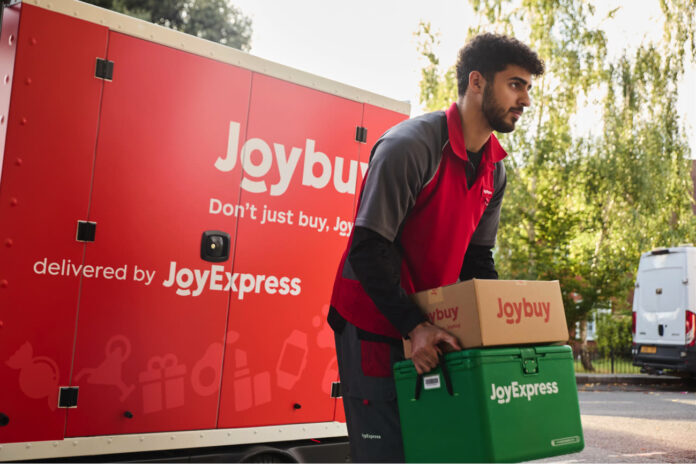
JD.com has spent a decade trying to figure out what its international business should look like. Now, as its European e-commerce platform Joybuy opens its doors to third-party merchants, the Chinese technology and retail group appears to have settled on a model that is less about exporting Chinese goods and more about rebuilding its supply-chain-driven retail system overseas.
In 2026, Joybuy began recruiting merchants for its European PoP, or platform-operated marketplace. The move marks a significant shift for a business that initially relied heavily on direct retail. Rather than sourcing and holding inventory itself for every product, Joybuy is beginning to bring selected third-party sellers onto the platform.
The strategy is deliberately selective. Merchants are expected to have substantial sales in Europe, operate through overseas corporate entities and hold the relevant VAT registrations. The requirements suggest that JD.com is not trying to recreate the low-barrier, mass-market marketplace model associated with many cross-border platforms. Instead, it is attempting to build a curated marketplace around established brands and sellers that can meet European fulfillment and compliance standards.
That transition is important because it reveals how much JD.com’s European strategy has changed from its earliest international ambitions.
When JD.com began exploring overseas markets around 2014, the ambition was much broader. The company initially focused on Southeast Asia, launching JD.ID in Indonesia in 2015 and later expanding into Thailand and other markets through investments and joint ventures. JD.ID followed a model broadly familiar to Chinese consumers: direct retail supported by third-party merchants, backed by warehouses and its own delivery infrastructure.
For a time, the strategy looked promising. JD.com invested heavily in local logistics and retail infrastructure, while JD.ID expanded its delivery network across Indonesia. But the competitive environment proved difficult. Shopee, Lazada and local platforms such as Tokopedia had already built strong consumer relationships, while JD.com faced the additional challenge of adapting its operating model to local markets.
The company eventually pulled back. In 2023, JD.com shut down its consumer e-commerce operations in Indonesia and Thailand, while emphasizing that it would continue investing in logistics and supply-chain infrastructure across Southeast Asia and other international markets.
That retreat became an important lesson. JD.com could not simply reproduce the Chinese e-commerce market overseas by putting the same retail model in a different country. Traffic, consumer habits, local competition and regulatory environments were fundamentally different.
What JD.com did have was something more portable: its supply chain. Over the following years, the company increasingly invested in overseas warehouses, international transportation, fulfillment and logistics services. The logic was relatively straightforward. Rather than beginning with a shopping app and trying to build the infrastructure around it, JD.com would first establish the infrastructure and then build retail businesses on top of it.
Europe has become the clearest test of that strategy. The company began laying the groundwork several years ago. In 2022, JD.com launched Ochama in the Netherlands, an omnichannel retail concept that gradually expanded across Europe. It also continued building logistics capabilities and overseas warehouses. By 2024, JD Logistics said it had more than 100 overseas warehouses, bonded warehouses and direct-mail facilities worldwide.
Then came Joybuy. In March 2026, Joybuy officially launched in six European markets: the United Kingdom, Germany, France, the Netherlands, Belgium and Luxembourg. Unlike the earlier cross-border businesses associated with the JD.com name, Joybuy was designed from the outset as a local retail platform. Products were stocked in European warehouses, orders were fulfilled locally, and JD.com’s JoyExpress network provided last-mile delivery.
Speed became the centerpiece of the proposition. In parts of the UK, Joybuy introduced a delivery service that closely resembles JD.com’s famous “211” promise in China. Orders placed before 11 a.m. can qualify for same-day delivery, while orders placed before 11 p.m. can arrive the following day. The company has expanded same-day delivery across locations including Greater London, Birmingham, Leicester, Nottingham, Oxford and Cambridge, while next-day delivery covers much of the UK.
Joybuy has also introduced JoyPlus, a paid membership program offering unlimited free delivery for around £3.99 a month in the UK, directly entering a market in which Amazon Prime has already accustomed consumers to paying for premium delivery and services.
The numbers released so far suggest that the strategy is gaining initial traction. JD.com said during its second-quarter 2026 earnings presentation that Joybuy’s revenue had doubled over two quarters. The company has also said its same-day delivery service now reaches more than 40 million people across the UK and Europe, up from an initial coverage of roughly 15 million households.
Those figures, however, need to be viewed in context. JD.com has not disclosed Joybuy’s absolute revenue, order volume, user base or unit fulfillment costs. Doubling revenue from a relatively small initial base does not by itself demonstrate that the business has reached meaningful scale. The harder question is whether JD.com can generate enough order density to justify a logistics model that requires warehouses, inventory and local delivery infrastructure.
That is precisely where the opening of Joybuy’s marketplace becomes significant. A fully self-operated retail model gives JD.com control over product quality, inventory and customer service, but it is expensive and inherently difficult to scale across a fragmented market such as Europe. Every additional product category requires procurement, working capital, inventory management and demand forecasting. A marketplace can solve part of that problem by bringing in merchants and brands that JD.com does not need to source itself.
But Joybuy is not opening the floodgates. The initial recruitment drive targets established businesses with significant European sales and local compliance capabilities. The objective appears to be less about maximizing seller numbers than about increasing assortment without sacrificing the service standards that differentiate the platform.
This could eventually produce a hybrid model: JD.com’s own retail business providing control and quality, third-party sellers providing assortment, and JD Logistics providing the infrastructure underneath both.
That combination is closer to the model that made JD.com successful in China. It is also fundamentally different from the way many Chinese cross-border platforms first entered Europe.
Temu, Shein and AliExpress initially benefited from China’s manufacturing base and cross-border shipping networks, using low prices and enormous product selection to acquire consumers. Their European strategies are now evolving, with greater investment in local warehouses, compliance and brands. JD.com, by contrast, is starting from the opposite direction: local inventory, fast fulfillment and established brands first, with marketplace scale coming later.
That makes Joybuy more expensive to build, but potentially more aligned with JD.com’s traditional strengths. The company is also trying to build something larger than an online marketplace.
Its proposed acquisition of CECONOMY, the German parent of MediaMarkt and Saturn, is potentially the most consequential part of the European strategy. The deal, valued at roughly €2.2 billion, would give JD.com access to a large network of European stores, customers, brand relationships and after-sales capabilities. CECONOMY operates around 1,070 stores across Europe and has tens of millions of members.
The transaction remains subject to regulatory review. In May 2026, the European Commission launched an in-depth investigation under the EU Foreign Subsidies Regulation. JD.com subsequently submitted remedies, but the details of those commitments have not been fully disclosed.
If completed, the acquisition could give Joybuy something that pure online platforms struggle to build: a physical retail and service network. Stores could potentially support click-and-collect, returns, product demonstrations, installation and repair, while JoyExpress and JD.com’s warehouse network could provide the logistics layer.
The combination would effectively connect three businesses: online retail, physical retail and logistics. That is also why the European strategy is so different from JD.com’s earlier overseas experiments. The company is no longer simply asking how to sell Chinese products abroad. It is asking whether the infrastructure that made JD.com successful in China can be reconstructed in another major consumer market.
The challenge is formidable. Amazon already has a deeply established Prime membership ecosystem, a vast third-party seller network and an extensive fulfillment infrastructure. Local platforms such as Allegro, Bol and Otto have strong positions in their respective markets. Meanwhile, Chinese competitors are moving closer to JD.com’s model, investing in local warehouses, faster delivery, brand partnerships and compliance.
Europe is also not a single market. Consumer preferences, tax systems, regulations, languages and purchasing habits differ substantially from one country to another. A logistics network that works in London does not automatically create a successful retail business in Paris, Berlin or Warsaw.
For JD.com, the biggest question is therefore not whether Joybuy can deliver a package quickly. It is whether fast delivery can become a reason for consumers to return regularly, whether the marketplace can attract enough high-quality merchants, and whether the resulting order volume can eventually support the cost of JD.com’s European infrastructure.
That is where the company’s decade of international experimentation becomes relevant. JD.com has tried local e-commerce, cross-border retail, overseas marketplaces, SaaS tools and international logistics. Many of those initiatives were eventually scaled back or disappeared. What remained was the company’s investment in supply-chain infrastructure.
The lesson appears to have been that JD.com cannot simply export its domestic e-commerce platform. It has to export the capabilities underneath it. That is why Joybuy represents more than another Chinese shopping app entering Europe. It is the latest attempt to turn JD.com’s defining competitive advantage, inventory, warehouses, logistics, fulfillment and after-sales service, into a local European retail system.
The company itself has acknowledged that this approach is slower and more capital-intensive. But that may be precisely the point. JD.com’s international strategy is no longer built around winning a short-term cross-border price war. It is built around spending years establishing infrastructure and then using that infrastructure to support retail growth.
Joybuy’s early growth suggests that consumers are beginning to respond. Its marketplace expansion suggests that JD.com now wants to move beyond being a retailer. The potential CECONOMY acquisition suggests that it wants to connect online commerce with physical stores and services.
Whether those pieces can eventually form a profitable European business remains an open question. For now, the significance of Joybuy lies elsewhere. After ten years of experimentation, JD.com appears to have stopped trying to build a second version of its Chinese e-commerce business overseas. Instead, it is attempting something more difficult: to transplant the supply-chain architecture behind that business into Europe, and then build a local retail ecosystem on top of it.
That is a much longer bet. It may also be the clearest expression yet of what JD.com means when it says it wants to go global.
Source: letschuhai, guandian, ebrun, stcn, sina, republik-retail, macg