


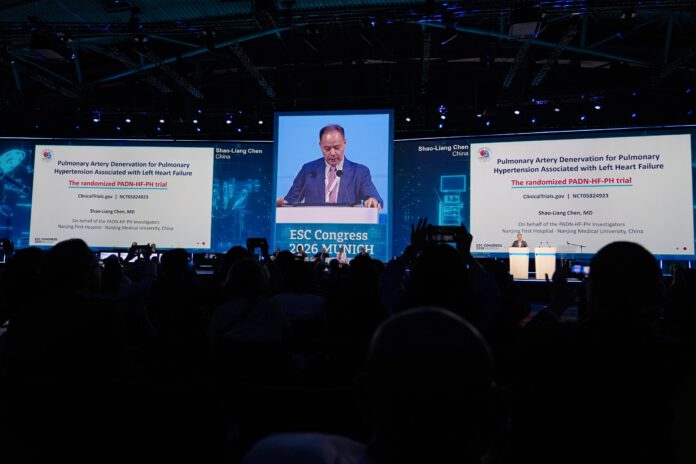
On August 30, 2026, in Munich, a clinical trial from China took center stage at one of the most closely watched sessions in global cardiovascular medicine.
At the European Society of Cardiology (ESC) Congress 2026, Professor Shaoliang Chen presented the results of the PADN-HF-PH trial during the Hot Line session. Published simultaneously in the New England Journal of Medicine(NEJM), the randomized trial evaluated pulmonary artery denervation, or PADN, in patients with heart failure and pulmonary hypertension caused by left heart disease.
For patients with this condition, the significance of the study goes beyond another positive clinical trial. For more than a decade, physicians have faced a difficult therapeutic gap: as heart failure progresses, pressure can build up in the pulmonary circulation, placing increasing strain on the right side of the heart. Yet treatments that effectively address the heart, the pulmonary circulation and the interaction between the two have remained limited.
PADN is an attempt to intervene in that gap.
Developed in China, the minimally invasive procedure uses a catheter to deliver radiofrequency energy to nerves surrounding the pulmonary artery. By modifying excessive sympathetic nerve activity, the treatment is designed to influence pulmonary vascular resistance and the abnormal interaction between the heart and pulmonary circulation.
The underlying concept is relatively simple, but the clinical problem is not.
Heart failure is not a single disease. As the condition progresses, abnormalities in the left side of the heart can raise pressure in the blood vessels of the lungs. Over time, this increased pressure can increase the workload on the right ventricle, creating a cycle in which the heart and pulmonary circulation place increasing stress on one another.
When pulmonary hypertension develops as a consequence of left heart disease, it is commonly referred to as PH-LHD. It is the most common form of pulmonary hypertension, but it has also been one of the more difficult areas to treat specifically.
Modern heart failure therapy has become increasingly effective. Guideline-directed medical therapy, or GDMT, uses combinations of drugs that target several biological pathways involved in heart failure progression. But treating the underlying heart failure does not necessarily eliminate the abnormal pressure and vascular changes that develop in the pulmonary circulation.
At the same time, drugs specifically developed for other forms of pulmonary hypertension have not consistently demonstrated benefit in patients whose pulmonary hypertension is caused by left heart disease. As a result, physicians have historically had few established options for directly targeting the pulmonary vascular component of the disease.
This is the clinical space into which PADN has entered.
The procedure is based on the idea that the pulmonary arteries are not simply passive blood vessels. They are also influenced by the autonomic nervous system. Excessive sympathetic activation may contribute to pulmonary vasoconstriction, vascular remodeling and the progression of cardiopulmonary dysfunction.
PADN seeks to modify that neural pathway through a catheter-based procedure rather than through another systemic drug. The approach has been developed over more than a decade. Early studies focused on whether the procedure could be performed safely and whether it could improve hemodynamic parameters such as pulmonary vascular resistance and pulmonary artery pressure. Later studies examined exercise capacity and longer-term clinical outcomes.
The PADN-HF-PH trial represents a further step in that evolution because it asks a more consequential question: when PADN is added to contemporary heart failure treatment, does it actually reduce clinical deterioration?
The answer from the randomized trial was encouraging. Conducted across 25 centers in China, the study randomized 264 patients to receive either PADN plus GDMT or GDMT alone. The patients had symptomatic heart failure and pulmonary hypertension associated with left heart disease and were already receiving stable background medical therapy.
The primary endpoint was deliberately designed around events that matter to patients rather than relying solely on changes in laboratory or hemodynamic measurements. It included death, heart or lung transplantation, hospitalization for worsening heart failure, outpatient deterioration requiring intravenous treatment, and clinically meaningful deterioration in six-minute walking distance.
After a median follow-up of 338 days, the Kaplan-Meier estimated two-year incidence of clinical deterioration was 25.7% in the PADN-plus-GDMT group, compared with 51.5% in the GDMT-alone group. The hazard ratio was 0.49, with a 95% confidence interval of 0.30 to 0.82 and a P value of 0.006.
In practical terms, the trial found that patients receiving PADN in addition to medical therapy experienced substantially fewer clinical deterioration events during follow-up. The significance of the result lies partly in what the researchers chose to measure.
A reduction in pulmonary artery pressure or pulmonary vascular resistance can demonstrate that a procedure is changing the physiology of the disease. But for patients and physicians, the more important questions are whether patients remain functional, avoid repeated hospitalization and experience fewer serious clinical events.
PADN-HF-PH therefore moves the evidence beyond physiology alone and toward patient-centered outcomes. The trial also reported improvements in functional and biological measures. Six-minute walking distance, a commonly used measure of exercise capacity in patients with cardiopulmonary disease, improved relative to the control group. The study also found favorable changes in Kansas City Cardiomyopathy Questionnaire scores and NT-proBNP, a biomarker associated with cardiac stress.
The findings do not mean that PADN has solved every question surrounding heart failure-related pulmonary hypertension. A single randomized trial cannot establish how broadly the results will apply to all patients, nor can it determine the full extent of long-term effects on mortality and hospitalization. Longer follow-up and additional studies will be needed.
But the trial does establish something important: a catheter-based intervention targeting pulmonary arterial nerves can be tested against contemporary medical therapy in a randomized setting and can produce a statistically significant reduction in a clinically meaningful composite endpoint.
That distinction matters. For much of modern cardiovascular medicine, major advances in heart failure treatment have come from pharmacology. New drugs have transformed the prognosis of many patients by targeting neurohormonal activation, renal mechanisms and other biological pathways.
The next stage of innovation may increasingly involve combining those therapies with devices and minimally invasive procedures that address different parts of the disease process. PADN represents one example of that broader shift. It also illustrates a changing role for Chinese medical-device innovation.
For decades, China’s medical-device industry was often associated with manufacturing scale, cost advantages and the localization of technologies originally developed elsewhere. Those capabilities remain important. But a different category of innovation is now emerging: Chinese companies are increasingly attempting to develop technologies for clinical problems for which there is no established global product or treatment pathway to copy.
This is the defining challenge of a first-in-class technology. When a product improves on an established device, the development pathway is relatively clear. There are existing benchmarks for safety, performance, clinical endpoints and regulatory approval. A company can study the market and improve upon an established design. A first-in-class therapy has no such template.
The company must establish the mechanism, develop the technology, demonstrate safety, design clinical trials, persuade physicians to participate, build the regulatory case and ultimately convince the medical community that the new treatment deserves a place alongside established therapies. PADN has followed precisely this longer path.
The technology has been investigated for more than a decade, beginning with early feasibility studies and progressing through randomized trials and longer-term follow-up. Earlier research provided evidence that PADN could influence pulmonary hemodynamics and exercise capacity. Subsequent studies sought to determine whether these physiological improvements could translate into meaningful clinical benefit.
The development program then moved beyond China. International studies have been used to test whether the procedure can be reproduced across different healthcare systems, patient populations and clinical teams. The company is also pursuing regulatory and clinical development programs in the United States and other international markets.
This progression is critical because medical-device globalization is fundamentally different from exporting an ordinary consumer product. A device can be physically shipped to another country relatively quickly. A new medical treatment cannot.
Before physicians in another healthcare system adopt it, the technology has to survive multiple layers of scrutiny: clinical evidence, regulatory review, procedural training, physician acceptance, reimbursement considerations and, ultimately, real-world use.For a first-in-class device, the clinical evidence becomes the foundation of the entire process.
This is why the publication of PADN-HF-PH in the New England Journal of Medicine and its presentation at the ESC Hot Line session carry significance beyond the visibility of a single company. They place a Chinese-developed medical-device technology within the same global evidence ecosystem in which new cardiovascular treatments are evaluated.
That does not automatically make PADN a standard treatment. Medical guidelines are based on the totality of evidence, and future recommendations will depend on additional randomized studies, longer follow-up, safety data, reproducibility across populations and regulatory assessment.
But the trajectory is notable. A technology that began as an experimental concept in China has progressed through multiple stages of clinical validation and is now being evaluated on a global stage. That progression also changes the meaning of “going global” for Chinese medical-device companies.
For many years, globalization meant selling a Chinese product overseas. Increasingly, the more consequential form of globalization is becoming something else: bringing a Chinese-developed clinical hypothesis into the global medical community and asking international physicians, regulators and researchers to test it against the same standards applied to technologies developed in Europe or the United States.
PADN provides a particularly clear example because the underlying problem is global.
Heart failure is a major burden across healthcare systems, and pulmonary hypertension associated with left heart disease affects large and diverse patient populations. The clinical challenge is not specific to China. If a new intervention ultimately proves safe, reproducible and effective across different healthcare environments, its potential impact will likewise extend well beyond its country of origin.
The commercial implications follow from the clinical question, rather than preceding it.
If a new therapy becomes accepted as part of the treatment pathway, the market is not necessarily limited to patients who previously received an existing competing device. In areas where there is no established device-based treatment, successful clinical innovation can create a new treatment category.
That is one reason first-in-class technologies attract strategic interest despite their higher development risk. In April 2026, Pulnovo Medical, the company developing PADN, announced a $100 million Series D financing round led by Medtronic, with continued participation from existing investors including EQT, Qiming Venture Partners, GaoRong Capital, OrbiMed and Lilly Asia Ventures. The company said the financing would support clinical development, regulatory activities and international commercialization.
The involvement of a global medical-device company is significant from an industry perspective, but it should not be confused with clinical validation. Investment and commercial partnerships can provide resources, expertise and distribution capabilities; ultimately, however, the medical value of a technology still depends on evidence generated through clinical research. For PADN, the next phase will therefore be at least as important as the milestone achieved in Munich.
The questions are becoming more demanding: Which patients benefit most? How durable are the effects? Can the results be reproduced in other countries? What is the long-term safety profile? How should patients be selected? How should the procedure be integrated with existing heart failure care? And can further studies establish whether the reduction in clinical deterioration translates into longer-term reductions in hospitalization or mortality?
Those questions will determine whether PADN moves from an emerging intervention to a widely adopted treatment.
The broader significance, however, is already visible. For decades, much of the global medical-technology landscape was defined elsewhere. Chinese companies entered markets where diseases had already been classified, treatment pathways had already been established and product categories had already been created.
Source innovation changes that relationship. When a company develops a technology for a clinical problem that remains unresolved internationally, the goal is no longer simply to compete within an existing market. It is to test whether a new treatment pathway can become part of global medicine. That is what makes PADN worth watching.
Its importance does not rest on the claim that one trial has already transformed heart failure treatment. Rather, it lies in the evidence that a Chinese-developed medical device has progressed from an original scientific concept to randomized clinical testing, high-level international publication and global regulatory development.
The journey is far from over. More evidence will be required before the full place of PADN in clinical practice can be determined. But the direction of travel is unmistakable.
For patients with heart failure and pulmonary hypertension caused by left heart disease, a therapeutic area that has long lacked a clear device-based option, PADN offers a new avenue for investigation.
For China’s medical-device industry, the story is even broader. It demonstrates what becomes possible when innovation begins not with the question of how to improve an existing product, but with a much harder question: what important clinical problem remains unsolved, and can a new technology provide an answer?
The significance of PADN will ultimately be determined by evidence accumulated over the years ahead. Yet the achievement already represents a meaningful shift in the role Chinese medical technology can play in global healthcare.
China is no longer only a market in which new medical technologies are adopted, nor simply a manufacturing base from which established products are exported. Increasingly, Chinese researchers and medical-device companies are attempting to develop the technologies, generate the evidence and propose the treatment pathways that the rest of the world may one day use. PADN is one of the clearest examples yet of that transition.
Source: 36kr, vbdata, bydrug, 2500sz, stcn