


Bring a smartphone close to a home appliance, and the device can be discovered automatically, without downloading another app, creating another account, searching for the device or entering a Wi-Fi password.
Measure blood pressure, blood glucose or body temperature, and data from different devices can be automatically consolidated into a health-management platform. In the kitchen, gas meters, alarms and shut-off valves that once operated independently can now work together across sensing, warning and control.
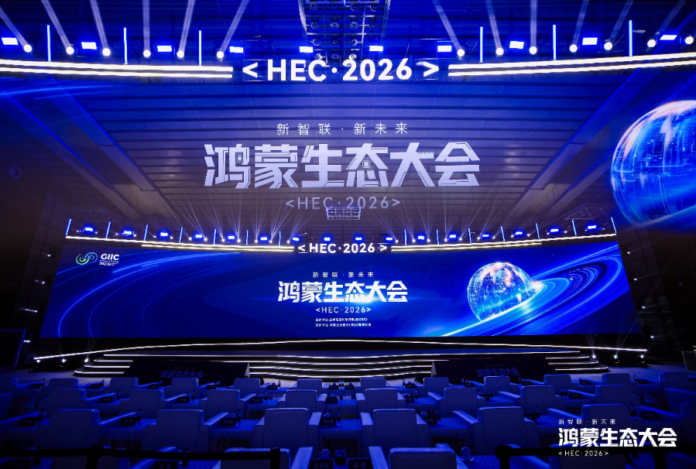
These are no longer futuristic concepts. They are emerging in real-world applications showcased at the 2026 HarmonyOS Ecosystem Conference. From smart homes and healthcare to gas utilities, transportation and industrial control, HarmonyOS and OpenHarmony are expanding into an increasingly broad range of business environments.
Beneath these seemingly unrelated applications lies a common shift: intelligence is moving beyond the upgrading of individual devices toward the coordination of multiple devices, the movement of data across systems, and the ability of AI to access and orchestrate capabilities distributed across different terminals.
This shift also signals a new stage in the digital transformation of industries. For years, the smart-device industry focused primarily on connectivity. Appliances, meters, sensors and industrial equipment were equipped with increasingly sophisticated functions, but they often operated within separate software ecosystems, communication protocols and data standards. Wi-Fi, Zigbee, Matter and PLC coexist with different operating environments such as RTOS, Linux and Android.
The result is a paradox familiar to both consumers and businesses: individual devices are becoming smarter, while the overall system remains fragmented. Consumers may need a different app for every appliance. Enterprises have to repeatedly adapt products to different operating systems and hardware platforms. Data collected by one device often remains trapped within that device or its proprietary platform.
The next challenge, therefore, is no longer simply whether devices can connect to the internet. It is whether they can understand one another, whether their data can move across systems, and whether AI can coordinate their capabilities. This is the problem HarmonyOS is increasingly attempting to address.
The smart home provides perhaps the clearest example. Haier has noted that a modern household may contain dozens or even hundreds of smart devices, running on different communication protocols and technical architectures. The difficult task is no longer getting an air conditioner, refrigerator or washing machine online individually. It is enabling these devices to work together around the needs of the household.
OpenHarmony provides an underlying framework for device discovery, connectivity and coordination. For consumers, this can mean fewer apps, fewer accounts and less complicated setup. For manufacturers, it creates the possibility of encapsulating the capabilities of different devices in a more standardized way. That change becomes even more significant when AI enters the picture.
An AI system operating in the physical world needs more than the ability to understand language or generate content. It needs to know what devices are available, what those devices can do, and how to safely invoke those capabilities. In other words, AI needs a pair of hands and feet.
This is where the role of an operating system begins to change. Traditionally, an operating system provided the basic environment in which applications and hardware interacted. In an AI-driven world, it increasingly needs to connect devices, data, computing resources and intelligent agents.
Gao Tongqing, chairman of the Global Intelligent IoT Consortium, has described operating systems as the underlying foundation of the digital world and AI as a core engine of industrial transformation. In his view, the two are moving beyond simple coexistence toward deeper integration.
The implication is significant. For AI to move from the cloud into homes, factories, hospitals, transportation systems and energy infrastructure, models alone are not enough. The underlying software must be able to coordinate devices, access data and manage distributed computing resources.
HarmonyOS’s multi-device architecture is designed around precisely this type of coordination. The value becomes particularly visible in industrial and public-service applications. In the gas sector, for example, a utility company may operate gas meters, alarms and valves supplied by different manufacturers. If each device requires separate integration, the system can quickly become a complicated web of one-to-one and one-to-many adaptations.
King Card Smart has been working with OpenHarmony on terminal adaptation, data security and distributed multi-device coordination. The objective is to connect measurement, sensing, warning and control into a more coherent operational chain. Healthcare presents a different version of the same problem.
Products showcased by Kefu Medical can collect data such as temperature, blood pressure and blood glucose from different devices and feed it into longer-term health management and AI analysis. Previously, measurements were often isolated events. Once data from different devices can be continuously aggregated, individual measurements become part of a longitudinal record.
The difference may appear small at the device level, but it is substantial at the system level.
The common thread running through these cases is not the creation of another “smart device.” It is the effort to make previously disconnected devices, data and services operate as a coordinated system.
That is also why HarmonyOS is increasingly moving beyond consumer electronics and into industrial digitalization. China’s digital industry generated more than RMB 20 trillion in revenue in the first half of 2026, according to figures cited at the conference, representing year-on-year growth of 13.6%. At the same time, the country’s “AI Plus” push is taking artificial intelligence into factories, homes, transportation networks, energy systems and healthcare.
As the number of intelligent terminals grows, the importance of the underlying software architecture grows with it. Transportation offers a clear example. Jiaotong Jiahong, developed by JiaDu Technology, is designed to connect different station systems through a unified operating-system framework. Shenzhen’s Honglingnan Station has become a pilot smart station based on HarmonyOS technology.
Elsewhere, Shenkaihong and Shenzhen Expressway have developed a smart-highway solution based on OpenHarmony and RISC-V, covering areas such as road-condition monitoring, equipment maintenance and traffic management. In Zhejiang’s Pujiang County, more than 1,600 streetlights along the G351 road have been upgraded with OpenHarmony technology, enabling dynamic lighting based on approaching vehicles.
Industrial control represents another important application. Industrial operating systems based on OpenHarmony are being used to connect controllers and equipment from different manufacturers, with the goal of improving interoperability and enabling more integrated industrial data flows.
Healthcare is similarly moving toward coordinated environments. At Nanshan Hospital in Shenzhen, a HarmonyOS-based smart ward integrates mobile nursing carts, millimeter-wave radar, smart mattresses and infusion-monitoring equipment. Patient vital signs can be automatically synchronized with nursing systems, while sensors can assist in detecting risks such as falls.
The significance of these projects goes beyond the performance of any individual device.
Early digital-transformation projects were often built around individual customers or locations: one hospital developed one system, one factory deployed another, and one railway station built a separate platform. Such projects could be successful but were difficult to reproduce at scale.
The deeper promise of an operating-system ecosystem is standardization. Once interfaces, development frameworks and certification processes become standardized, a solution developed for one environment can potentially be adapted to many others. Digital transformation begins to move from project-by-project customization toward repeatable products and platforms.
OpenHarmony has now developed into a broad ecosystem. According to figures released at the conference, the OpenHarmony community has more than 13,000 contributors, over 650 ecosystem partners and more than 2,000 ecosystem products. More than 100 industry-specific distributions, including versions serving electricity, industrial applications and mobile scenarios, have emerged, covering areas such as finance, manufacturing, transportation, healthcare, energy and government services.
The industry is also attempting to strengthen standardization. GIIC has previously released 11 standards covering areas such as interoperability and SDKs, with nearly 30 additional standards planned for 2026. The “Hongtu Plan” announced at this year’s conference aims to extend ecosystem support across development, testing and commercialization. A unified certification mechanism is expected to cover OpenHarmony compatibility, unified interoperability and HarmonyOS Connect scenarios, with the stated goal of reducing testing time and costs.
The underlying objective is straightforward: move from having products to having products that can be commercially deployed at scale. That distinction matters. An operating system does not become an industrial platform simply because it has a large number of compatible devices. It needs developers, applications, manufacturers, users and commercial incentives to reinforce one another. HarmonyOS is approaching an important milestone on that front.
As of August 20, 2026, more than 80 million devices had been upgraded to HarmonyOS 6, with the company expecting the figure to exceed 100 million in the fourth quarter. Native HarmonyOS applications have surpassed 100,000, while more than 400,000 applications are available on HarmonyOS smartphones.
The OpenHarmony ecosystem, meanwhile, is reported to encompass more than 1.35 billion devices, with more than 13,000 registered community contributors and over 2,040 products having passed compatibility certification. Huawei rotating chairman Xu Zhijun has described the 100-million-user milestone as a form of “critical mass.” The analogy points to an important economic mechanism: once an ecosystem reaches sufficient scale, developers have stronger incentives to invest, users gain access to more applications and devices, and manufacturers have greater reasons to support the platform.
The ecosystem can begin to reinforce itself rather than relying primarily on individual companies or demonstration projects. Shenzhen has become an important testing ground for this model. The city has hosted the HarmonyOS Ecosystem Conference for three consecutive years, reflecting its unusually complete industrial chain, spanning chips, modules, operating-system development, hardware manufacturing and application services.
More importantly, local governments have opened real-world environments to technology developers. Smart-city projects, industrial parks and public services provide conditions in which operating systems can be tested under far more complicated circumstances than those found in laboratories.
Local policy initiatives have also helped accelerate ecosystem development. Longgang District, for example, has introduced a package of policies supporting HarmonyOS-related projects and established a number of demonstration scenarios and industrial parks. Longhua and Luohu have also developed innovation centers and training programs around the OpenHarmony ecosystem.
For an operating system, these real-world environments are crucial. Compatibility, security and reliability are ultimately determined not by demonstrations but by whether a system can operate continuously across complex hospitals, factories, transportation networks and public infrastructure.
Yet the next stage will bring a different set of challenges. Xu Zhijun has acknowledged that while HarmonyOS has established a foothold in China, its longer-term development still depends on two major questions: how effectively it can capture the opportunities created by AI, and whether it can expand internationally. These challenges point to two distinct dimensions of competition.
The first is technological. The future operating-system race may be less about the number of apps available on a device and more about how effectively the system can understand the physical world, coordinate hardware capabilities and support AI agents.
As AI moves from screens into physical environments, the operating system could become the layer that translates AI’s intentions into actions performed by devices. The second challenge is ecosystem globalization. A platform that seeks to become a global infrastructure layer must operate across different technical standards, developer communities, supply chains, regulatory environments and consumer markets. Domestic scale can provide a strong foundation, but it does not automatically translate into global adoption.
This makes the current stage of HarmonyOS particularly important. The platform has moved beyond the initial question of whether an alternative ecosystem can be built. The more consequential question is whether that ecosystem can become sufficiently standardized, commercially viable and technically capable to support large-scale deployment across industries.
The evolution from connectivity to intelligence is not simply a matter of adding more functions to more devices. “Connected” devices can exchange signals. “Intelligent” systems need to understand context, coordinate capabilities and make decisions. That distinction is becoming increasingly important as AI enters the physical economy.
The first era of the smart-device industry was largely about making individual products intelligent. The next era is likely to be about making systems intelligent. In that transition, the operating system is moving from an invisible layer beneath the device to a potential infrastructure layer connecting hardware, data, applications and AI.
For industries undergoing digital transformation, the question is therefore changing as well. It is no longer simply whether to adopt AI, but how AI can be brought into real business environments and given secure, standardized and scalable access to the devices and data that those businesses depend on.
HarmonyOS is positioning itself around that transition. Whether it can turn technological capabilities into widely adopted standards, standards into commercial products, and products into a self-sustaining global ecosystem will determine how far the platform can ultimately go.
The shift from the Internet of Things to an intelligent Internet of Things is only beginning. And in that transition, the battle is increasingly moving away from individual devices toward the underlying systems that allow millions of devices to work as one.
Source: sznews, china daily, eastmoney, giiconsortium, huawei