


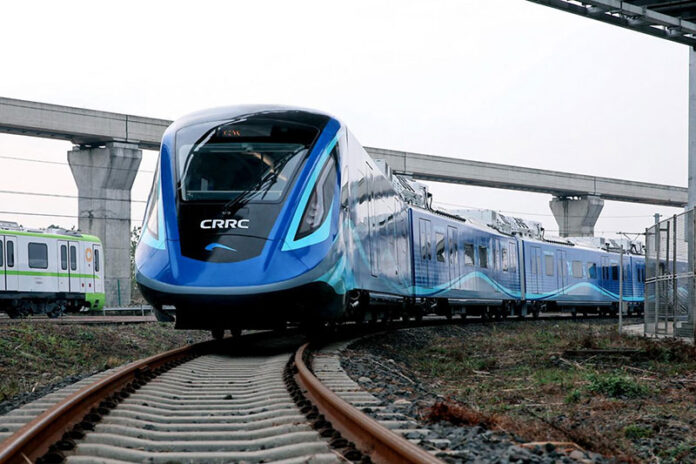
China is accelerating the development of hydrogen-powered rail vehicles, moving the technology from early demonstrations toward practical applications across passenger transport, freight, urban transit and railway maintenance. From hydrogen-powered trams entering commercial service to locomotives designed for heavy freight and trains capable of reaching 160 km/h, a series of domestic projects is demonstrating how hydrogen can help decarbonize railway transport.
One of the earliest milestones came in 2016, when CRRC Tangshan developed a hydrogen fuel cell-powered tram using a hybrid system that combined fuel cells with supercapacitors. The vehicle demonstrated the potential of hydrogen power for rail transport without conventional overhead electrification. In 2019, a hydrogen-powered tram entered commercial operation in Gaoming, Foshan, marking an important step from technical development to passenger service.
China subsequently expanded its exploration of hydrogen-powered rail vehicles beyond conventional trams. In 2022, hydrogen-powered digital rail-guided vehicles were introduced in Shanghai’s Lingang area and Suzhou. These vehicles combine hydrogen power with digital rail-guidance technology, offering a potential alternative for urban and suburban transport where the construction of conventional rail infrastructure may be difficult or costly. Five hydrogen-powered digital rail-guided vehicles were deployed in the Lingang project, providing a practical setting for evaluating the technology.
A major breakthrough came in the development of hydrogen-powered regional trains. In 2022, CRRC Changchun Railway Vehicles unveiled a hydrogen-powered regional train designed to operate without overhead power lines. In 2024, the train completed fully loaded tests at a speed of 160 km/h, demonstrating the feasibility of hydrogen propulsion for higher-speed passenger rail services. The train was designed for a range of up to 600 kilometres, highlighting the potential of hydrogen power for regional routes that require longer operating distances and rapid refuelling.
The technical progress behind these vehicles extends beyond the fuel cell itself. Engineers have had to coordinate fuel cells, energy storage systems, traction equipment and onboard control systems to ensure stable power delivery under different operating conditions. At CRRC Changchun, an energy-management strategy for hydrogen-electric hybrid systems has been developed to improve the allocation of power between the fuel cell and energy storage components. According to the company, the strategy can reduce energy consumption by at least 10 percent.
Hydrogen power also offers potential advantages over battery-only systems in certain railway applications. Refuelling can be faster than recharging large battery packs, while hydrogen systems may be better suited to some low-temperature operating conditions. These characteristics are particularly relevant to routes with long operating hours, limited opportunities for charging and demanding winter conditions. Nevertheless, the overall benefits depend on factors such as hydrogen supply, vehicle utilisation, fuel-cell efficiency and the cost of infrastructure.
China has also extended hydrogen technology into heavy-duty railway operations. In 2023, the hydrogen-powered locomotive known as Ningdong was unveiled. Converted from a Dongfeng 4B diesel locomotive, it uses an 800 kW fuel-cell system and carries approximately 270 kilograms of hydrogen. Its design is intended to support heavy freight operations, with a reported theoretical operating duration of up to 190 hours under specified conditions. On level track, it is designed to haul a train weighing up to 5,000 tonnes. The project represents an important attempt to apply hydrogen propulsion to freight transport, where high power requirements and long operating hours make decarbonisation particularly challenging.
Hydrogen technology is also being applied to railway maintenance. A hydrogen-powered subway construction and maintenance vehicle unveiled in 2023 can reach speeds of 80 km/h. Reported technical specifications include a refuelling time of approximately 30 minutes and continuous operation for up to 32 hours under specified conditions. Over its life cycle, the vehicle is projected to reduce carbon emissions by approximately 225 tonnes compared with the relevant conventional alternative. Such vehicles could help reduce emissions in railway engineering and maintenance operations, including work on lines where access to conventional traction power is limited.
Another area of development is the improvement of onboard hydrogen storage. In 2024, a hydrogen-powered digital rail-guided vehicle equipped with Type IV hydrogen storage cylinders completed assembly in Yibin, Sichuan Province. The vehicle was reported to have a range exceeding 200 kilometres on a single hydrogen refueling. Type IV cylinders use a composite structure designed to reduce weight while storing hydrogen at high pressure. Lower vehicle weight can improve energy efficiency and increase the amount of useful payload, making storage technology an important factor in the wider commercialisation of hydrogen-powered rail vehicles.
Refuelling infrastructure is developing alongside the vehicles. Automated hydrogen refuelling equipment has entered testing, with the aim of improving operational efficiency and reducing the need for manual intervention. Reliable refuelling is essential if hydrogen-powered trains are to move beyond demonstration projects and operate on regular schedules. The development of storage systems, refuelling equipment and hydrogen supply networks must therefore progress alongside vehicle engineering.
China’s hydrogen-powered rail projects are also beginning to attract international attention. A 1,000 kW hydrogen-powered freight locomotive developed for export to Chile reached the factory-delivery stage in 2024, illustrating the potential for Chinese rail manufacturers to extend hydrogen technology into overseas markets. In Malaysia, a hydrogen-powered autonomous rapid transit system underwent trial operations in Kuching, demonstrating another possible application of hydrogen propulsion in urban transport. Hong Kong has also explored hydrogen-powered trains through research and testing activities.
These developments do not mean that hydrogen-powered rail transport has overcome all its challenges. High system costs, fuel-cell durability, lightweight design, hydrogen production and distribution, refuelling infrastructure and safety approval remain important barriers. The climate benefits also depend on how the hydrogen is produced: hydrogen made using renewable electricity can offer substantial emissions reductions, whereas hydrogen produced from fossil fuels without effective carbon capture delivers a more limited benefit.
For China, the next stage is to establish which applications can achieve reliable performance and competitive life-cycle costs. Urban trams and digital rail-guided vehicles provide opportunities for localised deployment, while regional trains, freight locomotives and maintenance vehicles test the technology under more demanding operating conditions. Progress in hydrogen storage, energy management and automated refuelling will be critical to expanding these applications.
China’s experience is increasingly defined by a growing range of vehicles rather than a single technological showcase. From early hydrogen trams and commercial urban services to 160 km/h regional trains, heavy freight locomotives and export-oriented projects, domestic manufacturers are building practical experience across the railway sector. Whether hydrogen can become a widely adopted rail energy source will depend on the ability to turn these technical achievements into safe, economical and repeatable operations.
Source: zqb, stdaily, paper people, cnfol, gongyi cctv