


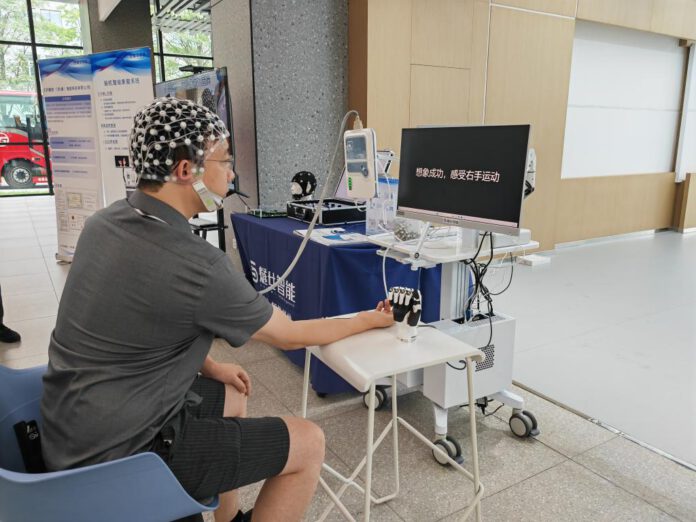
Brain–computer interface (BCI) technology establishes a direct communication pathway between the brain and external devices by recording and decoding neural activity. Its core function is to translate neural signals into executable commands and use feedback mechanisms to enable closed-loop control.
Based on signal acquisition methods, BCI systems are generally classified into non-invasive, invasive, and interventional approaches. Non-invasive systems typically collect signals through scalp electroencephalography (EEG), offering relatively convenient use and lower procedural risk, although signal quality can be affected by noise and attenuation.
Invasive systems use implanted electrodes to obtain higher-quality neural signals, making them promising for precise motor control but raising challenges related to surgical risk and long-term stability. Interventional systems seek to deliver electrodes through vascular pathways, aiming to balance signal quality with reduced surgical trauma.
BCIs can also be classified by their intended function: restorative systems seek to recover or replace impaired sensory, motor, or communication functions, whereas augmentative systems aim to enhance perception, cognition, or motor performance in healthy individuals. At present, medical treatment and rehabilitation represent the most clearly defined areas of demand and the most promising pathways for clinical translation.
Demand for BCI technology is driven primarily by neurological conditions and injuries that impair movement, sensation, and communication, including spinal cord injury, stroke, Parkinson’s disease, and epilepsy. Conventional medication and rehabilitation can improve patients’ conditions, but restoring voluntary movement and fine motor control remains difficult for people with severe damage to neural pathways.
By decoding a patient’s movement intentions and translating them into commands for external devices or rehabilitation systems, BCIs offer new possibilities for functional compensation and neurological rehabilitation. However, the commercial potential of these technologies depends not only on technical performance but also on demonstrable clinical benefits, integration into established healthcare pathways, and sustainable reimbursement arrangements. Clinical effectiveness, safety, and affordability are therefore as important as laboratory performance or the number of companies entering the market.
China’s BCI sector is gradually moving from exploratory research toward clinical validation and medical device registration. In March 2026, a brain-controlled hand motor function compensation system developed by Borui Kang received registration approval from China’s National Medical Products Administration (NMPA). Media reports described it as the world’s first approved invasive BCI medical device. The system uses epidural electrodes positioned outside the dura mater rather than directly contacting brain tissue and is designed to compensate for impaired hand movement associated with spinal cord injury.
According to reports, the product underwent a multicenter confirmatory clinical trial involving 11 hospitals and 32 patients with cervical spinal cord injuries, with some patients reportedly regaining the ability to perform brain-controlled grasping movements. This development marks an important step in China’s transition from technological research to the regulated clinical application of BCI systems for a specific medical indication. Nevertheless, clinical outcomes must be interpreted in the context of trial design, patient selection, follow-up duration, and long-term safety. Results from a defined patient group should not be assumed to apply equally to all people with spinal cord injuries.
Research and development continue across multiple technological approaches. The “Beinao-1” system, developed by Chinese research teams, has been reported to use a wireless, semi-invasive architecture with more than 100 channels, with seven human implantation cases reported. Its successor, “Beinao-2,” entered clinical validation in 2026, reflecting continued efforts to improve high-throughput neural signal acquisition and restore motor or speech functions.
Non-invasive systems are also being developed for rehabilitation, neurological assessment, and selected mental health applications. Each approach has different technical maturity levels and clinical applications. Invasive systems prioritize high-quality signals and precise control, while non-invasive systems offer advantages in accessibility and lower procedural risk. Interventional systems require further validation of their safety and signal performance. Future competition will depend less on maximizing channel counts or system complexity than on delivering reliable solutions for clearly defined clinical needs.
Policy support has become a major driver of BCI research and industrial development in China. BCI technology has emerged as an important component of national discussions on future industries and scientific innovation, while local governments are using industrial plans, research platforms, clinical infrastructure, and funding mechanisms to accelerate commercialization. In 2026, Guangdong Province issued its Action Plan for the Coordinated Development of Brain-Computer Interface Science, Technology and Industry (2026–2030).
The plan emphasizes breakthroughs in core technologies, the development of innovation platforms, support for enterprises and products, the expansion of application scenarios, and the improvement of the industrial ecosystem. By 2027, Guangdong aims to achieve technological breakthroughs in more than five major brain diseases, cultivate more than ten core BCI companies, and establish the foundations of industrial clusters in Guangzhou and Shenzhen. By 2030, it plans to add 100 BCI technology companies, promote more than ten non-invasive products with significant market impact, advance several invasive products through clinical translation and medical device registration, and develop 100 demonstration applications. The plan also sets targets of a core BCI industry worth RMB 100 billion and related upstream and downstream industries worth RMB 1 trillion. In addition, it proposes establishing 200 BCI clinical wards and cumulatively serving more than 500,000 patients. These targets demonstrate that policy support extends beyond research funding to clinical infrastructure, regulatory approval, demonstration projects, and industrial chain development. Their achievement, however, will depend on technological maturity, regulatory progress, genuine market demand, and commercially sustainable business models.
Guangdong’s existing industrial base provides a foundation for these policy ambitions. According to a relevant industry white paper, the province has more than 100 key companies with BCI products or products under development, placing it among China’s leading regions in this field. During the reporting period, Guangdong recorded 27 registered BCI clinical trials, accounting for 20.1% of the national total. Twenty-eight medical institutions had established or planned to establish BCI clinical research wards, while the province recorded 360 BCI patent applications. These figures indicate that Guangdong’s strengths extend beyond corporate concentration to clinical research capacity and intellectual property development. Guangzhou and Shenzhen form the province’s principal industrial centers, while other cities in the Pearl River Delta can contribute supporting capabilities in electronics, artificial intelligence, precision manufacturing, and healthcare. The key policy challenge is to translate the number of companies and patents into competitive core components, clinically validated products, and replicable application models.
Shanghai and Wuhan illustrate different but complementary regional development pathways. According to reports published in 2026, Shanghai’s Minhang District had attracted 61 BCI-related companies, including 13 focused on invasive technologies, 36 on non-invasive technologies, and 12 on supporting services. The cluster had accumulated more than RMB 1 billion in financing, while the combined valuation of its core companies exceeded RMB 5.5 billion.
Eight BCI products had reached the clinical stage, and the development pipeline contained more than 50 products or programs. The local ecosystem also includes proof-of-concept platforms, clinical research wards, data infrastructure, and industrial investment funds. A related EEG data platform was reported to contain more than 100,000 cases, providing resources for algorithm development and clinical research. Shanghai’s advantages lie in the integration of capital, research, medical resources, and medical device development. However, company valuations and pipeline size are not substitutes for regulatory approval or demonstrated commercial performance.
Wuhan, by contrast, has developed distinctive strengths in clinical resources and collaboration between engineering and medicine. Reports indicate that hospitals across the city have conducted clinical explorations involving invasive, semi-invasive, and non-invasive BCI systems. Clinical trials at institutions including Tongji Hospital and Union Hospital have exceeded 60, with more than 60% reportedly commissioned by companies based outside Hubei Province. Union Hospital’s engineering–medicine integrated ward has provided related services to more than 200 patients with spinal cord injuries, stroke, Parkinson’s disease, and epilepsy.
These figures highlight Wuhan’s capacity to support clinical research and suggest that hospitals serve not only as end users but also as essential partners in technology validation, indication development, and product improvement. Compared with Guangdong’s manufacturing and corporate concentration and Shanghai’s capital and commercialization resources, Wuhan’s clinical infrastructure provides a strong basis for testing technologies against real medical needs. Cooperation among these regions could help connect research, clinical validation, manufacturing, and commercialization.
Despite these advances, the further development of BCI technology faces significant technical, regulatory, and industrial challenges. Individual differences in neural signals, decoding accuracy in complex environments, long-term electrode stability, device maintenance, and infection risks all require continued investigation and clinical follow-up. Neural data are highly sensitive and raise concerns about personal privacy, data security, and informed consent. Clear rules are therefore needed for data collection, use, storage, and sharing. Because BCI development spans neuroscience, clinical medicine, materials science, microelectronics, artificial intelligence, and precision manufacturing, few companies can independently manage the entire process from fundamental research to commercial deployment. Public testing platforms, animal research facilities, clinical research wards, technical standards, and technology transfer services are consequently essential components of the industrial ecosystem. Policy support should encourage innovation while strengthening requirements for clinical evidence, ethical review, product quality, and long-term safety, preventing preliminary trial results from being misinterpreted as established and universally applicable treatment outcomes.
Source: stdaily, jiangmen gov cn, gdppnet, most gov cn, jingji cctv, wuhan gov cn, tmtpost