


Throughout human history, writing has preserved ideas, books have carried knowledge across generations, and paper has provided an essential foundation for the spread of learning. From ancient Chinese workshops to the scholarly centers of the Arab world and the printing houses of Europe, a technology originating in China crossed continents and transformed cultures. The spread of papermaking connected civilizations across Eurasia and profoundly influenced the development of human knowledge.
Before paper became widely available, people used various materials to record information. The ancient Egyptians made papyrus from the papyrus plant, while parchment, produced from animal skins, was widely used in Europe. In China, people wrote on oracle bones, bamboo and wooden slips, and silk. However, these materials had significant limitations.
Bamboo slips were heavy, silk was expensive, and producing papyrus and parchment required considerable resources. As societies developed and cultural exchanges increased, people needed a lighter, more affordable, and more practical writing material. Paper gradually emerged to meet this demand.
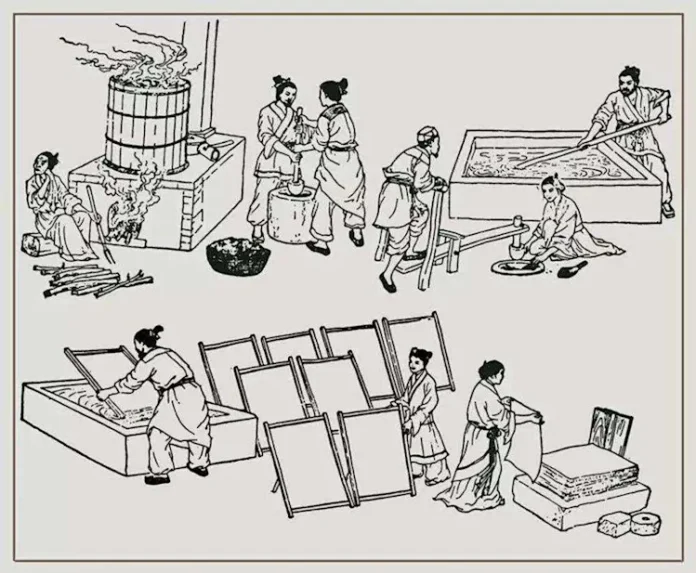
China was the birthplace of papermaking as an important technological tradition. Archaeological discoveries indicate that hemp-based paper existed in China during the Western Han dynasty. In the Eastern Han dynasty, Cai Lun improved existing papermaking techniques and presented his work to the imperial court around 105 CE. He used materials such as tree bark, hemp waste, old cloth, and discarded fishing nets to produce paper of better quality. By expanding the range of raw materials and improving the production process, these innovations helped make paper more practical and accessible.
The significance of papermaking extended far beyond writing. Paper was increasingly used for official documents, books, paintings, and packaging. It also provided an essential material foundation for the later development of printing. As the technology advanced, Chinese craftsmen accumulated considerable expertise, and paper became an important tool for cultural preservation and government administration. Through trade, migration, diplomatic contact, and warfare, papermaking gradually spread beyond China’s borders.
The westward spread of papermaking was a gradual process. By around the third century CE, paper had begun to move into Central Asia along routes connecting northwestern China with regions farther west. Archaeological discoveries in places such as Loulan, Dunhuang, and Turpan provide evidence of the use of paper and written documents along these routes. As merchants, travelers, and different communities interacted along the Silk Road, paper and knowledge of its production gradually traveled farther west, paving the way for the development of papermaking in the Arab world.
The Battle of Talas in 751 CE is often regarded as an important turning point in this history. The Tang dynasty forces fought the Abbasid Caliphate’s forces in Central Asia, and some Tang soldiers were captured. Historical accounts associate skilled papermakers among the captives with the subsequent spread of papermaking to Samarkand. Although the transmission of this technology was the result of a broader process of cultural contact rather than a single battle alone, the Battle of Talas remains a significant landmark in the story of papermaking’s westward journey.
Samarkand gradually developed into an important papermaking center. Local craftsmen adopted Chinese techniques and adapted them to regional materials and production conditions. The paper they produced was relatively affordable and suitable for writing. By the late eighth century, papermaking had also begun to develop in Baghdad under the Abbasid Caliphate, and workshops were subsequently established in other cities, including Damascus.
As the technology spread throughout the Islamic world, production expanded and paper became increasingly common in administrative, commercial, and cultural life. The growing availability of paper helped create favorable conditions for the cultural flourishing of the Arab world. Before paper became widely used, parchment and papyrus were relatively expensive, limiting the copying and preservation of written works. More affordable paper reduced the cost of producing books and documents, making it easier to circulate administrative records, commercial accounts, religious texts, and scholarly works. As books became more accessible, private collections and libraries developed, allowing knowledge to reach a wider audience.
During the Abbasid period, Baghdad became a major center of scholarship and cultural exchange. Translation movements brought philosophical, medical, mathematical, and astronomical works from Greek, Indian, and Persian traditions into Arabic. Paper was not the sole cause of this intellectual flourishing, but it made copying, preserving, and exchanging large numbers of manuscripts considerably easier.
Scholars could study earlier works, compare ideas, and build upon existing knowledge. The Arab world thus played an important role not only in preserving and transmitting knowledge from different civilizations but also in making original contributions to mathematics, medicine, astronomy, and other fields.
Papermaking subsequently continued its westward journey through North Africa and the Iberian Peninsula, bringing the technology into Europe. Spain became an important early center of European papermaking, followed by Italy, France, and other regions. Craftsmen adapted production methods to local materials and needs, and papermaking gradually expanded beyond its original centers. As production techniques improved, paper became more affordable and increasingly replaced traditional writing materials.
In Europe, the spread of paper transformed the conditions under which knowledge was produced and shared. During the Middle Ages, books were largely copied by hand, making them expensive and limiting their availability. As paper became more accessible, the costs of copying manuscripts and producing books declined. Schools, universities, religious institutions, and commercial communities gained a more practical means of recording and distributing information.
By the fourteenth and fifteenth centuries, European papermaking had expanded considerably. When movable-type printing developed in Europe in the mid-fifteenth century, the combination of paper and printing enabled books to be reproduced and distributed on a much larger scale.
These developments helped create favorable conditions for the Renaissance and the Reformation. Classical literature, religious texts, scientific discoveries, and humanist ideas circulated more widely, exposing increasing numbers of people to new perspectives. Paper also became essential for government administration, commercial contracts, mapmaking, and scientific records. Over time, papermaking spread to the Americas and other parts of the world, becoming an indispensable component of modern civilization.
The history of papermaking is not simply a story of a technology moving from one region to another. It is a story of civilizations exchanging knowledge, adapting innovations, and creating new possibilities.
Chinese craftsmen laid the foundations of papermaking; the Arab world developed the industry and supported the circulation of scholarship; and Europe expanded the reach of written knowledge through the growth of papermaking and printing.
A sheet of paper may appear fragile and insignificant, yet it carries centuries of history. By crossing geographical and linguistic boundaries, the paper connected China, the Arab world, and Europe, enabling ideas to be recorded, preserved, reproduced, and shared. The global journey of papermaking demonstrates that the progress of civilization rarely occurs in isolation. Instead, it grows through exchange, develops through adaptation, and continues through the collective contributions of different cultures.
Source: paper people, the paper, sohu, lingoace