


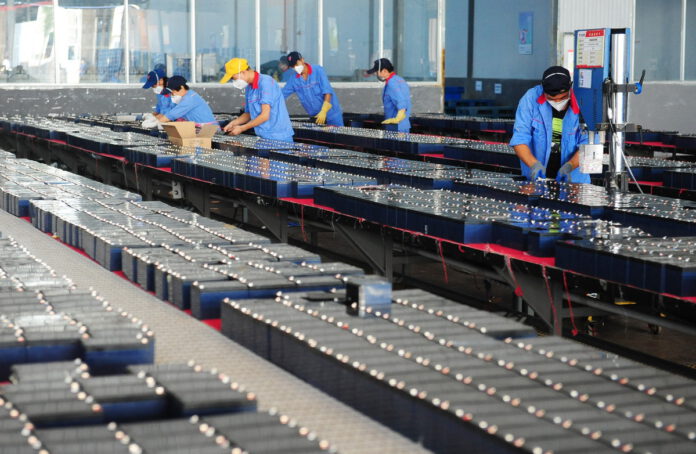
China’s rapid expansion of the new energy vehicle (NEV) industry is bringing another sector into the spotlight, the power battery recycling. Over the past decade, China has evolved from a policy-driven electric vehicle market into a global leader in NEV production and sales. Along the way, it has developed an extensive industrial chain spanning mineral processing, battery materials, cell manufacturing, vehicle assembly and end-user applications.
Yet batteries do not lose all their value when a vehicle reaches the end of its life. A retired power battery can be an urban mine rich in lithium, nickel and cobalt, but it can also become a source of environmental pollution and safety hazards if handled improperly. How to extract value from batteries after they leave vehicles is therefore no longer simply an environmental issue. It is increasingly a question of resource security, industrial competitiveness and the long-term sustainability of China’s NEV industry.
The market’s growth is underpinned by clear fundamentals. In 2025, China produced 16.626 million NEVs and sold 16.49 million, with NEVs accounting for 47.9% of total new vehicle sales. As vehicles sold during the industry’s earlier growth phase approach the end of their service lives, the volume of retired power batteries will continue to rise. Industry estimates suggest that China’s annual volume of retired power batteries could exceed one million tonnes by 2030. In 2025, the country’s comprehensive utilisation of waste power batteries had already surpassed 400,000 tonnes. A vast recycling market, closely intertwined with the NEV industry, is taking shape.
However, a growing market does not automatically translate into profitable businesses, nor does it mean that the industrial chain has matured. The fundamental challenge lies in collecting batteries dispersed across vehicles, repair shops, end-of-life vehicle dismantlers and battery manufacturers, directing them into compliant channels, and converting them into valuable secondary resources through appropriate technologies and business models.
Power battery recycling involves several stages, including collection, transportation, testing, dismantling, material extraction and resource recovery. Batteries that retain useful capacity may, following rigorous testing and safety assessments, be considered for further use in suitable applications. Batteries that are no longer fit for use require dismantling, crushing, separation and metallurgical processing to recover valuable materials.
The former pathway depends on accurate battery health assessments, quality control and the identification of appropriate applications; the latter relies on efficient material recovery, environmental safeguards and economies of scale. These pathways are not mutually exclusive. The key is to select the safest, most compliant and economically viable treatment for each battery according to its actual condition.
From a resource perspective, recycling can reduce reliance on primary mineral extraction, supplement supplies of critical materials such as lithium, nickel and cobalt, and mitigate pollution caused by improper disposal. From a commercial perspective, however, resource value is not the same as profit. The materials contained in a battery, prevailing commodity prices, processing costs and the availability of a stable supply of retired batteries all determine whether recycling can be commercially viable.
This reveals the first major contradiction facing the industry: the long-term market is promising, but making money today can be difficult. Over the past several years, capital and companies have poured into battery recycling, driving rapid capacity expansion. Yet the retirement cycle of power batteries has proved longer than some investors anticipated. A sharp increase in NEV sales does not mean that an equivalent volume of batteries will immediately reach the end of its service life. There is a significant time lag between vehicle sales, years of use and eventual battery retirement. As a result, many recycling facilities built in anticipation of future demand struggle to secure sufficient feedstock.
Meanwhile, batteries generated through accident repairs, warranty replacements and vehicle scrappage are dispersed across numerous channels. Compliant recyclers cannot necessarily obtain them easily. When processing capacity grows faster than the supply of retired batteries, companies are forced to compete for raw materials. Compliant operators must bear the costs of transportation, storage, environmental protection, safety infrastructure and personnel management. Informal operators, by contrast, may offer higher purchase prices by cutting corners on these requirements. Companies willing to comply with regulations can therefore find themselves at a disadvantage in the competition for feedstock.
This points to a deeper structural problem: competition in battery recycling is not determined by technological sophistication alone. It also depends on access to a stable supply of batteries. If compliant companies cannot secure enough feedstock, even advanced equipment cannot achieve economies of scale. If illegal operators can shift environmental and safety costs onto society, fair competition becomes difficult to establish.
The second contradiction stems from changes in battery chemistry. Not all batteries offer the same recycling value. Nickel-rich ternary lithium batteries contain valuable metals such as nickel and cobalt, making material recovery potentially more profitable, although returns remain highly sensitive to commodity price fluctuations. Lithium iron phosphate (LFP) batteries contain far less nickel and cobalt, so their economics depend more heavily on lithium prices, processing efficiency and operating scale. As LFP batteries become increasingly widespread, the traditional business model built around recovering high-value metals faces a growing challenge.
Battery recycling can no longer be understood simply as buying discarded batteries, extracting valuable metals and selling the recovered materials. For battery chemistries with lower recoverable value, companies must reduce costs through automated dismantling, higher lithium recovery rates, lower energy and reagent consumption, and better capacity utilisation. For higher-value battery chemistries, managing commodity price risk is equally important. Competition will increasingly shift away from capacity expansion and aggressive purchasing towards reliable feedstock acquisition, efficient resource recovery and sophisticated operational management.
A third contradiction lies in the gap between recycling responsibilities and operational capabilities. Vehicle manufacturers control consumer relationships, after-sales service networks and much of the information associated with a vehicle’s life cycle. Battery manufacturers, meanwhile, possess deeper knowledge of battery structures, material compositions and manufacturing processes. Both therefore have important roles to play in recycling.
However, vehicle manufacturing and battery recycling are fundamentally different businesses. The former centres on product development, production and sales; the latter involves reverse logistics, hazardous-material management, environmental treatment and secondary-material markets. Requiring automakers to assume recycling responsibility does not mean that every manufacturer should build its own dismantling and smelting plants.
For automakers, entering the recycling business through heavy investment entails substantial capital expenditure, specialised staffing requirements and long-term operational risks. If they merely collect batteries and transfer them to third-party processors, however, they may struggle to generate sufficient returns. Many therefore prefer to fulfil their responsibilities through authorised collection points, outsourced recycling and partnerships with specialised companies.
Such asset-light arrangements are not inherently problematic. The real question is whether they cover the entire recycling chain, whether battery movements remain traceable after handover, and who bears responsibility when something goes wrong.
China’s Interim Measures for the Management of Recycling and Comprehensive Utilization of Retired Power Batteries from Electric Vehicles, which took effect on 1 April 2026, seek to address these challenges through tighter regulation. The measures clarify the responsibilities of vehicle manufacturers, battery producers and other participants in the recycling chain. They also establish requirements for a national battery traceability platform, covering production, sales, maintenance, replacement, vehicle scrappage and comprehensive utilisation, while tightening environmental and safety requirements for recycling operators.
Under the new rules, an end-of-life NEV missing its power battery is treated as a vehicle with missing components. The aim is to make battery flows more transparent and ensure that responsibilities are assigned to identifiable entities. Whether this framework succeeds will depend on whether digital traceability evolves from information recording into genuine control over the physical movement of batteries. Assigning each battery pack a digital identity is only the first step. Transfers during maintenance, replacement, transportation, dismantling and material recovery must be recorded and linked, with information updated promptly. The final destination of recovered materials must also be traceable.
If information systems across government departments and businesses remain fragmented, digital identities risk becoming little more than formal records. Traceability must therefore be backed by on-site inspections, clear accountability and meaningful penalties to effectively restrict informal channels.
At the same time, policymakers must avoid equating compliant operations with simply imposing more costs on businesses. Environmental protection, safety and traceability investments are essential. Yet if local authorities and individual companies repeatedly build separate storage and pretreatment facilities, compliance costs may become unnecessarily high, undermining the competitiveness of legitimate recyclers.
A more effective approach would be to develop shared storage, transportation and pretreatment infrastructure according to regional battery supply and industrial needs. Automakers, battery producers and specialised recycling companies should also be encouraged to establish stable partnerships. Producers must remain accountable for recycling, but this does not mean they must operate every stage themselves. It means ensuring that every stage is properly managed, traceable and compliant.
The industry must also answer a more fundamental question: can the environmental benefits of recycling be converted into reliable economic returns? Battery recycling provides secondary materials and can reduce the environmental impact of primary mineral extraction. Yet most recyclers still depend heavily on commodity prices. When metal prices rise, recycling can become more profitable; when they fall, the costs of compliant processing do not necessarily decline accordingly. If profitability depends entirely on the price difference between recovered materials and processing costs, batteries may once again be diverted into informal channels whenever legitimate recycling becomes uneconomic.
Alongside stronger regulation, China therefore needs to explore more diversified revenue mechanisms. Policymakers could examine how battery recycling can be linked to green finance and carbon-reduction incentives, based on verifiable environmental benefits. Deposit or recycling-fee mechanisms could also distribute the costs of end-of-life management more fairly across production, sales and use.
Environmental benefits, however, do not automatically translate into carbon revenue. Any such mechanism would require clear accounting methodologies, verifiable emissions reductions and an appropriate regulatory framework. Only then can environmental performance become a predictable source of income rather than an additional selling point in corporate publicity.
These challenges are also becoming increasingly international. As Chinese NEV and battery manufacturers expand overseas, battery recycling is no longer merely an after-sales responsibility. Regulations such as the EU Battery Regulation place growing emphasis on producer responsibility, material traceability, carbon footprints and circularity.
For Chinese companies, focusing exclusively on vehicle and battery sales without planning for overseas collection networks, compliant recycling partners and secondary-material supply chains could lead to higher compliance costs and potentially restrict market access. Conversely, companies that integrate recycling into product design, supply-chain management and overseas operations will be better positioned to turn circularity into a lasting competitive advantage.
China’s battery recycling industry is therefore undergoing more than a simple expansion in scale. Its underlying development model is changing. In the past, the emphasis was on building capacity and extracting resources. Today, the priority is to connect producer responsibility, digital traceability, professional recycling and recovered-material utilisation into a system that is safe, transparent and commercially sustainable.
Source: xinhua net, people energy, ndrc gov cn, green peace, global net zero, china daily